




Minister of Finance Regulation (PMK) Number 172 of 2023 provides a comprehensive framework governing the concept of Related Party Relationships for the business interactions of Corporate Taxpayers in Indonesia. This regulation establishes three primary pillars as the determinants of such relationships: minimum capital ownership of 25%, management or contractual control, and one-degree family ties.
The Ministry of National Development Planning/Bappenas revealed that Indonesia has been trapped in the middle-income trap for more than 30 years. Minister of PPN/Head of Bappenas Rachmat Pambudy emphasized that the government must immediately shift national growth orientation from reliance on cheap labor and natural resources toward significantly higher productivity.
The government focuses human capital development through improving education quality, healthcare systems, and social protection as the primary foundation for transformation. Institutional strengthening and innovation encouragement represent crucial pillars to ensure economic growth benefits are distributed inclusively and sustainably. As a subsequent step, formulating a more measurable economic recipe requires deep insights from international financial institutions.
Chief Economist of the World Bank Group, Indermit Gill, highlighted that low efficiency in utilizing physical capital, human capital, and energy remains the primary challenge for middle-income economies. He revealed a crucial fact that if middle-income countries had high-income levels of efficiency in converting capital into output, output per worker could reach around 70 percent of the United States, yet in reality that figure currently stands at only around 20 percent.
This productivity gap and inefficiency demand that Indonesia execute structural changes, including disciplining inefficient State-Owned Enterprises (SOEs). The World Bank urges reallocating capital, labor, and energy away from less productive entities toward more efficient companies so economic progress is not hindered. Beyond internal efficiency, economic acceleration also requires a massive technological leap to pursue more ambitious growth targets.
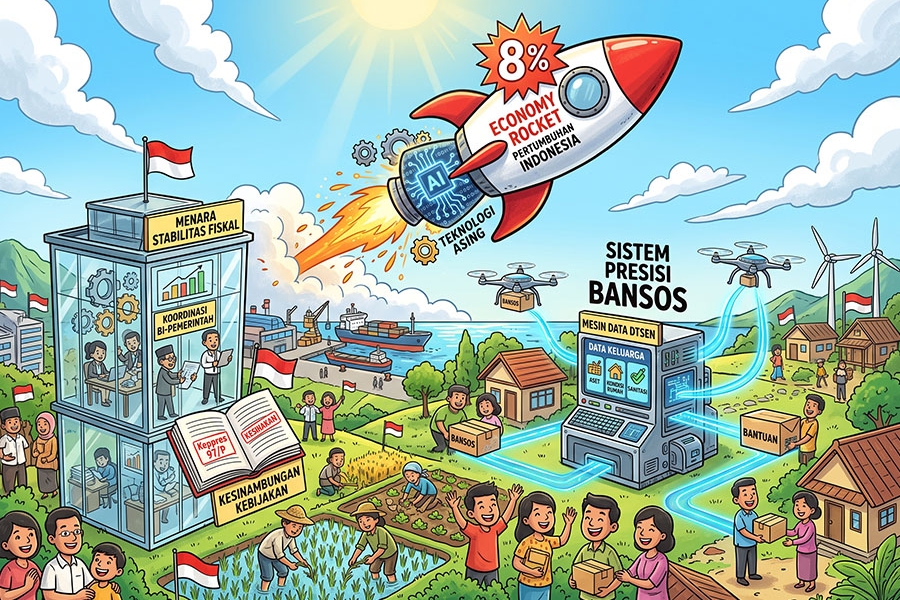
Indermit Gill is optimistic that Indonesia can raise its economic growth from around 5 percent toward 8 percent by opening broad access to foreign technology. Artificial intelligence utilization must expand beyond the private sector to encompass core government functions such as agriculture, education, health, and legal services.
Regulatory reform and granting greater economic freedom to corporations serve as absolute prerequisites for creating adaptive business process innovations. The government also needs to optimize human resource talent allocation inclusively regardless of gender or group background. Nevertheless, achieving this high target faces real probability indicators that require critical evaluation.
CEO of the Asian Development Bank Institute (ADBI), Bambang Brodjonegoro, explained that Indonesia's probability of escaping the middle-income trap currently stands at 0.44, which remains below the ideal threshold of 0.60 and lags behind Vietnam and Thailand.
Indonesia must strengthen its position within global value chains by shifting from mere assembly locations toward high-value-added activities like research, design, and technology development. The decline in the Institutional Coherence and Reform Readiness Index (ICRRI) from 0.72 in 1975 to 0.64 in 2020 underscores the importance of long-term policy consistency. Strengthening these institutional foundations will serve as the primary guarantee for investment climate sustainability and business certainty.
This policy direction renewal provides positive signals for investors and business leaders to start investing in high-tech sectors, research, and human capital development. For the general public, the government's commitment to strengthening education and health systems will enhance national workforce quality to compete in the global job market. Easier access to foreign technology and artificial intelligence adoption also create opportunities for local business players to boost operational efficiency and expand business scale internationally.
Liberating Indonesia from the middle-income trap is a national agenda requiring strong synergy among the government, private sector, and academia. The government must promptly execute institutional reforms consistently, facilitate advanced technology adoption, and provide targeted incentives for industries oriented toward high value-add. Business players are advised to accelerate digital-based business process transformations and enhance internal talent capacity to support national economic leaps toward high-income nation status.















 tpc.consulting
  tpc.consulting
  info@taxindo.co.id