




The government recorded tax revenue of Rp1,224.3 trillion up to July 2026, growing 23.7% year-on-year without raising rates or introducing new types of taxes. The government is also expanding the tax base through the implementation of the Foreign Digital Transaction Tax Collection System (SPP-TDLN), which is projected to nearly double the digital transaction tax base. On the other hand, the utilization of artificial intelligence and big data through the Indonesia National Single Window (INSW) system is directed at identifying potential state revenues that were previously undetected..
The government noted that the realization of tax revenue reached Rp1,224.3 trillion up to July 2026, a year-on-year growth of 23.7% compared to the same period the previous year. This revenue growth was achieved without raising tax rates or introducing new types of taxes.
The government focused its revenue enhancement strategy on improving tax administration, strengthening supervision, enhancing governance, and closing leaks in the tax system. Meanwhile, the realization of state expenditure up to July 2026 reached Rp1,969.6 trillion, or a year-on-year growth of 18.62%. Despite the increase in expenditure, the State Budget (APBN) deficit was recorded at Rp235.6 trillion, or 0.91% of the Gross Domestic Product (GDP). The government estimates that the 2026 APBN deficit will be around 2.85% of the GDP.
Efforts to strengthen this revenue have also been expanded to the digital economy sector through the taxation of foreign digital transactions.
The government officially implemented the Foreign Digital Transaction Tax Collection System (SPP-TDLN) starting September 10, 2026. This policy is implemented based on Presidential Regulation Number 68 of 2025 and has derivative regulations in the form of a Minister of Finance Regulation. In its implementation, the government involves PT Jalin Pembayaran Nusantara, a subsidiary of a State-Owned Enterprise (BUMN), to support tax collection on foreign digital transactions.
SPP-TDLN aims to enlarge the digital economy tax base. Previously, the government had implemented VAT collection through approximately 230 digital platforms operating domestically. The implementation of SPP-TDLN is projected to increase the tax base from digital transactions to nearly double its current state, which has already generated revenues of around Rp8 trillion to Rp12 trillion.
In addition to expanding the tax base through digital transactions, the government is also strengthening supervision by utilizing technology and data integration.
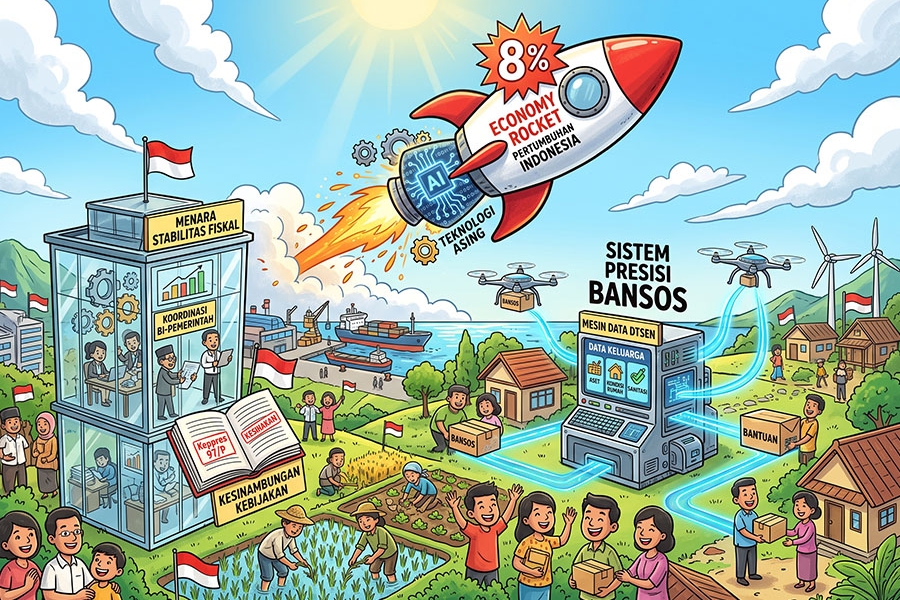
The government is utilizing artificial intelligence (AI) and big data technology to process and analyze data within the Indonesia National Single Window (INSW) system. The utilization of this technology is directed at detecting potential state revenues that were previously unidentified. The INSW system stores massive amounts of data, particularly related to the submission of export and import activity permits, which previously had not been fully integrated and thus could not be analyzed optimally.
The government is also developing a system to map and estimate the potential revenue obligations of each company by comparing them with documents such as Annual Tax Returns (SPT), royalty payment documents, and other records. Furthermore, the system can conduct analysis on data from several previous years to trace economic activities and identify discrepancies between potential tax obligations based on economic activities and the reported obligations.
Tax revenue growth up to July 2026 indicates a strengthening of state revenue supported by improvements in tax administration and supervision. The government is also expanding the tax base through the implementation of SPP-TDLN for foreign digital transactions and utilizing AI and big data through the INSW system to identify potential revenues that were previously undetected. These measures demonstrate the government's efforts to strengthen state revenue through the expansion of the tax base, the strengthening of supervision, and the utilization of technology, without raising rates or introducing new types of taxes.
















 tpc.consulting
  tpc.consulting
  info@taxindo.co.id