



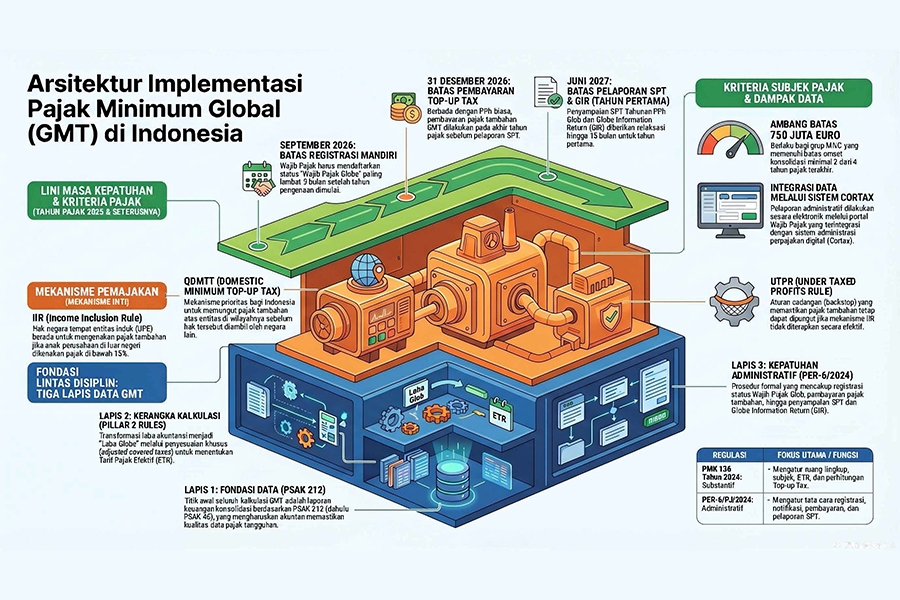
The Indonesian government has officially implemented the 15% Global Minimum Tax through legal instruments PMK 136/2024 and PER-6/PJ/2026. The tax authority secures state revenue as a priority using the Domestic Minimum Top-up Tax (QDMTT) instrument on companies meeting the threshold qualifications. Multinational companies are required to maintain a dual ledger system (dual ledger) to bridge the calculation differences between the PSAK 212 exception and tax obligations. Taxpayers are also required to settle the estimated top-up tax payments ahead of the final GloBE Information Return (GIR) reporting deadline. The investment attractiveness paradigm has now drastically shifted from Tax Holiday facilities toward the Substance-based Income Exclusion (SBIE).
The international taxation world is experiencing a tectonic shift. We have left the "race to the bottom" era—where countries competed to cut tax rates to attract investments—and transitioned into an era of an integrated global system foundation. In line with Indonesia's commitment to the Paris Agreement (Law No. 16 of 2016) and the G20 Bali Declaration, tax transparency is now an inseparable package with the global sustainability agenda.
The implementation of the Global Minimum Tax (GMT) through Pillar 2/BEPS 2.0 in Indonesia, formalized through PMK 136/2024 and PER-6/PJ/2026, is not merely a routine administrative update. It is a radical overhaul of how Multinational Enterprises (MNE) manage their fiscal obligations. Are your executive board and financial team ready to face a minimum effective tax rate of 15% wherever you operate? Here are five major surprises that will change the game's landscape in Indonesia.
Many companies assume that the status as a "GloBE Taxpayer" is solely determined by the current year's financial performance. This is a dangerous misconception. Based on the technical rules, the consolidated gross revenue threshold of €750 million is determined through a look-back test (look-back test): a company falls into the scope if the threshold is met in at least 2 of the last 4 fiscal years.
This "4 years backward" approach demands extraordinary accuracy in archiving historical data. Companies lingering around the threshold can no longer be reactive; they must conduct an audit of cross-jurisdictional consolidated data with standards compatible with GloBE rules early on. In Indonesia, it is estimated that there are around 40 Ultimate Parent Entities (UPE) and thousands of Constituent Entities (CE) that will be directly affected by these strict criteria.
In the GMT architecture, there are three main instruments: IIR (Income Inclusion Rule), UTPR (Under Taxed Profit Rule), and QDMTT (Domestic Minimum Top-up Tax). Indonesia has taken a firm stance by prioritizing QDMTT. This instrument allows Indonesia to collect a "top-up tax" on entities within its territory that have an effective tax rate below 15%, before the taxation right is "handed over" to the domicile country of the parent company abroad.
With QDMTT, the government asserts its fiscal sovereignty: potential taxes from economic activities in the homeland must remain as state revenue for Indonesia, rather than being deposited into another country's treasury.
A technical contradiction emerges that poses a major challenge for CFOs. PSAK 212 (an amendment to PSAK 46) provides a mandatory exception (mandatory exception) for entities not to recognize or disclose information regarding deferred tax assets and liabilities related to Pillar 2 in their commercial financial statements. This is done to avoid volatility and complexity that are yet untested.
However, on the other hand, PMK 136/2024 requires the calculation of the minimum tax using deferred tax data that must be adjusted (recasting) to the 15% rate.
Companies are required to set up a "Dual Ledger" system. One system for commercial financial reporting in accordance with PSAK, and one simultaneous calculation system to bridge the data gap to fulfill global tax reporting obligations. Without a robust data infrastructure, the risk of miscalculating the effective rate becomes very high.
The mechanism in PER-6/PJ/2026 presents a significant administrative surprise regarding the company's cash flow cycle. Unlike traditional Income Tax (PPh), the due date for the top-up tax payment is long before the final tax return (SPT) is submitted.
Here is the critical timeline for the 2025 fiscal year:
Because the payment is made in December 2026 while the final report (GIR) is newly submitted in June 2027, companies are practically paying based on estimations. If the estimation misses the mark and an underpayment occurs upon final reporting, the company faces the risk of significant penalty sanctions. Real-time data accuracy becomes the determinant of the company's financial safety.
Tax Holiday facilities do not disappear, but their effectiveness experiences a drastic devaluation. If a company enjoys a Tax Holiday to the point its effective rate drops to 0% or below 15%, the difference will still be collected through the top-up tax mechanism. Investment strategies can no longer rely on the "zero tax" narrative.
The focus of government incentives will shift towards Substance-based Income Exclusion (SBIE). Profit deductions will be based on real economic substance, such as payroll costs (payroll) and tangible assets. Investors must change their paradigm: future tax advantages will no longer come from on-paper arrangements, but from real contributions to research and development (R&D), industrial downstreaming, and job creation.
The implementation of the GMT marks the evolution of the role of accountants and tax practitioners. They are no longer merely tax return preparers, but strategic partners in corporate governance (corporate governance). As emphasized by Prof. John Hutagaul, tax transparency has now become part of a company's social legitimacy and the Environmental, Social, and Governance (ESG) agenda.
With the enactment of PMK 136/2024 and PER-6/PJ/2026, the business world enters an era of total transparency where there is no longer any place to hide from fair taxation. The question for you business leaders is: "Are your data systems and corporate governance robust enough to navigate this new global standard, or will you be trapped in expensive administrative surprises?"
RTD IAI KAPj - Kupas Tuntas Ketentuan Tata Cara Pelaksanaan Pajak Minimum Global: https://www.youtube.com/watch?v=mrZOJpVLjHw
















 tpc.consulting
  tpc.consulting
  info@taxindo.co.id