



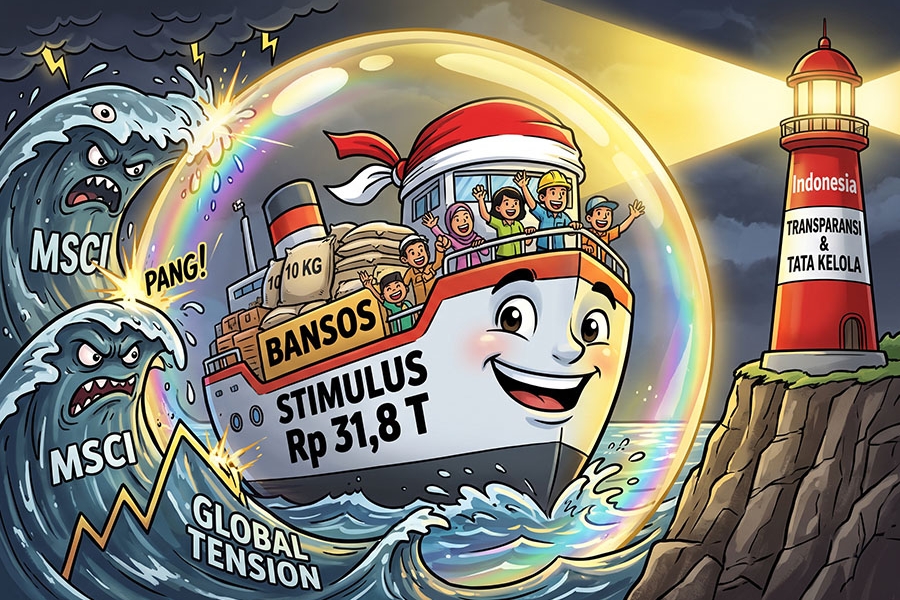
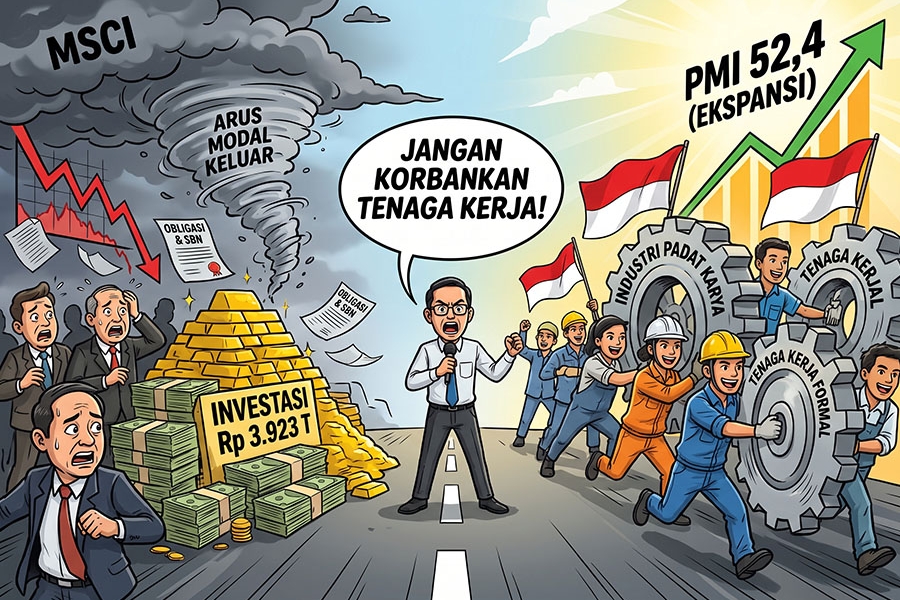
The President of the Republic of Indonesia asserted that Indonesia is not intimidated by MSCI's assessment and is fully prepared to face challenges deemed to affect national interests. On October 15, 2026, MSCI announced a consultation regarding the proposed reclassification of Indonesia's stock index from an Emerging Market to a Standalone Market. MSCI highlighted ongoing issues with the transparency of share ownership structures and alleged coordinated trading practices, which it assessed had not shown adequate improvement. The announcement triggered sharp pressure across financial markets, including an 11.6% plunge in the Jakarta Composite Index (JCI) on October 16, 2026. MSCI has scheduled a final decision for no later than the end of June 2027, meaning the reclassification is not yet final. The President's stance demonstrates the government's resolve in confronting external pressure, but restoring market trust ultimately requires measurable and consistent reforms. The immediate challenge is ensuring that market volatility does not devolve into prolonged pressure on investor confidence and national financing conditions.
Fitch Ratings assesses that the MSCI consultation adds risk to Indonesia's credit profile, though the stock market reclassification itself is not expected to cause a material credit impact in the near term. In a report dated October 21, 2026, Fitch explained that risks to the sovereign, banking, and corporate sectors depend heavily on the resilience of investor confidence as well as domestic and external funding conditions. Indonesia's gross foreign exchange reserves stood at US$146 billion at the end of September 2026, serving as a solid buffer against external pressures. However, continuous foreign exchange interventions could deplete these reserves, while sustained external pressure could drive up domestic funding costs. Fitch also warned that liquidity tightening and rising refinancing costs could pressure asset quality and bank earnings. Although the market showed signs of stabilization on October 20, 2026, the risks already reflected in Indonesia's Negative debt rating outlook have not automatically dissipated. Financial market risks demand close attention because shifts in asset values and investor confidence can directly influence household spending decisions.
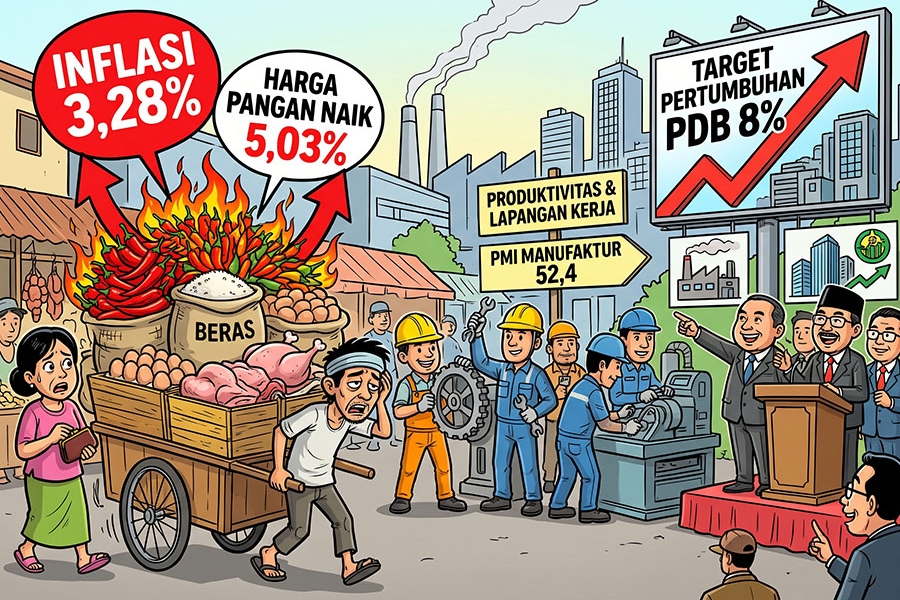
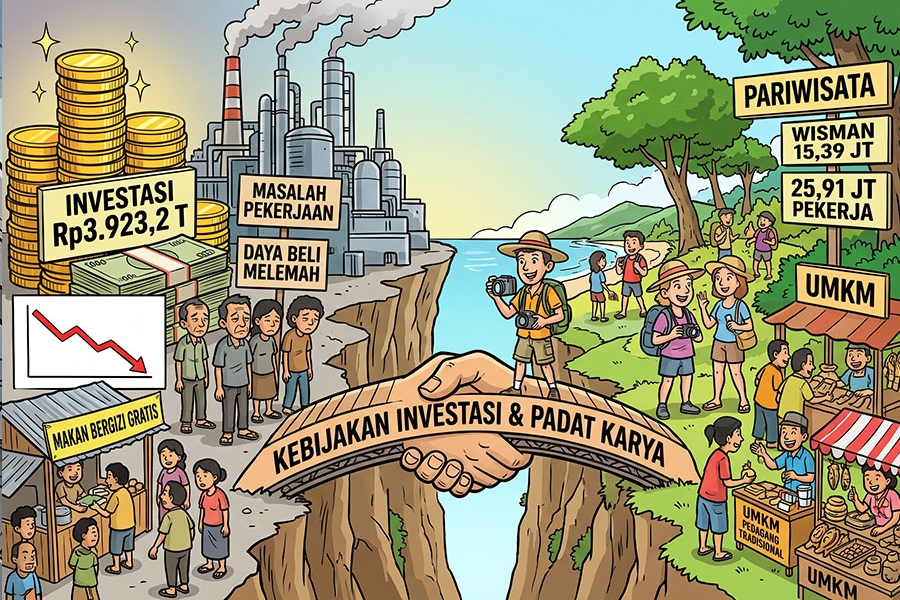
Economic and industry analysis prepared by economists at PT Bank Central Asia Tbk. (BCA) highlights the potential contagion of stock market volatility to household consumption. Bisnis.com reported foreign capital outflows from the stock market amounting to US$185 million on October 16, 2026, coinciding with the 11.6% JCI drop. According to the analysis, a decline in stock portfolio values can erode individual investors' wealth, prompting them to limit spending. During the market recovery phase, some investors may also allocate funds to "buy the dip" on discounted stocks rather than using that money for consumption. This risk emerges at a time when public purchasing power is already a significant challenge for the business world. The BIG Consensus 2026 survey noted that 72.41% of respondents cited weakening purchasing power as the primary factor disrupting business performance. Furthermore, 48.28% of respondents reported stagnant business volumes, while 34.48% experienced a decline. These findings indicate mounting pressure on the business sector, even if it does not prove that all business weakening stems directly from the MSCI turbulence. This condition reinforces the urgent need to protect domestic demand so that financial market pressures do not further burden business activities.
Responding to the capital market turbulence, the Coordinating Minister for Economic Affairs stated that the MSCI-related sentiment does not disrupt the Indonesian economy as a whole. He emphasized that the assessment of national economic conditions does not rely solely on a single index provider or rating agency. The government is working to maintain market confidence through cross-ministerial and institutional coordination, while simultaneously preparing approximately Rp31.8 trillion to support various programs through the end of 2026. These programs include 10 kilograms of rice assistance for three months, wage subsidy assistance, and Christmas and New Year period discounts. The government is also pushing for private sector collaboration and expanded market access through trade agreements with the United States and the European Union. Airlangga noted that global uncertainty, international trade dynamics, and tariff wars remain challenges that must be anticipated. These collective measures reflect the government's efforts to sustain economic activity and public purchasing power amidst market volatility and external risks.
For business actors, the MSCI turbulence serves as a stark reminder that shifts in investor sentiment can instantly affect funding costs, expansion decisions, and consumer demand prospects. Companies must safeguard cash flows, evaluate financing needs, and prepare contingency scenarios should sales or funding access weaken. Investors need to meticulously assess company fundamentals, governance quality, and investment risks without making decisions based purely on short-term volatility. For the public, market uncertainty is a reason to manage household finances more prudently and prioritize basic needs. The government must ensure that support programs reach the right beneficiaries and deliver tangible benefits to domestic consumption. Concurrently, the overhaul of share ownership transparency, trading supervision, and capital market rule enforcement must proceed consistently so that investor confidence can recover sustainably.
Ultimately, Indonesia's economic resilience cannot be sustained merely by government optimism or short-term JCI recoveries. The government must translate reform commitments into transparent, consistent, and verifiable capital market governance improvements. The government also needs to maintain adequate external buffers, manage fiscal risks, and ensure that purchasing power support programs operate effectively. Meanwhile, business actors must strengthen financial efficiency and resilience, while investors must base decisions on fundamentals and disciplined risk management. Indonesia's success in navigating the MSCI challenge will be determined by the ability of the government and market players to rebuild trust through tangible reforms, while simultaneously safeguarding consumption and business activities to ensure financial market stability runs parallel with inclusive economic growth.










 tpc.consulting
 tpc.consulting
 info@taxindo.co.id