



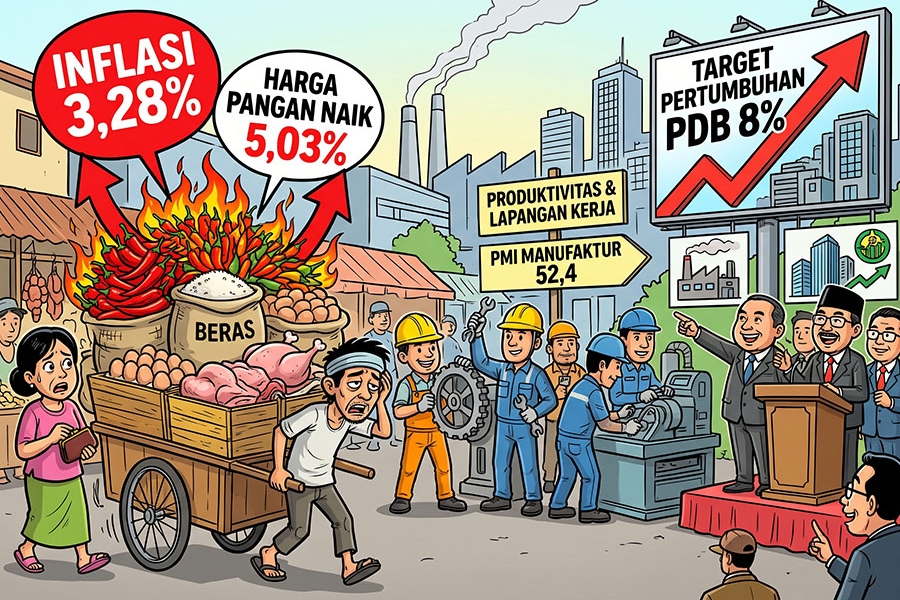
Indonesia's inflation rose to 3.28% in September 2026, while the quality of investments and formal workforce absorption remain persistent challenges. Fitch Ratings projects Indonesia's economic growth to fall well below government targets through 2028. These conditions underscore the critical need to maintain price stability while fortifying the foundational quality of national economic growth..
Indonesia's inflation rose to 3.28% year-on-year (yoy) in September 2026, up from 3.19% in August. The Central Statistics Agency (BPS) recorded a monthly inflation rate of 0.30%, with primary pressure stemming from volatile foods, which experienced an inflation rate of 5.03% yoy. This spike was driven by production declines in several central agricultural regions due to extreme weather and rising input costs. Commodities such as cayenne pepper, red chili, purebred chicken meat, rice, and purebred chicken eggs contributed significantly to the price pressures.
Despite the increase, inflation remains within Bank Indonesia's (BI) target range of 2.5% ± 1% for the 2026–2027 period. Core inflation actually eased from 2.92% to 2.84%, indicating that price pressures have not increased uniformly across all segments. However, expectations of price hikes approaching the end of the year and Ramadan still require close monitoring. Beyond price stability, economic challenges also lie in the capacity of this growth to improve public welfare through productivity and job creation.
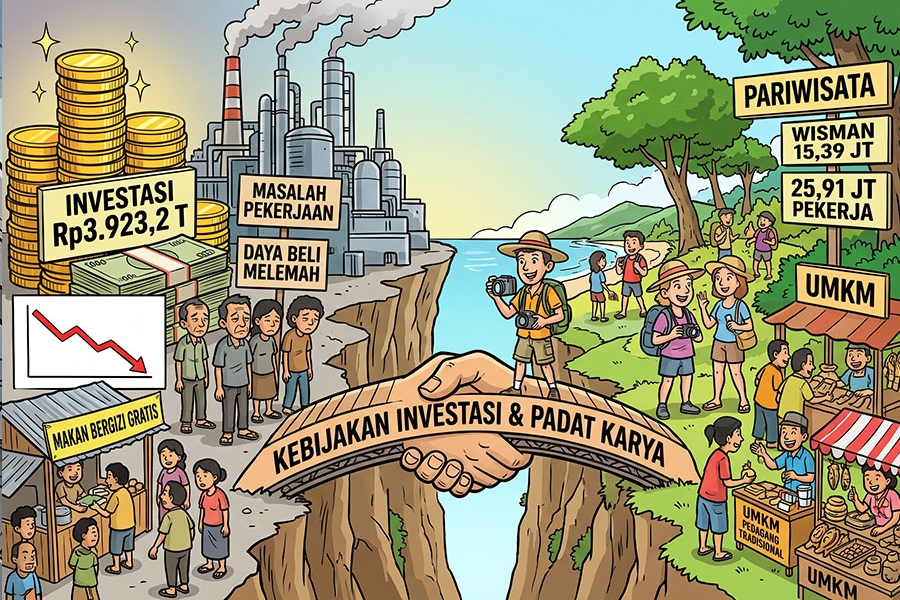
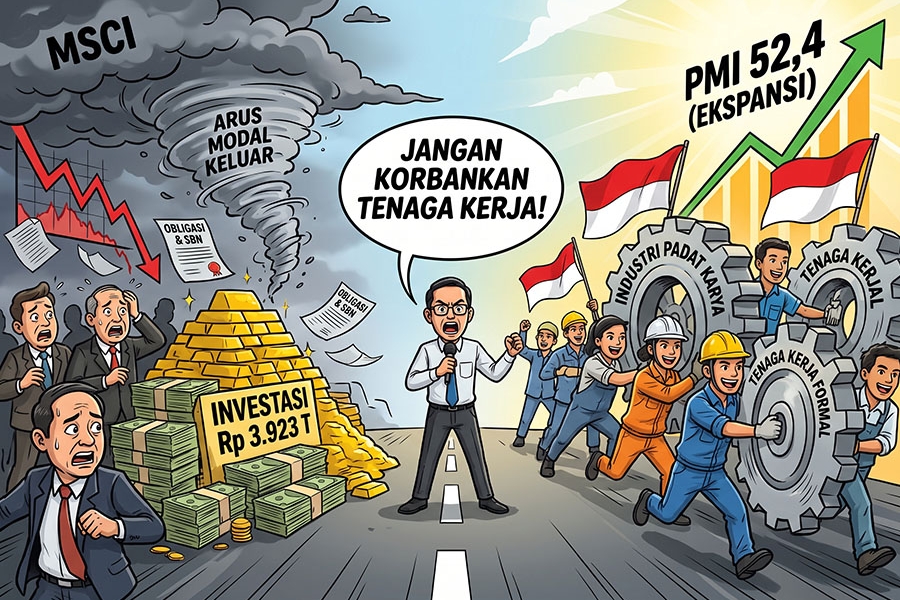
Concerns regarding the quality of growth arise as surging investments do not necessarily align with formal workforce absorption. In evaluating the two years of the Prabowo-Gibran administration, economists from the Institute for Development of Economics and Finance (Indef) criticized the policy orientation for being excessively focused on boosting the gross domestic product (GDP) and hitting the 8% growth target. Investments in capital-intensive industries, technology, and downstreaming can successfully boost output and export value, but they do not always create massive employment opportunities. Therefore, economic growth must be balanced with enhancements in worker productivity, real wages, and the involvement of domestic suppliers.
Indonesia's manufacturing sector is showing signs of recovery, with the S&P Global Purchasing Managers’ Index (PMI) rising from 49.8 in August to 52.4 in September 2026. A reading above 50 indicates an expansion in industrial activity. However, manufacturing still grapples with high energy costs, reliance on imported raw materials, weakened export demand, and competition from imported products. This indicates that the industrial recovery must be structurally fortified to yield more sustainable growth. These challenges align with projections from Fitch Ratings, which assess that Indonesia's economic growth targets remain difficult to achieve based on current growth trajectories.
Fitch Ratings raised its estimate for Indonesia's GDP trend growth from 4.7% to 4.9%, but this figure remains far below the government's 8% target for 2029. Fitch projects the Indonesian economy to grow by 5.2% in 2026 (lower than the government's 5.4% target). For 2027, when the government targets 6% growth, Fitch projects only 4.9%. The agency expects growth to stagnate at 4.9% in 2028. This divergence in projections reflects the limited anticipated impact of structural reforms on Indonesia's productivity and economic potential.
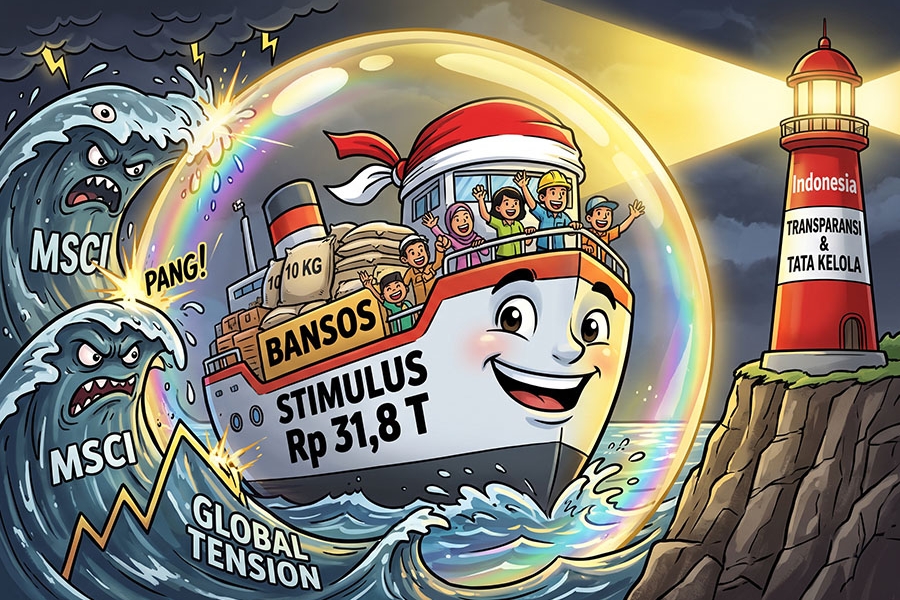
Beyond productivity challenges, Fitch highlighted rising policy uncertainty and risks surrounding the consistency and credibility of the policy mix. In March 2026, the agency downgraded Indonesia's credit outlook from Stable to Negative. Fitch also expects fiscal support to wane following accelerated spending in the first half of 2026, while net exports are projected to drag on growth. Nevertheless, the government's responses to support the rupiah and the drafting of the 2027 State Budget are viewed as active efforts to address market concerns. Fitch noted that achieving high growth still demands significant reforms while maintaining macroeconomic and financial stability.
For the public, rising food prices threaten to add heavy burdens to household expenditures. For business actors, price pressures and production costs demand more meticulous cost management. Meanwhile, investors must carefully monitor productivity, policy certainty, and the ability of investments to generate real value-add. Growth that merely relies on capital influxes without strengthening labor productivity risks failing to distribute economic benefits equitably.
Ultimately, Indonesia's challenge is not merely hitting an 8% growth target, but ensuring that this growth is built on a strong, sustainable foundation. The government needs to accelerate structural reforms, safeguard economic stability, and drive investments that create genuine value-add and quality employment. By doing so, growth targets can be redirected toward elevating public productivity and welfare, rather than just chasing headline economic numbers.













 tpc.consulting
 tpc.consulting
 info@taxindo.co.id