



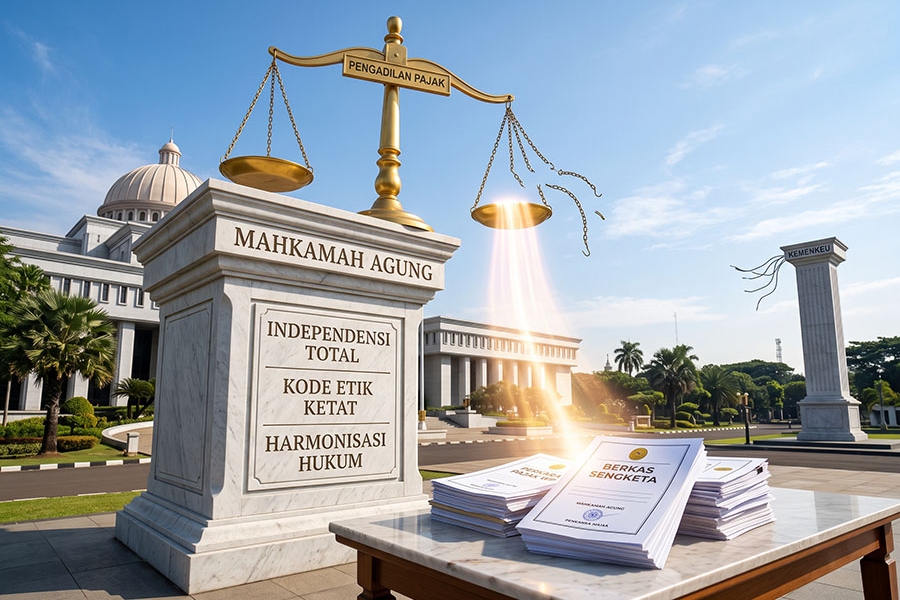
Currently, the Tax Court is not yet fully under the Supreme Court (MA) but is undergoing a transition period toward a complete transfer under the MA. Legally, this transfer process was officially mandated in 2023 through the Constitutional Court (MK) Decision No. 26/PUU-XXI/2023.
Prior to the MK ruling, the Tax Court operated under a dual-supervision system that frequently sparked debates regarding its independence:
Consequently, many parties assessed that this system could create a conflict of interest because the Ministry of Finance, through the Directorate General of Taxes (DJP) or the Directorate General of Customs and Excise, acts as a litigating party in the Tax Court, yet simultaneously manages the court's budget and administration.
Therefore, the MK decided that all supervisory functions of the Tax Court must be unified under one roof, namely under the Supreme Court. Nevertheless, the MK granted a transition period to ensure that the transfer of assets, budgets, personnel, and documents from the Ministry of Finance to the Supreme Court can proceed smoothly without disrupting ongoing judicial processes.
Once the Tax Court is officially and fully under the umbrella of the Supreme Court (MA) following the transition period, there will certainly be substantial structural and fundamental changes. Several changes that may occur include:
As explained above, there have historically been concerns regarding conflicts of interest because the Ministry of Finance, as a litigating party, also managed the budget and administration of the Tax Court. By placing the Tax Court under the MA, taxpayers (individuals and corporate entities) will certainly feel they are being treated more fairly, as their cases will be adjudicated by a genuinely neutral third party.
Transferring the Tax Court under the auspices of the MA will facilitate the implementation of a stricter and multi-layered supervisory system over the integrity of tax judges. Tax judges will be fully subject to the Code of Ethics and Code of Conduct for Judges (KEPPH), which is directly overseen by the Supreme Court’s Supervisory Body and the Judicial Commission (KY).
Under the single roof of the MA, the technical coordination of jurisprudence (the collection of previous judicial rulings) between the Tax Court (court of first instance) and the Supreme Court's State Administrative Chamber (at the Judicial Review / Peninjauan Kembali level) will become more aligned. This will significantly reduce the risk of conflicting rulings (disparity of verdicts) for similar tax dispute cases.
Fundamentally, this transfer is expected to create a more efficient and conducive court climate. However, this does not mean it is without challenges. The transition process will not always be 100% smooth, as the parties involved must adapt to a completely different work culture. Employees and judges accustomed to the rhythm and facilities of the Ministry of Finance (the executive branch) must adjust to the culture, regulations, and remuneration systems within the Supreme Court environment (the judicial branch). Therefore, this transition period is crucial to ensure the core objectives of this transfer are successfully achieved.
















 tpc.consulting
  tpc.consulting
  info@taxindo.co.id