



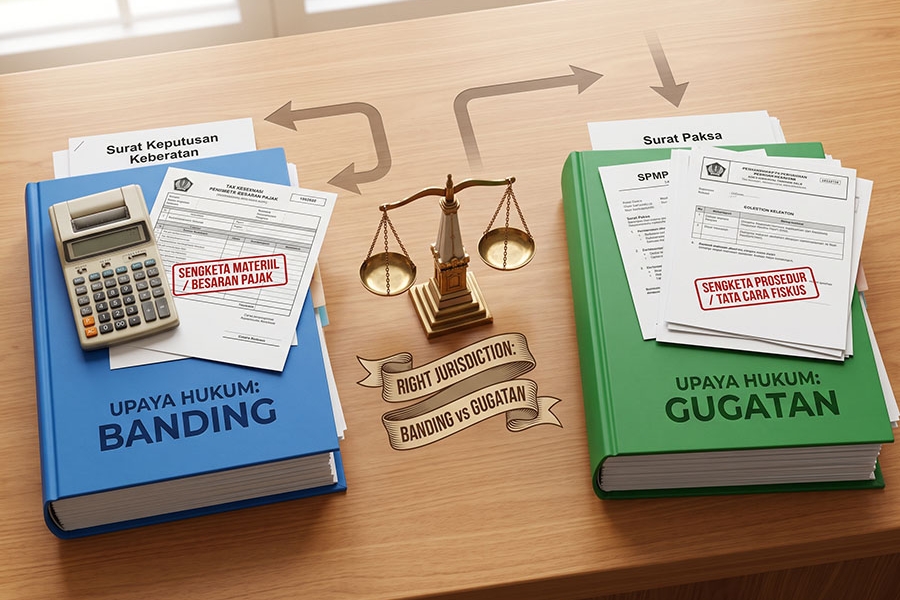
In the Indonesian tax justice system, the Tax Court accepts two types of legal remedies filed by Taxpayers, namely Appeals (Banding) and Lawsuits (Gugatan). Both remedies have different objects of dispute, so Taxpayers need to understand these differences before determining which legal remedy to take based on the object of their dispute. The explanation regarding the differences between these two legal remedies is as follows:
An Appeal is a legal remedy taken by a Taxpayer if they are dissatisfied or disagree with the material/substance/amount of tax determined in an Objection Decision (Keputusan Keberatan).
A taxpayer can only file an Appeal against a decision issued by the tax authority (Directorate General of Taxes, Directorate General of Customs and Excise, or Regional Government) that rejects or partially grants the Taxpayer's Objection.
For example: If a Taxpayer disagrees with an Underpayment Tax Assessment Notice (SKPKB) issued by the DGT, the Taxpayer must first file an objection to the DGT. After that, if the Taxpayer is dissatisfied with the Objection Decision, only then can they file an Appeal to the Tax Court.
More specifically, the type of dispute that can be Appealed is one concerning the material or the amount of tax owed, also known as a material dispute. The disputes in question include:
Meanwhile, a Lawsuit is a legal remedy filed by a Taxpayer against the process, procedure, administrative implementation, or collection actions carried out by the tax authorities (fiscus) that are deemed non-compliant with the prevailing laws and regulations. Unlike an Appeal, a Lawsuit does not discuss the right or wrong of a number/material in the tax calculation, but rather the formality of the tax authority's legal actions.
In short, the issue at hand in a Lawsuit is how the tax collection action was carried out. Furthermore, a Lawsuit can also be filed against administrative decisions other than those subject to an Appeal. In contrast to an Appeal, a Lawsuit can be filed directly to the Tax Court without needing to go through the objection process first (except for certain types of administrative decisions that provide a rebuttal route).
The differences between an Appeal and a Lawsuit in brief are as follows:
| Distinguishing Aspect | Appeal (Banding) | Lawsuit (Gugatan) |
|---|---|---|
| Core of Dispute | Substantive material (Agreement/disagreement with the nominal amount of tax billed). | Formality/Procedure (Agreement/disagreement with the procedures for the execution of actions by tax officials). |
| Prerequisite | Must go through the Objection process first at the DGT/Customs and Excise/Regional Government. | Can be filed directly without an objection process (depending on the object of collection/letter being sued). |
| Main Object | Objection Decision Letter. |
|
| Main Legal Basis | Article 27 of the KUP Law & Article 31 paragraph (2) of the Tax Court Law. | Article 23 paragraph (2) of the KUP Law & Article 31 paragraph (3) of the Tax Court Law. |
Broadly speaking, the difference between an Appeal and a Lawsuit lies in the nature of the case. It is important for Taxpayers to understand these differences so they do not take the wrong path when filing a case with the Tax Court. In practice, it is not uncommon for Taxpayers to make mistakes when choosing which legal remedy to take between an Appeal and a Lawsuit, resulting in their submitted application ending up being unacceptable due to formal defects.

















 tpc.consulting
  tpc.consulting
  info@taxindo.co.id