



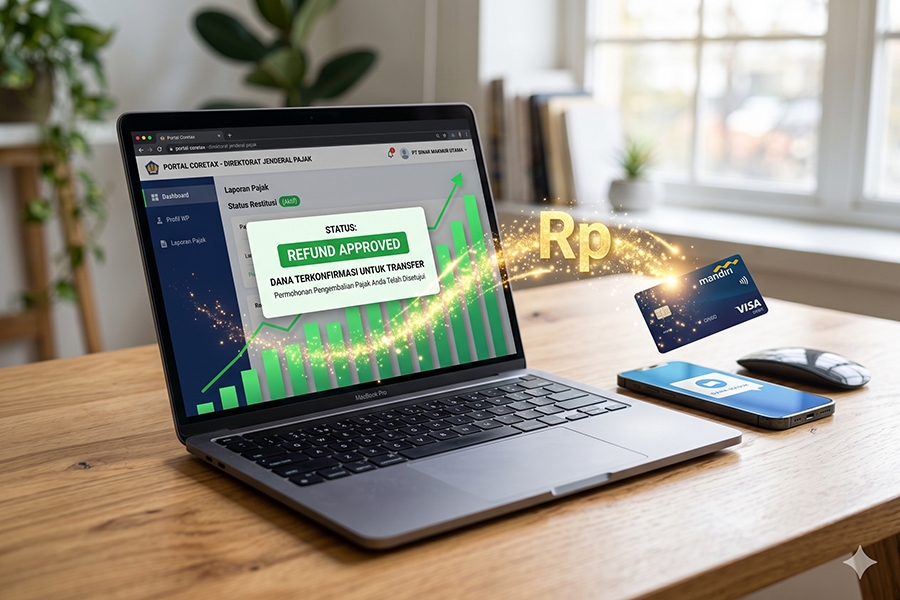
The implementation of the Core Tax Administration System (Coretax) brings a massive transformation in the business processes of tax payments and refunds. Many payment error correction mechanisms that could previously be resolved through Book-Entry (Pemindahbukuan/Pbk) are now strictly shifted to the Refund of Tax that Should Not be Owed (PYSTT) scheme. PYSTT allows taxpayers to withdraw cash for taxes collected outside the regulations, errors in treaty rates application, or cashing out idle balances in their Tax Deposit. An in-depth understanding of the scope, administrative requirements, and submission procedures of PYSTT is crucial for taxpayers to safeguard corporate liquidity and ensure that their tax refund rights can be executed smoothly without sanctions..
In the tax system, taxpayers often face situations involving payment errors, over-withholding, or failed transactions causing funds to be inadvertently deposited into the state treasury. Under the previous system, taxpayers generally submitted a Book-Entry (Pbk) request to shift the tax balance to another tax period or tax type.
However, in the Coretax era, the scope of Pbk is tightened. Book-entry essentially only moves tax balances from one type to another without any cash being refunded. Conversely, if taxpayers genuinely want their money refunded to their corporate bank accounts because there are no pending tax obligations, the appropriate route is PYSTT (Pengembalian Pajak yang Seharusnya Tidak Terutang).
For example, if there is a payment of Import VAT or VAT on the Utilization of Intangible Taxable Goods/Services from outside the Customs Area (JKPLN) with the wrong Taxpayer Identification Number (NPWP) inputted which cannot be credited, the taxpayer can no longer apply for Pbk and is obliged to use the PYSTT route to get their funds back.
Based on the latest regulations, the scope of PYSTT submission is very broad and encompasses various types of tax assessments. Tax objects that can be submitted for a PYSTT request include Income Tax (PPh), Value Added Tax (PPN), Sales Tax on Luxury Goods (PPnBM), Land and Building Tax (PBB), Stamp Duty, Carbon Tax, and balances in the Tax Deposit account.
Specific conditions that allow Taxpayers to apply for PYSTT include:
The PYSTT application in Coretax prioritizes digitalization and automation. The application can be submitted online by the withholding/collecting taxpayer or the party whose tax was withheld.
Here are the steps and procedural requirements:
PT Andromeda withheld Article 23 Income Tax for consulting services from PT Orion in February amounting to Rp50,000,000.00 and has deposited and reported the Unified Periodic Return. In April, it turned out the project experienced a contract value cut, and the invoice was revised so that the Article 23 tax that should have been withheld was only Rp30,000,000.00. Resolution: PT Andromeda amends the Unified Withholding Slip to Rp30,000,000.00 and reports the February Amended Unified Return. There is an Overpaid difference of Rp20,000,000.00. Because Unified Income Tax Overpayments do not have a compensation facility in Coretax, PT Andromeda attaches a Power of Attorney from PT Orion and submits a PYSTT request for Rp20,000,000.00 via the Refund Request Form in Coretax to be withdrawn in cash to PT Andromeda's account (to be subsequently returned to PT Orion).
Mr. Budi intends to pay off his Annual Tax Return Underpayment of Rp10,000,000.00. However, when transferring funds to his Tax Deposit account in Coretax, he accidentally inputs a nominal of Rp100,000,000.00. Mr. Budi's Tax Deposit balance increases by Rp100,000,000.00, and the system deducts Rp10,000,000.00 to settle the Tax Return. Resolution: There is an idle and unutilized remaining fund of Rp90,000,000.00 in the Tax Deposit. Mr. Budi does not want to leave the funds sitting there. He logs into the Coretax portal, selects a PYSTT request with the reason "Unutilized Tax Deposit". The Tax Office will verify and transfer the remaining Rp90,000,000.00 back to Mr. Budi's bank account in full.















 tpc.consulting
  tpc.consulting
  info@taxindo.co.id