



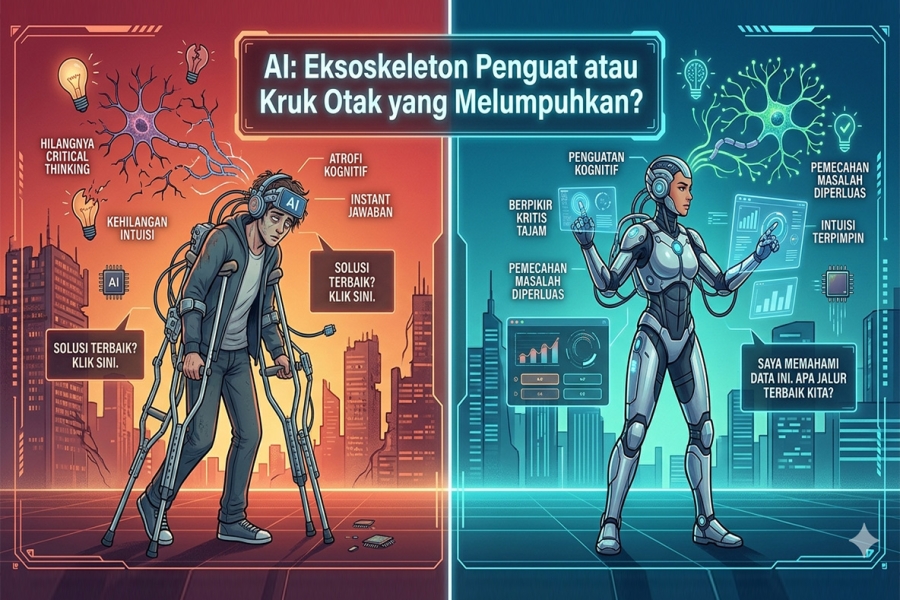
Artificial intelligence evolves rapidly beyond basic typing assistance into an advanced strategic cognitive partner for humanity. Acute reliance on this technology triggers cognitive atrophy risks due to the absence of independent intellectual exercise. The elimination of desirable difficulties in problem-solving degrades long-term memory retention and dampens natural intuition. Humans must reconstruct their interactive paradigm by positioning AI as a capacity-enhancing exoskeleton rather than a crippling crutch. Enforcing strict boundaries in AI utilization guarantees the preservation of human intellectual sovereignty in an automated world.
The 21st century has ushered in a fundamental paradigm shift in the history of human civilization. The presence of Artificial Intelligence (AI) is no longer confined to mechanical automation or passive word-processing tools. Today, AI has evolved into an entity acting as a genuine "cognitive partner." In a matter of seconds, cutting-edge generative technology can synthesize billions of rows of complex data, construct comprehensive corporate strategic blueprints, and solve macro problems that previously required weeks of human expert labor. This radical efficiency offers a promise of boundless productivity, permanently altering how we work, learn, and process daily information.
However, beneath this revolutionary and seemingly effortless landscape lies a deeply concerning latent threat. Neuroscientists and cognitive psychologists worldwide are sounding alarms regarding a phenomenon known as the "cognitive crutch." A fundamental tension arises when the instant convenience offered by AI begins to supplant basic deep human thinking functions. Our relationship with technology has shifted from a controlled instrument to a support system upon which we fully lean, raising crucial questions about the future of humanity's intellectual capabilities.
Biologically, the human brain is not a static computer, but a dynamic organ governed by the laws of neuroplasticity. The brain develops, forms, and reinforces synaptic pathways based on the intensity of the stimuli and exercise it receives. Conversely, the brain operates on a strict efficiency mechanism: neural pathways that are rarely utilized are systematically pruned away through a process called synaptic pruning. When individuals consciously or unconsciously outsource their intellectual heavy lifting to AI, their native
cognitive muscles begin to experience shrinkage, or intellectual atrophy. We voluntarily halt the training that keeps our minds sharp.
The first and most apparent danger of this acute dependence is the paralysis of critical thinking skills. In the pre-AI era, when confronted with a complex problem, the human brain automatically activated high-level cognitive networks: dissecting root causes, testing various hypotheses, and analyzing logical consequences. Today, the immediate reflex of the majority of technology users upon encountering an obstacle is to open an AI prompt window. The crucial process of independently deconstructing a problem is entirely bypassed. The brain loses a golden opportunity to practice analytical reasoning, rendering individuals passive consumers of information who are highly vulnerable to manipulation due to an inability to independently verify facts.
Furthermore, excessive reliance on AI eliminates what educational psychologists term "desirable difficulties." Human learning achieves its highest efficacy precisely when the brain experiences obstacles, mild frustration, confusion, and the trial-and-error process before arriving at a solution. This friction forces information to transition from short-term memory to long-term memory stores. AI short-circuits this entire struggle by delivering flawless, neatly packaged answers. Consequently, our information retention plummets drastically; we become trapped in an illusion of competence where we only know where to find the answer (within the AI ecosystem), but do not truly understand or possess the substance of the knowledge itself.
The third fatal impact encompasses the degradation of synthesis capabilities rooted in natural intuition and creativity. Generative AI operates using predictive mathematical models, meaning its outputs are derived from statistical probabilities of past training data. AI does not generate genuine novelty; it merely remixes existing information. If humans completely delegate their thinking roles, we lose creative leaps, originality of ideas, and profound intuition. Human intuition is not random chance; it is the crystallization of emotional experiences, contextual observations, and deep contemplation accumulated over years—qualities that binary code algorithms can never replicate.
To avoid the trap of mass intellectual degradation, humanity must urgently execute a radical reconstruction of its interactive paradigm with technology. AI must never be positioned as a crutch upon which we dump our entire cognitive load. Instead, an ideal future demands that we view and treat AI as a "cognitive exoskeleton"—a protective, strengthening armor that enhances power without stripping away the function of the biological organ inside. In an exoskeleton model, absolute strategic control remains firmly in human hands, while AI functions as an accelerator of intellectual reach.
| Dimension of Analysis | AI as a Cognitive Crutch (Danger) | AI as an Exoskeleton (Ideal) |
|---|---|---|
| Workflow & Delegation | Surrendering raw problems entirely and directly adopting the finished output from AI without curation or verification. | The human brain formulates the framework, conducts preliminary analysis, and then utilizes AI to accelerate execution. |
| Neuroscientific Impact | The brain becomes passive, avoids rigorous debate, and suffers a decline in neuroplasticity and long-term memory functions. | The brain retains critical and strategic control; cognitive capacity expands as repetitive tasks are offloaded to technology. |
| Output Characteristics | Uniform, generic, and cliché, completely lacking empathy, genuine intuition, and real-world local contextual understanding. | Sharp, enriched by vast secondary data, while firmly maintaining original human arguments and deep analytical substance. |
Rejecting the presence of AI in the modern era is a utopian stance that only guarantees competitive obsolescence. However, adopting it blindly represents a form of willful cognitive paralysis. The key to successful navigation in this era lies in establishing strict boundaries and high mental discipline. Humans must know exactly when to engage technology and when to shut it off to preserve their mental fitness.
The optimal strategy is to strictly allocate AI functions to tasks that are technical, administrative, and repetitive—such as cleaning raw data structures, formatting complex documents, or mapping initial secondary references. However, when the process enters the domain of strategic decision-making, complex problem-solving that demands human empathy, or deep analysis involving business acumen or legal justice, absolute
















 tpc.consulting
  tpc.consulting
  info@taxindo.co.id