



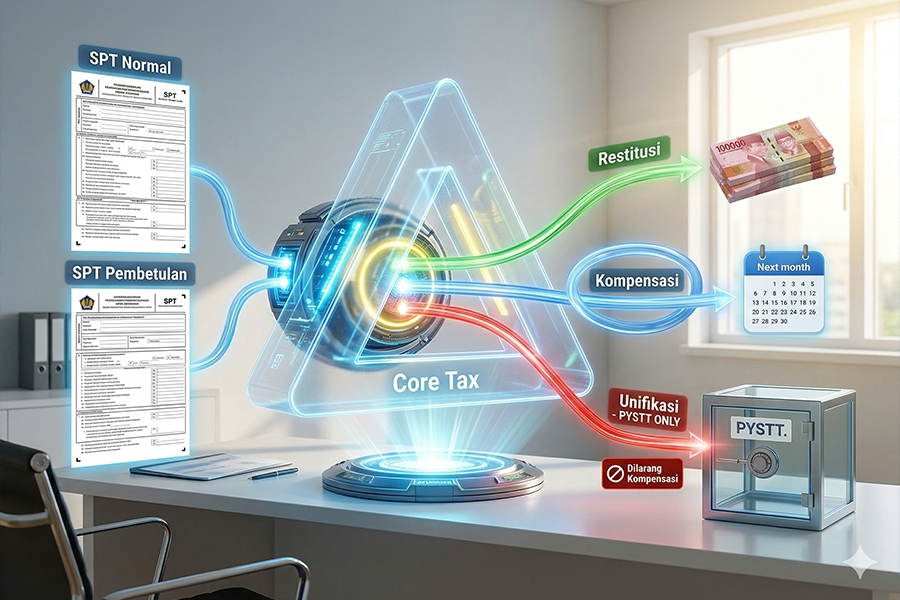
The Coretax system introduces a fundamental shift in the amendment procedure for Overpaid Tax Returns through the implementation of the Delta SPT concept. This concept automatically calculates the difference (delta) between the Normal Return and the Amended Return to determine the exact status of compensation, restitution, or underpayment. The most revolutionary feature is the "Replace Previous Tax Return" option, which allows taxpayers to cancel their initial restitution requests to avoid extreme underpayment assessments, provided the audit process has not yet commenced. However, special and strict rules apply to Unified Income Tax Periodic Returns, where overpayments absolutely cannot be compensated and must be reclaimed via the Refund for Taxes That Should Not Be Owed (PYSTT) mechanism. A thorough understanding of these new mechanisms based on PMK 81/2024 and PER-11/PJ/2025 is crucial for taxpayers to accurately manage their tax rights and obligations without incurring administrative sanctions.
The Directorate General of Taxes (DJP) continues to undertake massive digital transformation through the implementation of the Core Tax Administration System (CTAS) or Coretax. This system brings a fundamental paradigm shift in fulfilling tax rights and obligations, one of which is the procedure for amending a Tax Return (SPT) that has an Overpaid (Lebih Bayar/LB) status. For taxpayers, understanding this new mechanism is crucial to avoid administrative sanctions and ensure their right to tax overpayments can be executed properly. This article will thoroughly explore the mechanism of amending Overpaid Tax Returns within the Coretax system, the SPT Delta concept, and relevant case simulations.
Prior to the Coretax era, taxpayers amending a Tax Return often used a manual "replace" method, where they zeroed out the figures on the previous return to reflect the total value on the amended return. In the Coretax era, this concept has been changed to the Delta System.
The SPT Delta concept means the system will automatically calculate only the difference (delta) between the tax value on the Normal SPT (or previous amended SPT) and the value on the newly Amended SPT. If a taxpayer amends an Overpaid SPT, the system will evaluate whether the amendment causes the Overpayment to increase, or if the Overpayment becomes smaller (which results in an Underpaid status for the difference).
The mechanism and treatment of this Overpayment difference (delta) depend heavily on the type of SPT being amended and the refund choice on the previous SPT.
For VAT Periodic Returns, the treatment of an Overpayment amendment is divided based on the compensation or restitution status of the previous return:
For Article 21/26 Income Tax withholding, if the amendment results in a larger tax over-withholding value than before, the larger difference (delta) of the over-withholding can be compensated to the Article 21/26 Income Tax Return for subsequent Tax Periods without having to be sequential (e.g., to the next Tax Period that has not yet been filed).
The Unified Income Tax Periodic Return has strict limitations. If the amendment of the Unified SPT results in overpaid tax or an Overpayment, the excess cannot be compensated to the following tax period. Coretax does not provide a compensation feature for Unified Tax Overpayments. Taxpayers can only request the excess payment back through the Tax Refund for Taxes That Should Not Be Owed (Pengembalian Pajak yang Seharusnya Tidak Terutang/PYSTT) mechanism in the Services/Payment menu.
To make it more comprehensive, let's simulate amendment cases across various types of tax returns with different scenarios in the Coretax system.
Scenario 1: Overpaid (Compensated) becomes a Larger Overpayment The September 2025 VAT Periodic Return had an Overpaid status of Rp1,700,000 and was compensated to the next period. On December 19, 2025, the taxpayer amends the September 2025 Return so that the Overpayment increases to Rp2,000,000. Resolution: There is an Overpaid difference (delta) of Rp300,000. The taxpayer simply amends the September Return, and this Rp300,000 Overpayment delta can be compensated directly to the Tax Period when the amendment is made (December 2025), without needing to amend the October and November returns.
Scenario 2: Overpaid (Compensated) becomes a Smaller Overpayment The September 2025 VAT Return had an Overpayment of Rp200,000 and was compensated. In December 2025, it is amended to a smaller Overpayment of Rp100,000. Resolution: Due to this decrease in Overpayment, the system calculates an Underpayment (delta) of Rp100,000. The taxpayer must pay this Rp100,000 VAT Underpayment to the state treasury along with administrative sanctions.
Scenario 3: Overpaid (Restitution via Audit) becomes a Smaller Overpayment The December 2025 VAT Return had an Overpayment of Rp200,000 and a refund via Audit (Pemeriksaan) was requested. On February 20, 2026 (before the audit begins), the taxpayer amends the return to an Overpayment of Rp150,000. Resolution:
Scenario 4: Overpaid (Restitution via Audit) becomes Underpaid The December 2025 VAT Return had an Overpayment of Rp1,000,000 and a refund via Audit was requested. It is amended before the audit to an Underpayment of Rp200,000. Resolution:
Scenario 5: Overpaid (Compensated) becomes Nil The September 2025 VAT Return had an Overpayment of Rp200,000 and was compensated. It is amended in December 2025 to a Nil status. Resolution: The system will record an Underpayment difference (delta) of Rp200,000. The taxpayer must pay this Rp200,000 to the state treasury.
Scenario 1: Overpaid becomes a Larger Overpayment PT ABC reported the 2025 Corporate Income Tax Return with an Overpayment of Rp17,000,000. In May 2026, PT ABC amended the return so that the Overpayment increased to Rp20,000,000. Resolution: The Coretax system will record an Under/Overpaid delta due to the amendment as an Overpayment of Rp3,000,000. The taxpayer simply selects a refund option (Audit or Preliminary Refund) for this Rp3,000,000 difference.
Scenario 2: Overpaid becomes a Smaller Overpayment (Initially Restitution via Audit) PT DEF reported the 2025 Corporate Tax Return Overpaid by Rp200,000,000 and requested a refund via Audit (Pemeriksaan). When amended, the Overpayment dropped to Rp150,000,000. Resolution: Because the audit hasn't started, the taxpayer can check "Replace Previous Tax Return". The old return is canceled, and the new return with an Overpayment of Rp150,000,000 replaces it. The taxpayer simply re-selects the refund option for the Rp150,000,000 figure.
Scenario 3: Overpaid becomes a Smaller Overpayment (Initially Preliminary Refund) PT GHI reported the 2025 Tax Return Overpaid by Rp20,000,000 and requested a Preliminary Refund (Pengembalian Pendahuluan). When amended, the Overpayment dropped to Rp15,000,000. Resolution: Because the Preliminary Refund is already/being processed, the "Replace Previous Tax Return" option cannot be checked. Consequently, the Rp5,000,000 decrease in Overpayment is calculated as an Underpayment (delta). PT GHI must pay Rp5,000,000 before the Amended Return can be submitted.
Scenario 4: Overpaid becomes Underpaid PT JKL reported the 2025 Tax Return Overpaid by Rp1,000,000 (Audit). It was amended to an Underpayment of Rp250,000. Resolution: The taxpayer checks "Replace Previous Tax Return", canceling the initial restitution request. PT JKL only needs to pay its actual Underpayment value, which is Rp250,000.
Scenario 1: Miscalculation Resulting in Under-withholding (Underpaid) Ministry ABC created a PPh 21 Withholding Slip for Rp1,000,000 for Mr. NF in the March 2025 period. In April, it was realized that the tax that should have been withheld was Rp1,250,000. Resolution: Ministry ABC creates an amended withholding slip for Rp1,250,000. There is a deficit (delta) of Rp250,000. The taxpayer must settle this Rp250,000 underpayment using a tax deposit or billing when reporting the Amended PPh 21/26 Return.
Scenario 2: Miscalculation Resulting in Over-withholding (Overpaid) PT CAB created a PPh 21 Withholding Slip for January 2025 for Rp375,000 for Mr. AS. It turned out the actual invoice was smaller, so the PPh 21 should have been only Rp125,000. Resolution: PT CAB creates an amended slip. There is an Over-withholding (delta) of Rp250,000. For this excess, PT CAB reports the Amended Return and compensates the Rp250,000 value to the subsequent PPh 21 Tax Return non-sequentially (e.g., directly compensated to the April 2025 Tax Period when the amendment is made).
Scenario 3: Cancellation of Withholding Slip CV IPD withheld PPh 21 amounting to Rp450,000 for Mr. KS's services in June 2025. The contract was suddenly canceled, and the money was fully refunded. Resolution: CV IPD creates a Cancellation Withholding Slip (PPh 21 value becomes 0). The excess payment of Rp450,000 in the June Amended Return can be compensated to the following tax period.
Scenario 1: Under-withholding (Underpaid) PT B withheld PPh 23 for PT EM's installation services amounting to Rp25,000,000 (February Period). It was later discovered the service value was larger, so the invoice should be Rp35,000,000, resulting in an Underpayment. Resolution: PT B creates an Amended Unified Withholding Slip. There is an Underpaid difference (delta) of Rp200,000. PT B must pay the Rp200,000 shortage to the state treasury and then report the Amended Unified Tax Return.
Scenario 2: Over-withholding (Overpaid) PT B withheld PPh 23 for CV TB's management services amounting to Rp300,000 (March Period). Later it was realized the cost was smaller, and the tax should only be Rp100,000. Resolution: PT B creates an Amended Unified Slip. There is an over-withholding (delta) of Rp200,000. Attention: Excess in Unified PPh cannot be compensated. PT B must file a request for a Refund for Taxes That Should Not Be Owed (PYSTT) to the Tax Office (KPP) for this Rp200,000.
Scenario 3: Transaction Cancellation PT B withheld PPh 23 amounting to Rp600,000 for PT MP's billboard (April Period). The contract was canceled. Resolution: PT B issues a Cancellation Unified Slip. The Rp600,000 excess tax payment cannot be compensated, but instead, a PYSTT request must be filed to the Tax Office in accordance with laws and regulations.
The mechanism of procedures for executing rights and fulfilling obligations, including the amendment and compensation mechanisms in the Coretax system, are comprehensively regulated in the following regulations:
The amendment of Overpaid Tax Returns in the Coretax era heavily relies on the automated Delta calculation system. The "Replace Previous Tax Return" option for VAT and Corporate Income Tax provides extraordinary flexibility for taxpayers to correct their restitution requests without bearing the burden of double payments due to system differences, provided the audit or preliminary refund process has not been locked in. On the other hand, PPh 21 amendments provide flexibility for cross-period (non-sequential) compensation. Taxpayers must be very careful when amending Unified Income Tax Periodic Returns, because the excess absolutely cannot be compensated and must be withdrawn in cash through the Refund for Taxes That Should Not Be Owed (PYSTT) process. A deep understanding of PMK 81/2024 and PER-11/PJ/2025 is key to successful tax compliance in this digital era.
















 tpc.consulting
  tpc.consulting
  info@taxindo.co.id