




Transfer pricing rules apply primarily to the cross-border business operations of multinational enterprises (“MNEs”). MNEs are firms that conduct integrated business operations in more than one country. This chap-ter describes the factors that gave rise to MNEs in an attempt to provide the reader with the basic business context for the detailed transfer pricing discussion that will follow in the rest of this Manual. This chapter shows how an MNE may be able to exploit integration opportunities in the cross-border production of goods and provision of services through a “value-chain” (or “value-added chain”). As used in this Manual, the term “value chain” refers to the process or activities by which a company adds value to a good or service, including production, marketing, and the provision of after-sales service.
MNEs generally operate across international borders through locally incorporated subsidiaries or permanent establishments. They may also use other legal structures such as joint ventures and partnerships. An MNE’s business operations may be organized and managed in several different ways such as through a functional structure, a divisional structure or a matrix structure. This chapter outlines the legal and operational structures that may be used by MNEs, and considers the differences between them.
This chapter also describes how a “value chain analysis” can be used to measure or test the performance of an MNE. An MNE manages its busi-ness to maximize its profits and minimize its costs. It manages its transfer pricing function to minimize the risk of transfer pricing adjustments and to avoid double taxation. While MNEs often monitor the overall performance of their business operations on a line of business basis without regard to national borders, for tax and company law purposes they are often required to separately report the performance of associated entities in each of the countries in which they operate. An MNE’s transfer pricing policy helps the group to report on a separate country basis and should provide guidance on how the group will comply with transfer pricing documentation requirements, how it will report the results of operations in its tax returns, how it will deal with transfer pric-ing audits conducted by local tax authorities, and the appropriate measures the group will utilize to resolve any disputes with tax authorities that may arise
Firms are organizations that arrange the production of goods and the provision of services. The aim of a firm is to produce goods and provide services to maximize profits. In the absence of MNEs, production and distri-bution would be carried out through a series of arm’s length transactions between independent parties6. These transactions require contracts between the independent parties to transactions, but a significant part of each individ-ual firm’s resources are used in the process of making contracts. Individual firms become MNEs as these firms grow, expand and diversify their oper-ations internationally. Rapid advances in technology, transportation and communications have given MNEs the flexibility to place their enterprises and activities almost anywhere in the world.
UNCTAD (1993). World Investment Report: Transnational Corporations and Integrated Production. New York: UN Publishing. Available from https://unctad. org/system/files/official-document/wir1993_en.pdf; Coase, R. (1988). The Firm, the Market and the Law. Chicago: University of Chicago Press. See p. 7.
The expenses of making contracts is referred to as “transaction costs” since expenses are incurred by entities in finding other entities with whom to contract, as well as in negotiating and finalizing the contracts. As contracts cannot cover every possible issue that may arise between contracting parties, there is a risk of disputes arising from unforeseen contingencies. When disputes occur between contracting parties, those parties may incur consid-erable costs in resolving these including negotiation costs, legal expenses, and litigation and mediation expenses. It is economically rational for MNEs to be created to produce goods and services to achieve efficiencies in scale in transaction and associated costs, provided that the MNE’s costs of produc-tion are less than the costs of outsourcing the production.
Within an MNE, contracts between the various parties involved in production of goods and services may be eliminated and replaced with admin-istrative arrangements; in other cases, the group members within the MNE may enter into formal contracts The administrative costs of organizing produc-tion within an MNE are usually lower than the cost of the alternative, which is outsourcing market transactions. The theoretical limit to the expansion of an MNE is the point at which its costs of organizing transactions are equal to the costs of carrying out the transactions through the market. An MNE will internalize the costs of production to the extent that it can achieve economies of scale in production and distribution and establish coordination economies.
MNEs create organizational structures and develop strategies to arrange the cross-border production of goods and services in locations around the world, and to determine the level of intra-entity or intragroup integration. The structure of transactions within an MNE is determined by a combination of market and group forces which can differ from open market conditions between independent parties. A large number of international transactions within MNEs are therefore not governed directly by market forces but driven by the common interest of the MNE.
Successful MNEs use their location and internalization advantages to maximize their share of global markets and growth opportunities. Thus, MNEs may be able to minimize costs through their integration economies; such economies are not available to domestic firms.
A key feature of MNEs is that they have integrated global supply chains. A supply chain is a collection of suppliers required to create one specific product or service for a company. Each supplier is a link in the end-to-end supply chain. If those links/enterprises are under common control, the enterprises may be considered as “associated enterprises”. The term “supply chain” is defined as “the sequence of processes involved in the production and distribution of a commodity.”7 The process of running and improving the efficiency of the supply chain for the benefit of most, if not all, of the links in the supply chain, can be a feature of the value chain of the MNE.
The Oxford English Dictionary. Oxford: Clarendon Press. Available from https://www.lexico.com/definition/supply_chain
Globalization has made it possible for an MNE to achieve high levels of integration and the ability to have control centralized in one or a few locations. Modern information and communications systems also facilitate communi-cations across geographic and functional business lines. This has resulted in many MNEs providing services such as advisory, research and development (R&D), legal, accounting, financial management, and data processing from one or several regional centres to group companies. Also, management teams of an MNE can be based in different locations, so that the group may have manage-ment resources dispersed in several locations. From the economic perspective of the MNE, these resources need to be allocated with maximum efficiency and in an optimal manner, in order to contribute to an optimal value chain.
International business has experienced far-reaching structural change with the rise of service and knowledge-intensive industries and, with the expansion of the internet economy, service and technology enterprises are playing an increasingly important role in the international marketplace.
In the past MNEs mostly operated in physical markets and through presence in multiple jurisdictions. However, the current pace of digitaliza-tion of the economy enables some MNEs to conduct significant business in places where they do not have any physical presence. This makes addressing the taxing rights of the respective countries to avoid double or non-taxation particularly challenging.
The rapid evolution in MNEs is also reflected in the rise of many developing economies where foreign investments have grown significantly. In developing countries, MNEs have diversified well beyond primary produc-tion and extractive industries into manufacturing, assembly, domestic market development and services, utilizing transport and other infrastruc-ture, skilled labour and low production costs.
The activities of MNEs, through international trade and investment, have strengthened and deepened the ties that join countries in an increas-ingly interdependent world. These activities can bring substantial benefits to both home and host countries. These benefits accrue when MNEs supply the products and services that customers want to buy at competitive prices and when they provide fair returns to the suppliers of capital. Their trade and investment activities can contribute to the efficient use of capital, technology and human and natural resources.
MNEs have common control, common goals and common resources, and the members of the group — parent/HQ company, subsidiaries, affili-ates and branches — are located in more than one country. Thus, many MNEs are fully integrated businesses that plan and implement global strate-gies. UNCTAD has noted, however, that integration of production by MNEs creates challenges for policymakers in adapting the methods for allocating the income and costs of MNEs between jurisdictions for tax purposes.8
UNCTAD (2019). Trade and Development Report 2019. New York: UN Publishing. Available from https://unctad.org/system/files/official-document/ tdr2019ch1_en.pdf
In Multinational Enterprises and the Global Economy (2008)9 the authors argue that the history of MNEs was shaped by political, social and cultural events that influenced the ownership, organization and location of international produc-tion of their goods and services. The authors claim that MNE groups tended to integrate their operations until the late 1980s and then more recently moved to outsource some activities in which they do not have competitive advantages.
Dunning, J. H., & Lundan, S. M. (2008). Multinational Enterprises and the Global Economy. Cheltenham: Edward Elgar Publishing. See p. 197.
For most of the twentieth century, the same authors note, MNE groups and international enterprises operating through branches or subsid-iaries tended to expand the range of their value-adding activities, and by the late 1980s MNEs had integrated their production and marketing functions. Up to the 1960s and 1970s, MNEs engaged in limited or no outsourcing of operations and many became large integrated conglomerates. However, the authors argue that from the late 1980s MNEs began outsourcing activities that were previously performed by the companies themselves.10 From the early 1990s, MNEs began restructuring to specialize in the areas where they had competitive advantages, such as unique, firm-specific assets, in particu-lar high value intangible assets, and the capabilities that provided the firms with their market position and competitive edge.
Ibid, p. 196.
MNEs examined their value chains to identify the functions in which they had no advantage over other firms.11 They then began deciding which functions they would perform themselves and which functions could be outsourced to independent firms or centralized shared service centres, a process called “value chain optimization”. For in-house services, an MNE may decide to provide some services through centralized service centres. While the initial functions that were outsourced were non-core activities such as payroll, billing and maintenance services, in some cases outsourc-ing has expanded to cover core activities. The core activities may involve producing goods or providing services. For example, many firms outsource call centre activities or certain administrative functions to (in)dependent firms in countries which have educated workforces and relatively low-cost labour. Consequently, modern MNEs organize their cross-border operations through a network of contractual arrangements with (in)dependent enter-prises and cooperative in-house relationships.
Ibid.
Consequently, domestic transfer pricing rules which apply to SMEs should reflect the capacity of SMEs to comply and the capacity of the tax authorities to administer such rules. Some countries may have special simplified rules for SMEs, such as simplified documentation requirements, and may use flexible approaches in handling transfer pricing issues involving SMEs. This creates the need to define an SME. Although there is no universal definition, an SME may be defined on the basis of criteria including: turno-ver; balance sheet value; number of employees; and transaction values.
The legal systems used by countries include the common law and civil law systems. The common law system originates in the UK and is used in Commonwealth countries such as Australia, Canada, India, Malaysia, New Zealand, and is also used in the majority of states in the United States. Common law originated in the practices of the courts of the English kings after the Norman Conquest, and is derived from custom and judicial prece-dent rather than statutes. This system spread through the British Empire to its then colonies, many of which retain the common law system today. These are legal systems that give great weight to judicial precedent, and to the style of reasoning inherited from the English legal system. A judgment of a supe-rior court is binding on lower courts in future cases.
The civil law system has its origins in Roman law and operates in most European countries, Latin America and Japan. Under a civil law system, law is enacted and codified by parliament. Companies are recognized under both systems as artificial legal persons with perpetual life and generally limited liability.
One of the key decisions any MNE needs to take when expanding its operations is the type of legal structure it will use to operate. There are many alternatives for an MNE to operate either through locally incorporated subsidiary companies (associated enterprises) or else through permanent estab-lishments (branches). Subsidiaries may be either fully owned by the parent company or partly owned. An MNE may also operate by using an agent, which may be an independent agent, a dependent agent or a commissionaire. Other alternatives may be expanding via a partnership or a limited liability partner-ship. Depending on domestic law in the investee jurisdiction, partnerships may be treated for tax purposes as fiscally transparent entities with flow-through treatment; alternatively, they may be treated as taxable entities.
MNEs can also carry on their business through a joint venture. Joint ventures involve independent businesses (which could themselves be incor-porated entities, branches or partnerships) working together on a specific project. Joint venture partners can include a government agency or an entity that is normally a competitor (subject to competition policy/ antitrust rules).
The choice of an MNE’s legal structure may be affected by a number of factors. The tax implications of a particular legal structure may be important. Other equally relevant considerations include issues related to legal liability, risk and control, financing concerns, and administrative and regulatory obligations and costs. In addition, exchange controls, “partnerability” (i.e. how well an entity is set up and managed to operate as a partner with others), “bankability” (i.e. having sufficient profit, assets, and liquidity to get a loan at a bank), requirements for minimum shareholding by local persons or entities, issues related to extraction of profits and capital requirements may all affect the selection of a legal structure.
Legal structures used by MNEs vary and evolve over time. The business structures used by an MNE group may similarly change over time such as, for example, commencing operations in a jurisdiction using a joint venture structure and then buying out the joint venture partner and operat-ing in that jurisdiction through an associated enterprise.
In an MNE, the parent company and subsidiary companies are sepa-rate legal entities and they may enter into intragroup transactions. On the other hand, an international enterprise with a head office in one country and a permanent establishment in another country is considered one legal entity. As such a permanent establishment itself cannot enter into transactions with other parts of the enterprise in a formal, legal sense since transactions typi-cally require at least two legal entities.
Company law determines how corporate entities are governed in many respects. “Corporate authorities”, the powers exercised by various officers of an entity, originate from the respective legal authorities accorded to entities within the MNE. The Board of Directors has the authority to exer-cise all of the corporation’s powers; and it delegates authority to act to certain company officers in certain circumstances. This includes delegating powers locally in accordance with local legal entities’ requirements. The execution of a corporate authority binds the legal entity and consequently delegates must be aware of local legal and tax cross-border requirements as company and/or personal liability may arise as a result of the execution of such an authority.
Corporate and tax laws view corporations as separate entities. That is, parent companies, subsidiaries and affiliates are all legally distinct from each other. The separate existence of the subsidiary may be manifested, for example, in having its own properly constituted management, its own busi-ness purpose and its own assets appropriate to that purpose.
The boards and management of subsidiaries continue to hold fidu-ciary duties to control and manage the assets of, and to govern and manage the operations of, their respective subsidiaries and are not required to imple-ment a shareholder request if implementation conflicts with those fiduciary duties (e.g. if the request contravenes local law).
“Organizational authorities” are the risk-based approval hierarchies that ensure operations are executed in accordance with internal business process and control requirements of the MNE. They are delegated from the Board of Directors down the chain of command. Organizational authorities can be executed across country borders as they do not create or constitute a legal commitment.
Corporate separateness is the concept of maintaining separate legal entities within the MNE, each subsidiary having its own separate legal identity and Board of Directors. While this does not mean that group compa-nies must be treated as if they were wholly detached from the head office or its requests, it does mean that the boards and management of subsidi-aries continue to hold fiduciary duties to control and manage the assets of, and to govern and manage the operations of, their respective subsidiaries. Organizational authorities can be considered as an advice to the separate legal entities and their boards. The corporate authorities in the end are the decision-making powers that legally bind the legal entities.
In order to be able to perform a transfer pricing analysis it is crucial to understand how the management of the MNE is organized and what framework exists for decision-making. Ultimately an analysis of MNE deci-sion making may provide useful context in determining risk assumption and control of important functions. It is important to understand that the management structure of the MNE may or may not be fully aligned with the legal structure. A particular legal entity in the MNE may house employees that function in various operational divisions or various management teams. Similarly, a management team or division may draw on people or use assets housed in several different legal entities.
The management or organization structure is used to outline and direct how people and resources are used to achieve the MNE’s objectives. Finding the optimal arrangement requires adjustments at many levels. Some organizational structures may be more rigid than others. Some may define tasks, competencies and responsibilities, and establish the patterns or rela-tionships between positions more rigidly, while others may be more fluid. There are a number of different types of organizational structures (discussed below) including the traditional ones, functional, divisional and matrix models. However, with the rapid development of the digitalized economy, a new organizational model is on the rise: a decentralized model based on a “network of teams”, the lateral structure.
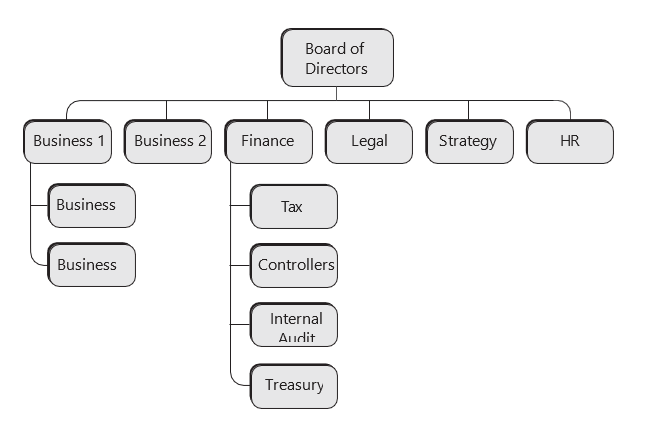
In a functional structure an MNE’s functions are performed by the employees within functional divisions. These functions are usually special-ized tasks, for instance all the accountants, controllers and tax advisors are grouped together in a finance function based on their speciality. In general, a functional organization is best suited to a producer of standardized goods and services at large volume and low cost to exploit economies of scale. Coordination and specialization of tasks are centralized in a functional struc-ture, which makes decision making quicker, because the group members of a function can easily communicate as they have the same background.


 tpc.consulting
 tpc.consulting
 info@taxindo.co.id