



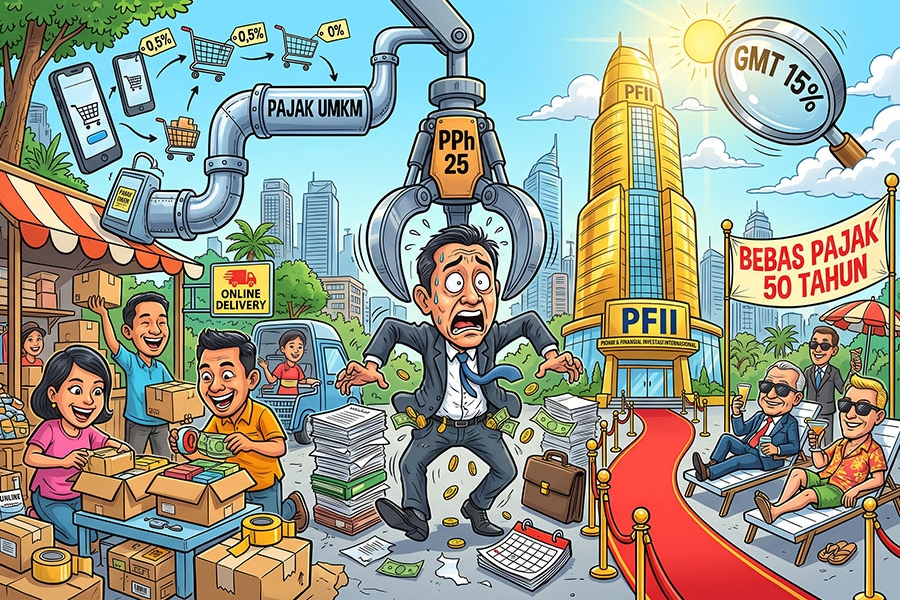
The Indonesian E-Commerce Association prepares its initial marketplace tax withholding report while safeguarding the commercial continuity of online small enterprises. Concurrently, dynamic corporate income tax installment adjustments draw warnings from economists over potential advance collections that deplete company liquidity. Meanwhile, the government introduces 50-year full tax exemptions within the Indonesia International Financial Center amid global minimum tax compliance safeguards..
The Indonesian E-Commerce Association (idEA) is finalizing its debut compliance report on Article 22 Income Tax withholding across digital marketplace merchants ahead of the November 2026 reporting deadline. The association is gathering comprehensive operational data from four designated e-commerce platforms, namely Tokopedia, Shopee, Lazada, and Blibli, to ensure smooth statutory execution. Governed by Minister of Finance Regulation Number 37/2026, this tax withholding policy requires platforms to remit a 0.5% final income tax on merchants generating gross revenues between Rp500 million and Rp4.8 billion, while micro-enterprises earning under Rp500 million continue to enjoy a 0% tax exemption.
Chairman of idEA affirmed the digital sector's commitment to supporting national tax compliance without disrupting the operational stability of partner merchants. The association maintains continuous communication with the Directorate General of Taxes (DJP) to ensure collection procedures remain transparent and avoid imposing redundant administrative burdens on small businesses. Director General of Taxes confirmed that the four marketplace platforms completed their initial tax remittances on November 15, 2026, and authorities will officially announce full collection figures shortly. This compliance push across the digital commerce ecosystem operates alongside corporate tax installment adjustments that are sparking heated debates among economic analysts.
Year-end dynamic installment adjustments for Article 25 Corporate Income Tax enforced by tax authorities triggered early warnings regarding potential unearned advance tax extractions. Executive Director of the IEF Research Institute explained that lowering the adjustment threshold from 150% to 125% under regulation PER-11/PJ/2025 grants tax offices broad authority to increase monthly installment obligations. However, these adjustments risk deteriorating into premature revenue extractions if tax collectors impose revisions exceeding realistic profit projections merely to meet 2026 state budget targets.
Ariawan identified three technical areas requiring rigorous oversight from regulatory bodies and the public. Advance collections may manifest through accelerated December 2026 payments ahead of the statutory January 15, 2027 deadline, the utilization of tax deposit balances to inflate current-year fiscal metrics, and unchecked discretionary powers exercised by local tax office heads without transparent formulas. Imposing steep installment hikes in the final two months risks quadrupling monthly payment obligations and causing extensive corporate tax overpayments in 2027 tax filings. These corporate concerns over domestic working capital constraints contrast sharply with extraordinary 50-year tax holidays offered to foreign capital within specialized economic zones.
The government introduced 100% income tax exemptions for up to 50 years targeting core commercial sectors in the Indonesia International Financial Center (PFII) under Law Number 6 of 2026. This half-century incentive package targets multinational financial institutions and foreign investors through full corporate tax cuts, 0% final tax rates, and comprehensive VAT and customs duty exemptions. Nevertheless, these fiscal privileges remain bounded by the 15% Global Minimum Tax framework applicable to multinational groups generating consolidated annual revenues exceeding 750 million euros through QDMTT, IIR, and UTPR mechanisms.
Head of Taxation Research at CITA warned that 50-year fiscal holidays in financial centers risk being exploited by family offices for aggressive tax planning rather than generating productive, job-creating capital investments. Conversely, Minister of Investment and Downstream Industry dismissed assumptions that prospective investors in the zone are restricted to private wealth managers. The government is currently finalizing four implementing decrees covering institutional governance, spatial zoning, and two finance ministerial regulations on tax incentives and budgeting procedures.
The intersection of digital marketplace tax withholdings, year-end corporate installment revisions, and half-century tax holidays in financial centers delivers far-reaching implications for commercial operators, investors, and the public. For online small enterprises, automated withholding systems provide statutory clarity and establish transparent commercial track records. For domestic corporations, objective monitoring of Article 25 installment adjustments safeguards daily working capital against premature revenue collections that strain operational cash flows. Meanwhile, for international investors, specialized financial zones offer high-value capital management gateways, provided regulators maintain market fairness to ensure domestic industries thrive alongside global entrants.
In conclusion, national tax policy must balance short-term revenue mobilization with real-sector corporate liquidity protections and long-term investment attractiveness. The government is recommended to deploy streamlined marketplace reporting interfaces across Coretax, restrain corporate tax installment hikes using audited interim financial data, and establish rigorous governance rules for financial center incentives to prevent passive tax haven abuses. Commercial enterprises are advised to review annual earnings projections accurately, utilize formal installment reduction petitions when warranted, and adapt digital bookkeeping systems ahead of 2027 fiscal implementations.














 tpc.consulting
 tpc.consulting
 info@taxindo.co.id