


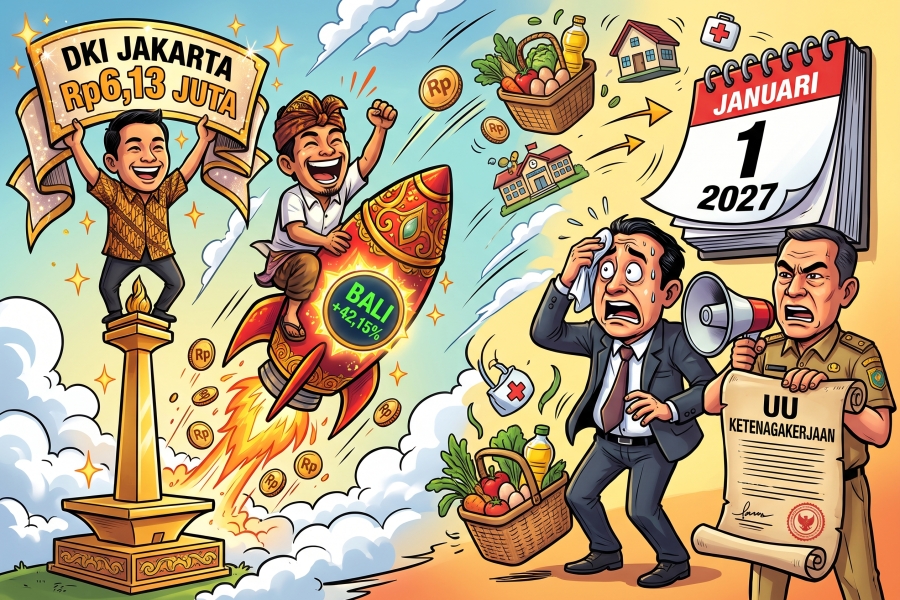
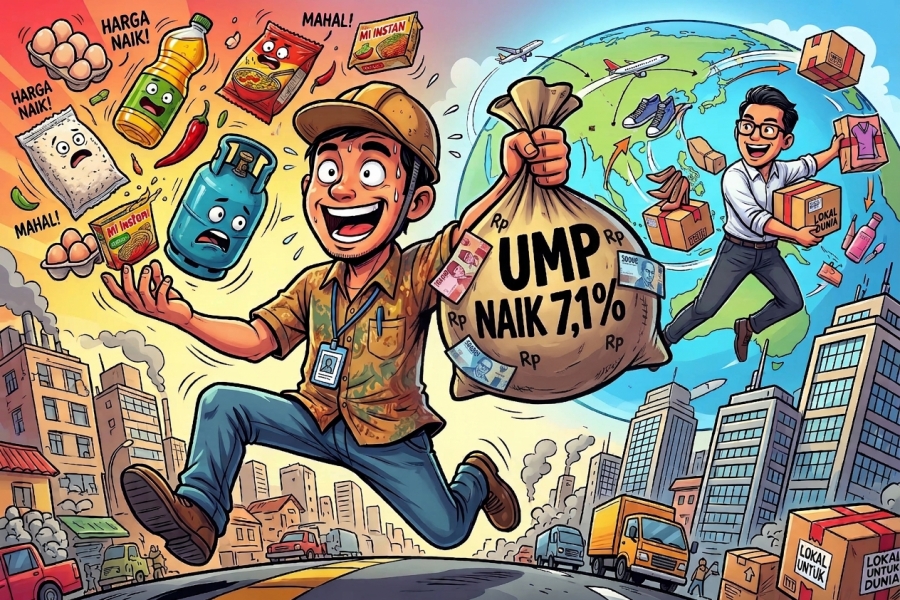
The government has begun finalizing the 2027 Provincial Minimum Wage (UMP), set to take effect on January 1, 2027. DKI Jakarta recorded the highest UMP at Rp6,136,941 per month, while Bali posted the sharpest percentage surge at 42.15%, climbing to Rp4,559,287. This year's wage determination incorporates 268 Decent Living Needs (KHL) components alongside regional economic and labor conditions. Simultaneously, the government has sharply tightened worker protections by imposing criminal penalties of up to four years in prison and corporate fines of up to Rp2 billion for companies caught paying below the minimum threshold..
The determination of the 2027 Provincial Minimum Wage (UMP) stands as a pivotal government policy aimed at balancing workers' living needs with business continuity. Under Government Regulation (PP) Number 49 of 2025 concerning Wages, the deadline for governors across all provinces to establish their UMP was November 21, 2026. Announcements are being rolled out in stages by regional administrations, with 20 provinces confirmed to have finalized their 2027 UMP figures by the evening of November 21. All newly established minimum wages will take effect on January 1, 2027.
Based on official announcements, DKI Jakarta maintains the highest UMP at Rp6,136,941 per month, representing a 7.10% increase from its 2026 level of approximately Rp5.73 million. Meanwhile, Bali recorded the largest percentage jump at 42.15%, soaring from roughly Rp3.21 million to Rp4,559,287 per month—an increase of about Rp1.35 million. These stark variations in nominal amounts and percentage hikes reflect tailored wage adjustments calibrated to regional economic conditions and local living costs.
Beyond the UMP, the Ministry of Manpower has laid out a strict timeline for subsequent wage tiers. Governors are mandated to establish the Provincial Sectoral Minimum Wage (UMSP) no later than five days after the UMP is set. Meanwhile, the Regency/City Minimum Wage (UMK) must be finalized by November 25, 2026, followed by the Regency/City Sectoral Minimum Wage (UMSK) no later than five days after the UMK. While governors are legally obligated to set both the UMP and UMSP, UMK and UMSK determinations remain subject to prevailing regional criteria. This structured schedule is intended to provide clear predictability for both workers and corporations preparing for 2027 payroll budgets.
On the enforcement front, the government has significantly fortified worker protections through Law Number 27 of 2026 concerning Manpower Protection, which took effect on October 28, 2026. Article 140 paragraph (5) explicitly prohibits employers from paying wages below the statutory minimum. This rule applies to workers with less than one year of tenure at a given company. The minimum wage serves as the lowest monthly pay floor, structured either as a wage without allowances or as a basic wage plus fixed allowances. If a company uses a scheme combining a basic wage with non-fixed allowances, the basic wage alone must still meet or exceed the minimum wage.
Violating these provisions carries severe criminal and financial consequences. Under Article 288 of Law Number 27 of 2026, individual employers who pay below the minimum wage face up to four years in prison and/or a Category IV fine of up to Rp200 million. If the violation is committed by a corporation, the penalty escalates to a fine ranging from Category IV (Rp200 million) to Category VI (Rp2 billion), referencing Article 79 of Law Number 1 of 2023 (the Criminal Code/KUHP). Consequently, strict payroll compliance is now an urgent legal imperative for businesses to avoid heavy criminal and financial liability.
Nevertheless, the government has preserved an exemption mechanism for companies genuinely unable to meet the new wage floor. According to the Ministry of Manpower, distressed companies may apply for a wage exemption to their respective governors, provided they secure a formal bipartite agreement with workers and undergo an external financial audit. Both the agreement and the audit results must be attached to the formal petition for gubernatorial approval, ensuring that corporate financial realities are accommodated within a strict procedural framework.
The 2027 wage calculation introduces a major methodological shift by factoring in 268 Decent Living Needs (KHL) components. These items are divided into four expenditure groups: food (177 items), health and education (22 items), other basic necessities (54 items), and housing (15 items). This KHL framework adapts the 2025 International Labour Organization (ILO) study, Minimum Wage Study: Developing a Formula and Methodology for Minimum Wage Determination in Indonesia, to the domestic context. The calculations were jointly executed by the Ministry of Manpower, the Central Statistics Agency (BPS), and the National Economic Council (DEN) at both the provincial and regency/city levels.
In addition to KHL, the wage formula incorporates regional inflation and economic growth multiplied by a specific index ( ), which is set within a range of 0.5 to 1.0 under Article 139 of Law Number 27 of 2026. Selecting the exact value weighs the balance between worker and employer interests, the ratio of the minimum wage to KHL, and local labor market dynamics. This ensures that wage adjustments account not only for household living costs but also for regional business capacity and sustainability.
The rollout of the 2027 UMP alongside steepened corporate penalties carries substantial implications for labor cost management and regulatory compliance. Companies—particularly those operating across multiple provinces—must immediately re-evaluate their payroll budgets to absorb regional wage disparities and ensure full compliance ahead of the January 1 deadline. Strengthening bipartite communication will also be essential for navigating these adjustments smoothly. For the government, consistent labor inspection and proactive social dialogue between unions and employers will be critical to ensuring the new wage regime effectively protects workers without undermining business viability.




 tpc.consulting
 tpc.consulting
 info@taxindo.co.id