



Minister of Finance Regulation (PMK) Number 172 of 2023 provides a comprehensive framework governing the concept of Related Party Relationships for the business interactions of Corporate Taxpayers in Indonesia. This regulation establishes three primary pillars as the determinants of such relationships: minimum capital ownership of 25%, management or contractual control, and one-degree family ties.
A Perseroan Terbatas (Limited Liability Company), commonly abbreviated as PT, is a legal entity in Indonesia established based on an agreement to conduct business activities. Unlike other business entities, a PT is characterized by having its initial capital divided into shares. Ownership of these shares grants the owner (Shareholder) enforceable rights.
According to the provisions of Article 52 Paragraph (1) of the Indonesian Limited Liability Company Law (UU PT), a shareholder in a PT holds voting rights in the General Meeting of Shareholders (RUPS) to make strategic decisions, the right to receive dividends (distribution of net profit), and the right to receive the remaining assets from liquidation if the company is dissolved. Additionally, these shares act as movable property that can be transferred or used as collateral, subject to the company's articles of association.
This unique structure is what makes this business entity different from other business entities, such as a CV (Comanditaire Vennootschap/Limited Partnership) and a Firma (General Partnership). However, what sets a PT apart is more than just the capital contribution alone, but also extends to its legal status.
One of the fundamental differences between a PT and a CV or Firma lies in its legal status. Unlike a CV and Firma, a PT is a business entity that was established as a legal entity (badan hukum). This is regulated under Article 1 Number 1 (Chapter I) of the Job Creation Law (Undang-Undang Cipta Kerja/UU Cipta Kerja), which states:
"A Limited Liability Company, hereinafter referred to as the Company, is a legal entity which constitutes a capital partnership, established based on an agreement, conducting business activities with authorized capital entirely divided into shares, or a sole legal entity that meets the criteria for micro and small enterprises as regulated in the laws and regulations concerning micro and small enterprises."
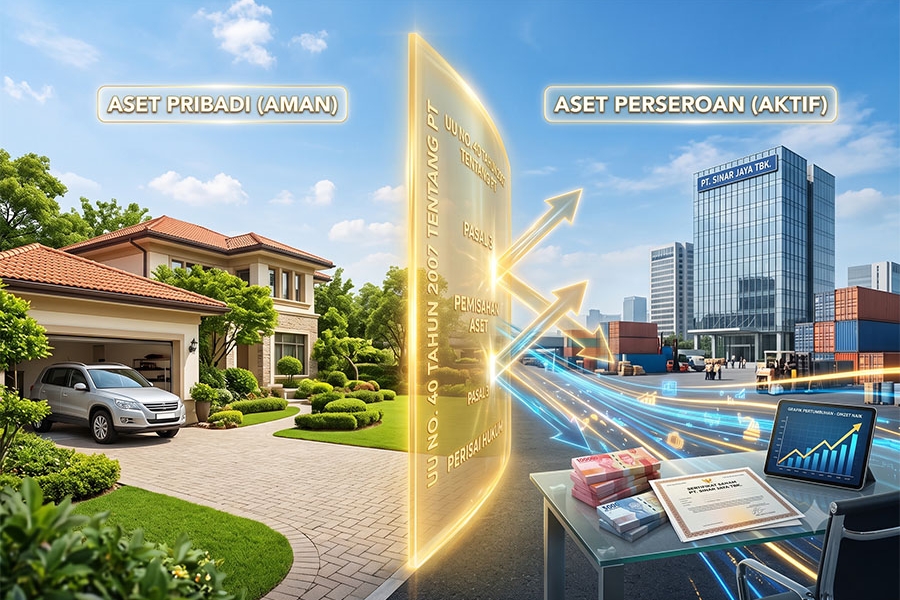
Based on this provision, a PT is treated as an independent legal subject—much like a person—where the PT's assets are strictly separated from the personal assets of the people within it. Conversely, a CV and a Firma are business entities that do not hold status as a legal entity, meaning there is no separation between the owner's personal wealth and the business's assets. This is because the capital system in a CV or Firma uses partnership system or joint capital ownership in a shared fund, rather than formal shares registered under ministerial authority like a PT. Consequently, the assets owned by a CV or Firma are considered one and the same as the personal assets of their owners.
By separating personal wealth from corporate wealth, a PT offers massive legal advantages to its founders and shareholders. The primary benefit is limited liability. In corporate law, the wealth of a PT belongs independently to the company (encompassing all movable, immovable, tangible, and intangible goods). Therefore, a shareholder's liability is strictly limited to the nominal value of the shares they have paid for.
As a result, if the company faces losses, goes bankrupt, or is sued by a third party in the future, the personal assets of the PT's organs—such as the shareholders, Board of Directors, and Board of Commissioners—cannot be seized to cover the company's losses.
Based on the explanation, we can see the advantages offered by this business structure. However, this does not mean a PT is suitable for every entrepreneur, as it ultimately depends on the specific needs of each entrepreneur. If a business owner requires substantial capital and plans for large-scale expansion, yet still wants to protect their personal assets, then establishing a PT is the most suitable choice for those needs.















 tpc.consulting
  tpc.consulting
  info@taxindo.co.id