




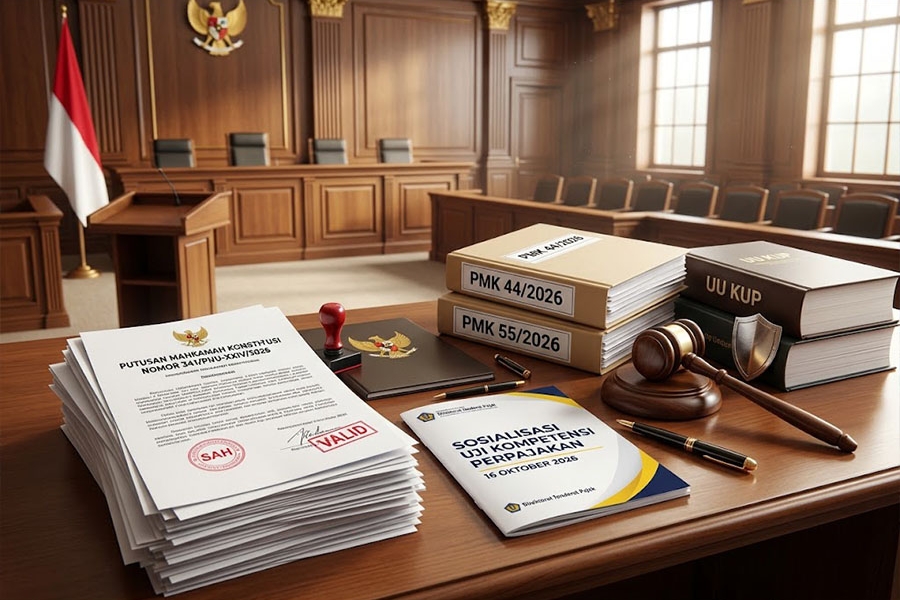
Minister of Finance Regulation Number 44 of 2026 requires company employees to hold the status of an "Other Party" when acting as a Taxpayer Proxy. These employees must participate in and pass an official tax Competency Test to prove their formal eligibility. The government issues a Certificate of Registration valid for three years as proof of legitimate proxy authority. The Directorate General of Taxes will fully enforce this mandatory provision starting January 1, 2027. Company management must immediately map out internal tax roles to mitigate the risks of administrative sanctions and personal criminal liability..
Provisions of Article 32 The Law on General Provisions and Tax Procedures (UU KUP) affirms that Corporate Taxpayers are represented by the Management in exercising their rights and fulfilling tax obligations. In business practice, the management or Director often delegates the execution of tax actions to internal employees through the appointment of a power of attorney. The issuance of Minister of Finance Regulation (PMK) Number 44 of 2026 concerning Tax Consultants and Other Parties Acting as Taxpayer Representatives changes the formal legal framework regarding the boundaries of legality, qualification standards, and the legal responsibilities of employees acting on behalf of the company before the Directorate General of Taxes (DJP).
For company leadership, Directors, and Tax Managers, a deep understanding of the operational boundaries, competency standards, and legal consequences of internal tax actions becomes very crucial to ensure tax compliance (tax compliance) and to mitigate the risk of administrative as well as criminal sanctions.
Under the regime of the Manpower Law and UU KUP, employees act for and on behalf of the company based on an employment relationship (employment contract). However, in formal tax law, this employment relationship status does not automatically grant formal legal authority (legal standing) to act as a representative or proxy for the Corporate Taxpayer.
Article 2 paragraph (2) of PMK Number 44 of 2026 limits the parties who can receive a power of attorney from the Taxpayer to only three categories:
┌─────────────────────────────────────────────────────────────────┐
│           Taxpayer Representative Categories (PMK 44/2026)      │
├───────────────────┬─────────────────────────────┬───────────────┤
│  Tax Consultant   │        Other Parties        │   Family      │
│ (Practice License)│(SKT & P2PK Competency Test) │  (Individual  │
│                   │    [Including Employees]    │   Taxpayer)   │
└───────────────────┴─────────────────────────────┴───────────────┘
Company employees who will be appointed by the Director (as the Taxpayer Representative according to Article 32 of UU KUP) to become a Taxpayer Representative must have the status of an Other Party. Employees do not have a sui generis or special path outside the Other Party category if the actions taken fall under the qualification of actions requiring a Special Power of Attorney.
An employee is required to undergo qualification and be registered as an Other Party if appointed through a Special Power of Attorney to exercise rights and/or fulfill certain tax obligations that legally bind the company.
Tax actions that require a Special Power of Attorney and mandate Other Party status include:
The DJP strictly distinguishes between Representative Legal Actions (Legal Representation: requires a Special Power of Attorney) and Administrative-Operational Actions (Support/Drafting: does not require a Special Power of Attorney). Employees can perform various technical tax activities without needing to become an Other Party and without a Special Power of Attorney.
                     Employee Tax Actions
                               │
      ┌────────────────────────┴────────────────────────┐
      ▼                                                 ▼
   Legal Actions (Needs Proxy)          Operational Actions (Without Proxy)
──────┬─────────────────────────────────   ──────┬────────────────────────────
      ├─ SPT Signing (Signer)                    ├─ SPT Drafting
      ├─ Final Audit Discussion                  ├─ Issuance of Tax Invoices/Bupot
      └─ Objection/Appeal Submission             └─ Document Submission to TPT
| Analysis Parameter | Taxpayer Representative (Management/Director) | Taxpayer Proxy via Other Party Route (Employee) | Operational Employee (Drafter/Staff) |
|---|---|---|---|
| Legal Basis | Article 32 paragraph (1) UU KUP | PMK 44/2026 & PMK 55/2026 | Employment Agreement / Industrial Relations |
| Power of Attorney Requirement | Not Required | Mandatory (Special Power of Attorney) | Not Required |
| Formal Legitimacy Requirement | Deed of Establishment / GMS Decision | SKT & Passed Competency Test | Assignment Letter / Internal Appointment |
| Competency Requirement | No Competency Test | Mandatory SKT & Passed Competency Test | No Formal DJP Requirement |
| Scope of Legal Authority | Absolute (Corporate Representation) | Limited According to the Scope of Special Power of Attorney | Limited to Input & Document/File Delivery |
| Legal Responsibility | Personal / Joint and Several | Ethical Sanctions, SKT Access & Criminal/Sanctions for False Information | Internal Company Employment Accountability (Manpower) |
| Coretax System Access | PIC / Main Signer (Main Authorized Signer) | Delegate Authorized Signer (With Proxy) | Drafter / Tax Preparer |
The regulation of Article 3 of PMK Number 44 of 2026 affirms that all parties acting as Taxpayer Proxies must have certain competencies in the field of taxation.
Based on PMK Number 44 of 2026, the legitimacy of the Other Party is ensured through objective qualification standards managed by the Center for Functional Position Development and Quality Assurance of the Financial Education and Training Agency of the Ministry of Finance.
Employees who will be appointed as Taxpayer Proxies must take and be declared to have passed the Taxation Competency Test (Article 7 PMK 55 of 2026). This competency test is organized by the Competency Test Management Unit in the Ministry of Finance, namely the Center for Functional Position Development and Quality Assurance of the Financial Education and Training Agency.
                   Other Party Certification Flow
                               │
      ┌────────────────────────┴────────────────────────┐
      ▼                                                 ▼
 Competency Test Registration           Competency Test Implementation
      (MoF Portal)                           (Competency Standards)
      │                                                 │
      └────────────────────────┬────────────────────────┘
                               ▼
               Passed: Certificate of Competency
                               │
                               ▼
                   Issuance of SKT by P2PK
                  (Validity Period 3 Years)
Participant Prerequisites:
Competency Certificate Categories:
The Registered Certificate (SKT) is a legality document issued by the Minister of Finance (through P2PK) stating that the Other Party has the formal qualifications to act as a Taxpayer Proxy (Article 1 point 7 PMK 44 of 2026).
In order to maintain Taxpayer operational continuity, Article 16 of PMK Number 44 of 2026 provides a transition period:
                 Transition Period Rules (Article 16 PMK 44/2026)
                               │
      ┌────────────────────────┴────────────────────────┐
      ▼                                                 ▼
    Until December 31, 2026                      Starting January 1, 2027
──────┬────────────────                          ──────┬───────────────
      ├─ Tax Brevet Certificate                        ├─ Must Have P2PK SKT
      └─ D3/S1 Taxation Diploma (Accred A)             └─ (Brevet No Longer Valid)
Becoming a Taxpayer Proxy via the Other Party Route carries significant legal consequences. The act of acting as a Taxpayer Proxy via the Other Party Route shifts a portion of formal responsibilities onto the employee's shoulders personally. Employees are no longer only responsible internally to the management ranks (such as the board of directors), but have direct legal responsibility before state law.
                     Legal Risks of Other Parties
                               │
      ┌────────────────────────┼────────────────────────┐
      ▼                        ▼                        ▼
 Administrative Sanctions     Tax Criminal Risks     Material Responsibility
────────────────────     ───────────────────     ───────────────────────
 Suspension/Revocation    Article 39/39A UU KUP   Losses Remain with the
 of P2PK SKT              (False Information)     Taxpayer (Company)
According to Article 2 paragraph (3) of PMK Number 44 of 2026, although the appointment of power of attorney is given to an employee, the material responsibility for the payment of tax owed remains with the Taxpayer (Company). However, the employee as the proxy assumes full responsibility for the validity, formal correctness, and integrity of the authorized process.
In addition, based on Article 8 paragraph (3) of PMK Number 44 of 2026, a Taxpayer Proxy is strictly prohibited from delegating (waiving/substituting) the power received to another person. Employees who have received a Special Power of Attorney must carry out the tax actions themselves and cannot delegate them to subordinate staff.
Other Parties proven to have violated tax provisions, provided incorrect information, or violated the code of ethics may be subject to sanctions in the form of:
Although material responsibility in the form of settling tax debts or material losses for tax underpayments remains attached to the company as the Taxpayer, the employee acting as a Taxpayer Proxy bears personal criminal responsibility. Based on Article 9 of PMK 44/2026, a proxy is strictly prohibited from providing misleading information or false documents during the compliance or tax audit process. If a violation occurs, the employee can be charged with tax criminal sanctions (as regulated in Article 39 or 39A of the UU KUP).
From a criminal law perspective, the signing of the Special Power of Attorney positions the employee as an independent legal subject who assumes full responsibility for their actions. Therefore, the doctrine of complicity (deelneming) can be applied, and employees cannot use the defense of 'only following orders from superiors' (befehl ist befehl) to escape criminal tax charges if they are proven to have consciously engineered transactions.
The regulatory changes in PMK Number 44 of 2026 require companies to restructure their administrative governance and tax roles. The appointment of employees as Taxpayer Proxies demands the fulfillment of strict formal qualifications through the Other Party scheme. The implementation of PMK Number 44 of 2026 clarifies the legal boundaries between executing routine administrative tasks and legal representation actions. The Board of Directors and company management need to take the following mitigation steps:
Q1: Are company employees required to become Other Parties if appointed as a Taxpayer Proxy?
A1: Yes. Based on PMK Number 44 of 2026, employees appointed through a Special Power of Attorney to exercise certain tax rights and obligations of the company must be registered and fulfill the qualifications as an Other Party, complete with a Registered Certificate (SKT) from P2PK.
Q2: When is the deadline for using brevet certificates for employees who become Taxpayer Proxies?
A2: Brevet certificates or formal taxation education diplomas (minimum D3 Accredited A) can only be used to fulfill proxy requirements until December 31, 2026. Starting January 1, 2027, employees must pass the P2PK Competency Test and hold an SKT.













 tpc.consulting
  tpc.consulting
  info@taxindo.co.id