




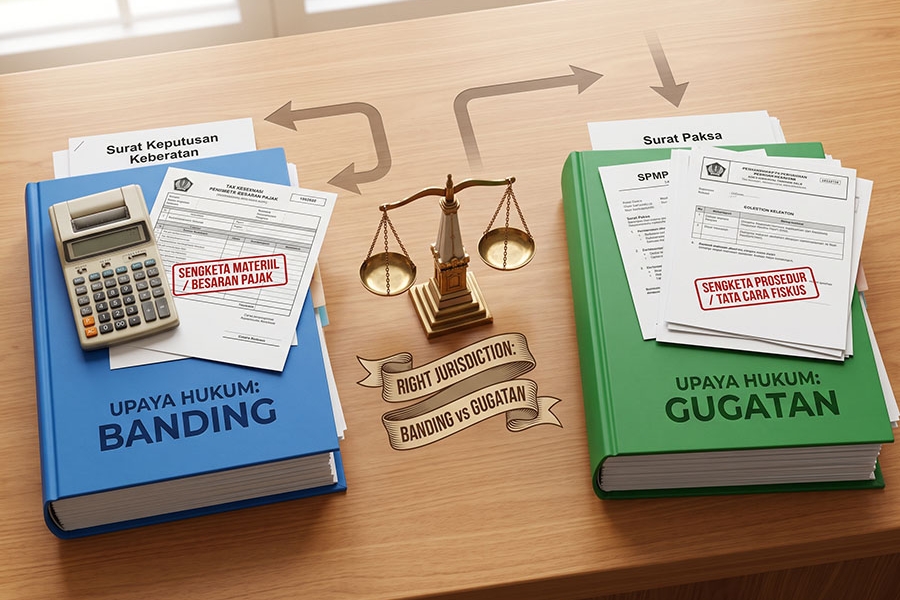
The Objection Examination process at the Directorate General of Taxes (DGT) is the first legal remedy stage pursued by Taxpayers in seeking justice when they disagree with the results of a tax assessment from the DGT. Unlike the Appeal and Lawsuit remedies which are examined at the Tax Court, the Objection process is conducted within the internal/administrative scope of the DGT.
Provisions regarding the implementation of Objections are generally regulated in Article 25 and Article 26 of the Law on General Provisions and Tax Procedures (UU KUP) as amended several times, most recently by Law Number 6 of 2023 (Job Creation Law), and are technically regulated in the Minister of Finance Regulation (PMK) No. 9/PMK.03/2013 (PMK 9/2013) as last amended by PMK No. 15/PMK.03/2018 (PMK 15/2018). The examination stages and documents that must be prepared by the Taxpayer are as follows:
Overall, the objection process at the DGT has a maximum completion time limit of 12 months from the date the Objection Letter is received. This process is carried out by an independent team at the DGT called the Objection Review Team (not by the tax auditor who issued the Taxpayer's Tax Assessment Letter).
First, the Taxpayer submits an Objection Letter to the Tax Office (KPP) where the Taxpayer is registered. The submission period is 3 months from the date the Tax Assessment Letter (SKP) is sent or from the date of tax withholding/collection by a third party, unless the Taxpayer can demonstrate that the time limit could not be met due to circumstances beyond their control (Force Majeure). The SKPs that can be objected to are as follows:
a. Underpaid Tax Assessment Letter (SKPKB);
b. Additional Underpaid Tax Assessment Letter (SKPKBT);
c. Nil Tax Assessment Letter (SKPN);
d. Overpaid Tax Assessment Letter (SKPLB); or
e. tax withholding or collection by a third party based on the provisions of tax laws and regulations.
Before submitting the Objection Letter, the Taxpayer must also pay off the outstanding tax, at least the amount agreed upon by the Taxpayer during the final discussion of the tax audit results.
Based on Article 25 paragraph (2) of the UU KUP, the Objection must be submitted in writing in Indonesian, stating the amount of tax payable, the amount of tax withheld or collected, or the amount of loss according to the Taxpayer's calculation, accompanied by the reasons underlying the calculation. After the DGT conducts a file review, if all formal requirements are met, the objection will be processed. However, if the formal requirements are not met, the Objection Letter is considered not submitted and will not be considered.
The DGT Objection Review Team will then borrow the Taxpayer's books, records, and supporting documents through a Letter of Request to Borrow Books, Records, and Documents. The Review Team will also send a Notice of Attendance (SPUH) accompanied by a Notice of Objection Dispute Review Results (SPUL) before the final decision is issued.
During the Objection process, the Taxpayer has the right to attend an internal hearing with the Objection Review Team to convey their rebuttal against the SPUL, provide clarification, and present strong evidence from their bookkeeping that was either not considered or incorrectly considered by the previous Tax Auditor.
Following that, the Director General of Taxes must issue a decision on the submitted objection within a maximum period of 12 months from the date the Objection Letter is received. The decision may take the form of: fully accepting, partially accepting, rejecting, or increasing the amount of tax payable.
It is important to note that based on Article 26 paragraph (5) of the UU KUP, if the Director General of Taxes does not issue a decision within the 12-month period, the objection filed by the Taxpayer will be deemed granted, and the DGT must issue an SK KBP in accordance with the Taxpayer's request. Meanwhile, if the Taxpayer is dissatisfied or rejects the contents of the Objection Decision Letter (SK KBP) issued by the DGT, the Taxpayer may file an Appeal to the Tax Court within 3 months from the date the SK KBP is received.
Meanwhile, the documents that must be prepared by the Taxpayer when filing an Objection include:
written in Indonesian, submitted to the Director General of Taxes (through the registered KPP), containing clear reasons regarding the tax calculation according to the Taxpayer, and submitted separately for each SKP (Tax Assessment Letter) or withholding/collection.
attaching a copy of the SKPKB, SKPKBT, SKPLB, SKPN, or proof of withholding/collection by a third party whose value is being disputed.
The Taxpayer must first pay off the amount agreed upon in the Final Discussion of Audit Results (PAHP) before the Objection Letter is submitted.
if the Taxpayer is represented by a Tax Consultant or Legal Counsel.
including accounting documents, ledgers, invoices, contracts, bank statements (Rekening Koran), or other records that form the basis of the Taxpayer's calculation arguments.












 tpc.consulting
  tpc.consulting
  info@taxindo.co.id