



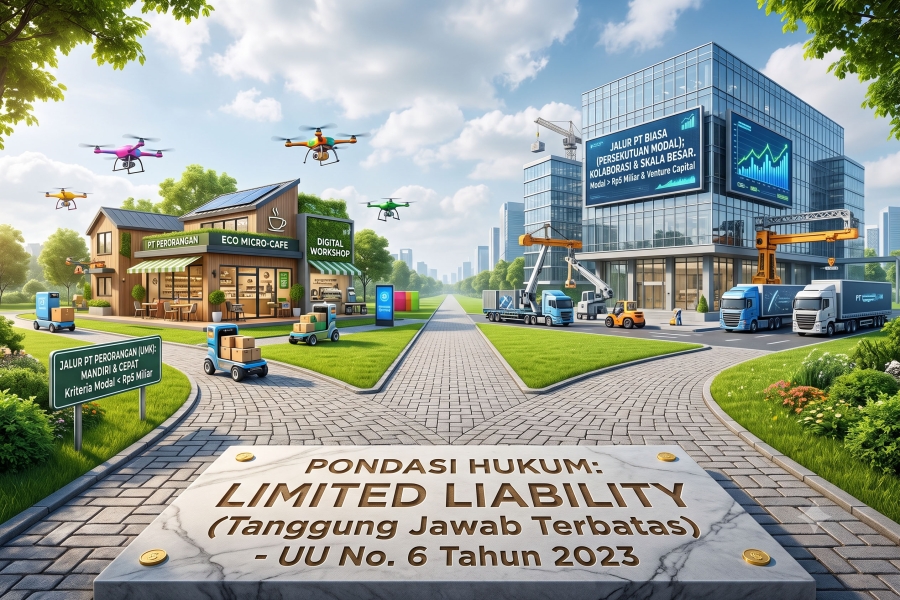
The Job Creation Law introduces two types of Limited Liability Companies (PT) in Indonesia, namely the Regular PT (PT Biasa) and the Individual PT (PT Perorangan). Both of these legal entities protect the owners' personal assets through a limited liability scheme. The Individual PT makes it easier for a single micro and small enterprise (MSE) entrepreneur to establish a business without a notarial deed. Meanwhile, the Regular PT facilitates two or more founders in formally running a medium to large-scale business. Entrepreneurs must choose a business entity form that aligns with their vision, financial capacity, and business governance..
In starting or developing a business, one of the most crucial decisions an entrepreneur must make is determining the right type of business entity for their venture. Since the enactment of the Job Creation Law (Undang-Undang Cipta Kerja or more commonly known as the Omnibus Law), the business landscape in Indonesia has recognized two types of Limited Liability Companies (Perseroan Terbatas/PT) tailored for different business scales: Regular PT (Capital Partnership) and Individual PT (Micro and Small Enterprise Perseroan).
Before launching a venture, it is vital for entrepreneurs to understand the characteristics, requirements, and limitations of each business entity. This ensures that the established legal entity truly aligns with the entrepreneur's strategic vision, financial capacity, and business governance.
These provisions are regulated under Law Number 40 of 2007 concerning Limited Liability Companies (UU PT), as amended by Law Number 6 of 2023 concerning the Enactment of Government Regulation in Lieu of Law Number 2 of 2022 on Job Creation into Law (UU Cipta Kerja).
Key Differences and Characteristics:
The most fundamental difference between these two entities lies in who and how many individuals establish them:
This is a capital partnership established based on an agreement. Referring to Article 7, paragraph (1) of the UU PT (as amended by UU Cipta Kerja), it must be founded by 2 (two) or more persons through a notarial deed drawn up in the Indonesian language. Each founder must take a share portion upon establishment. Shareholders can be individuals or legal entities (such as another PT or a cooperative).
This entity is specifically designed to provide ease for Micro and Small Enterprises (UMK). Based on Article 153A, paragraph (1) of the UU PT (as amended by UU Cipta Kerja), an Individual PT can be established by just 1 (one) person. Furthermore, Article 153E, paragraph (1) of the UU PT (as amended by UU Cipta Kerja) stipulates that the shareholder must be an individual and cannot be a legal entity.
Capital serves as the main engine of a business. Under the Job Creation Law, authorized capital policies have become highly flexible to stimulate investment:
Pursuant to Article 32 paragraphs (1) and (2) of the UU PT (as amended by UU Cipta Kerja), every PT must have authorized capital, but the minimum amount is no longer set at IDR 50 million. Instead, it is entirely determined by the decision of the company's founders.
While the capital amount is determined by the founder, an Individual PT is strictly limited by business scale. It is only intended for businesses that meet the Micro and Small Enterprise (UMK) criteria. Based on implementing regulations, the business capital for the UMK category is capped at a maximum of IDR 5 billion (excluding land and business premises). If the capital or turnover eventually exceeds this UMK threshold, the legal status must be converted.
The establishment process requires a Notarial Deed. Legal entity status is officially acquired after all data is registered with the Minister of Law and Human Rights and a certificate of registration/approval is issued.
The process is much more streamlined and economical. Establishment is done simply through a Statement of Establishment written in Indonesian. This statement is then registered electronically with the Minister of Law and Human Rights. Additionally, the government provides specific incentives, including fee reductions for the establishment of Individual PT legal entities.
Despite its practicality and flexibility, an Individual PT is bound by specific legal constraints:
An entrepreneur cannot establish an unlimited number of Individual PTs. Article 153E paragraph (2) of the UU PT (as amended by UU Cipta Kerja) strictly states that a founder may only establish 1 (one) Individual PT within a period of 1 (one) year.
If the business grows rapidly and no longer meets the micro and small enterprise criteria (e.g., capital or annual turnover scales up to medium/large), the company is legally required to convert its status into a Regular PT.
Even though it is managed individually, accountability is still legally monitored. Article 153F paragraph (1) of the UU PT (as amended by UU Cipta Kerja) obligates the Director of an Individual PT to submit financial reports periodically to ensure good corporate governance.
| Comparison Component | Regular PT (Capital Partnership) | Individual PT (UMK) | Legal Basis (Law No. 6/2023) |
|---|---|---|---|
| Number of Founders | Minimum 2 or more people | Exactly 1 person | Article 7 (1) & Article 153A (1) |
| Shareholder Category | Individuals or Legal Entities | Must be an Individual | Article 7 (1) & Article 153E (1) |
| Capital Requirement | Determined by the founders' decision | Determined by the founder, must fit UMK criteria | Article 32 (2) & Article 153A (1) |
| Establishment Document | Notarial Deed | Statement of Establishment | Article 7 (1) & Article 153A (2) |
| Quota Limitation | No limit on the number of PTs | Max. 1 PT per person per year | Article 153E (2) |
| Legal Liability | Limited to the value of shares owned | Limited to the value of shares owned | Article 3 & Article 153J (1) |
Note on Legal Protection: Both Regular and Individual PTs offer the legal protection of Limited Liability, meaning there is a clear separation between company assets and the owner's personal assets. Based on Article 153J, paragraph (1), shareholders of an Individual PT are not personally liable for agreements made on behalf of the company and do not bear losses exceeding the value of their shares.
Both entities offer the primary advantage of a PT: shielding your personal wealth from business liabilities. However, your choice should depend on your specific business goals:
You are a solopreneur, an early-stage start-up founder, or an independent MSME actor with capital within the UMK threshold. It allows you to separate personal assets and run your business freely without complex internal bureaucracy (since you act as both Director and Sole Shareholder), all while enjoying a fast and affordable setup.
You are founding the business with partners (co-founders, investors, or institutions). It is also the right choice if you need a formal organizational structure (clearly separating the Board of Directors and Board of Commissioners from the start), plan to launch directly into a medium-to-large scale, or aim to raise external equity funding from venture capital.















 tpc.consulting
  tpc.consulting
  info@taxindo.co.id