



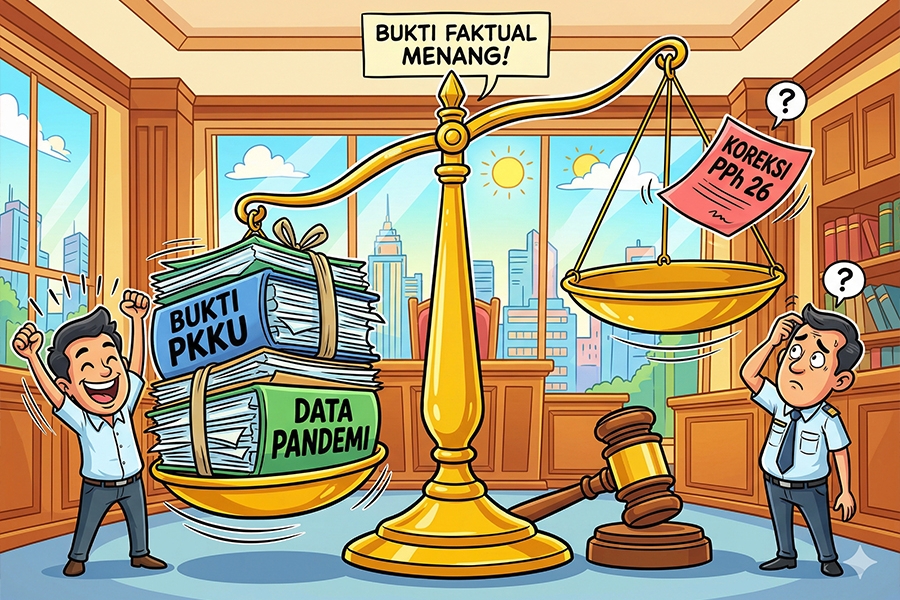
Directorate General of Taxes (DJP) frequently impose secondary adjustments in the form of Article 26 constructive dividends on transfer pricing differences deemed non-arm’s length in cross-border affiliated transactions. The PT JSSI case highlights how the application of Article 18 paragraph (3) of the Indonesian Income Tax Law (UU PPh) and the secondary adjustment concept in PMK-22/PMK.03/2020 become central points of dispute when the DJP interprets operational losses as an indication of profit shifting abroad.
The core conflict stems from a correction to the Article 26 Income Tax base (DPP PPh Pasal 26 in Indonesian) amounting to IDR 33,690,177,043.00, performed by the DJP as an automatic consequence of transfer pricing corrections in Corporate Income Tax. The DJP argued that price differences in export sales, raw material purchases, as well as royalty and management service fees constituted disguised dividends to foreign shareholders. However, PT JSSI strongly countered, arguing that the declining financial performance was purely due to automotive supply chain disruptions during the Covid-19 pandemic and that all transactions complied with the Arm’s Length Principle (ALP).
The Tax Court Judges provided a resolution using a systematic legalistic approach. In their consideration, the Bench emphasized that since this dispute is derivative, its validity depends entirely on the primary dispute. Given that in the previous Corporate Income Tax appeal the Bench had annulled all transfer pricing corrections as they were proven reasonable, the basis for establishing constructive dividends lost its legal standing. The final verdict granted the entire appeal for the cancellation of the Income Tax Article 26 assessment.
Analysis of this decision shows that robust documentation regarding external factors (such as the pandemic) is vital in defending transfer pricing positions. The implication for other taxpayers is the importance of maintaining consistent arguments between Corporate Tax and Withholding Tax dispute items. This decision reaffirms that without a final primary adjustment, secondary adjustments cannot stand alone. In conclusion, strengthening evidence of the existence and benefits of intercompany services is the main key to mitigating the risk of disguised dividend allegations in the future.













 tpc.consulting
  tpc.consulting
  info@taxindo.co.id