



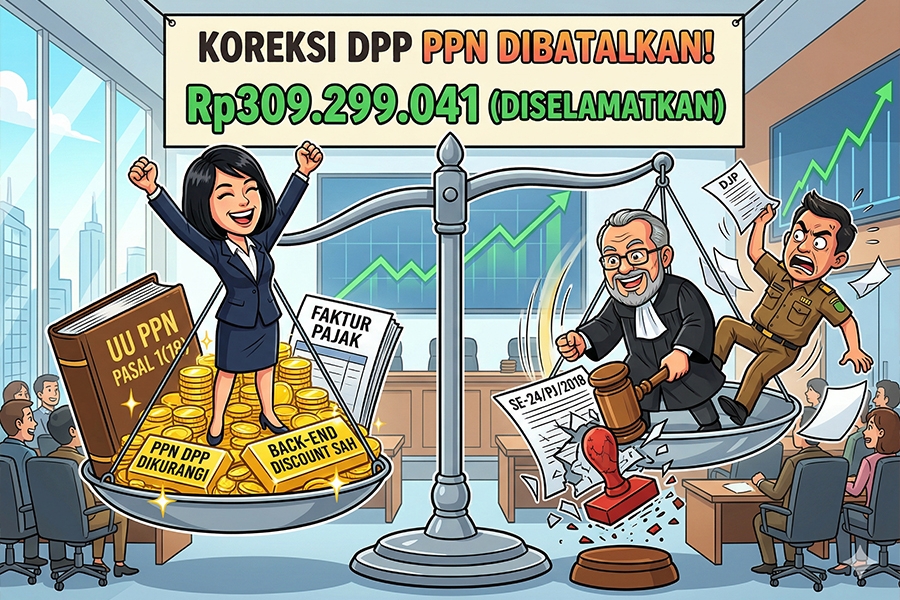
The application of the Tax Base (Dasar Pengenaan Pajak/DPP in Indonesian) principle in Value Added Tax (VAT) often sparks disputes, especially when discount schemes are not granted directly upfront. The case of PT PLII against the VAT DPP correction for May 2019, amounting to IDR 309,299,041.00, sets an important precedent regarding the validity of back-end discounts as a reduction to the selling price. The core of this conflict lies in the fundamental disagreement over classifying the item "Discount-Third Party-Back-End Discount"—is it a legitimate price discount that reduces the DPP under the Indonesian VAT Law (UU PPN), or is it a performance award or incentive that cannot reduce the DPP, as argued by the Directorate General of Taxes (DJP)?
The DJP insisted that the discount granted to distributors after achieving a certain purchase volume threshold constituted a performance award or service compensation. This argument was supported by the Director General of Taxes’s Circular Letter No. SE-24/PJ/2018, which explicitly categorized incentives related to achieving specific conditions as awards. Consequently, the DJP argued that the value of this award could not reduce the Selling Price, leading to a larger amount of output VAT due and the issuance of an Underpayment Tax Assessment Letter (SKPKB).
Conversely, PT PLII firmly refuted this. PT PLII argued that the discount was a sales price reduction granted to boost turnover and was directly related to the supply of Taxable Goods (BKP). By referencing Article 1 Paragraph 18 of the UU PPN, which excludes price discounts stated in the Tax Invoice from the definition of the Selling Price, PT PLII demanded that the VAT DPP be calculated from the net selling price. PT PLII further strengthened its argument with accounting evidence that classified this item as a reduction to gross sales, not as a separate expense or compensation.
In its consideration, the Tax Court Panel comprehensively ruled in favor of PT PLII. A crucial point emphasized by the Panel was the legal status of the DJP’s basis for correction. The Panel determined that SE-24/PJ/2018 is an internal regulation lacking the legal authority to interpret or override the provisions within UU PPN. Since the discount was granted as an incentive directly related to the distributor's daily business activities (buying and reselling), the Panel concluded that the substance of this discount was a reduction in selling price and not an award. Given that the price discount had been clearly stated as a DPP reduction in the Tax Invoice, the Panel ruled that the DJP’s VAT DPP correction lacked legal basis and must be cancelled.
This decision provides significant legal certainty for Taxpayers employing back-end discount or volume rebate schemes in their distribution chains. The implications of this ruling confirm that: (1) Transactional substance must be prioritized, where a price discount related to the supply of goods must be treated as a VAT DPP reduction, regardless of the timing of its payment; (2) The hierarchy of regulations is upheld, where a Circular Letter cannot be used as a basis to override the UU PPN; and (3) Administrative compliance (stating the discount in the Tax Invoice) is key to defending the legitimacy of the output VAT treatment.
The PT PLII case is a classic study in the conflict of interpretation between economic substance (price discount) and administrative interpretation (performance award). PT PLII's success proves that strong documentation, correlation with the Indonesian accounting standards (PSAK), and arguments firmly rooted in the Law are the Taxpayer's main defense in VAT disputes.













 tpc.consulting
  tpc.consulting
  info@taxindo.co.id