



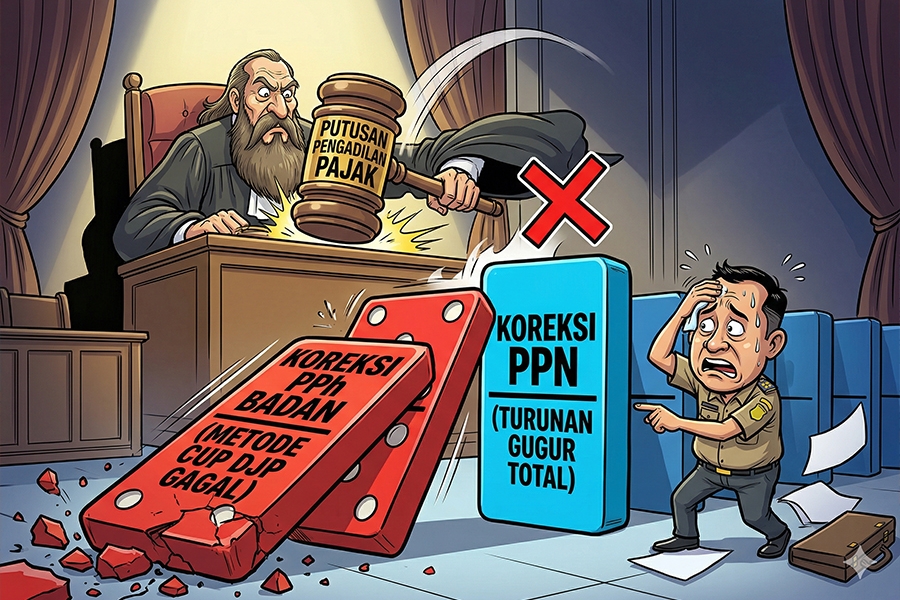
Tax regulations stipulate that the selling price or compensation for the delivery of goods influenced by a Special Relationship (Related Party) must reflect the Arm’s Length Price, as mandated by Article 2 paragraph (1) of the Indonesian VAT Law (UU PPN). In this Tax Court Decision, the central issue is the correction of the Value Added Tax Base (VAT Base/ DPP PPN in Indonesian) amounting to billions of Rupiah, which is a direct consequence of the Corporate Income Tax (CIT) Business Turnover correction conducted by the Directorate General of Taxes (DJP). This correction was based on the assumption that the selling price set by PT BEU to its affiliate was too low compared to the Arm’s Length Price, a determination made using the Comparable Uncontrolled Price (CUP) method. The core of the conflict lies in a fundamental disagreement over the validity of the internal comparable data used by the DJP, namely the selling price to an end customer involving incidental quantities.
The DJP, in its attempt to uphold the correction, relied on the authority granted by Article 18 paragraph (3) of the Indonesian Income Tax Law (UU PPh) to redetermine the income of Taxpayers with Special Relationships. The DJP’s argument posits that the price charged to the independent party (DB) is a reflection of the fair market price. Conversely, PT BEU presented a structured rebuttal, emphasizing that the transaction with the affiliate was massive and routine (distributor), whereas the comparable transaction only involved 3 kg (incidental). These differences in functionality, credit risk, and volume assurance create an absolute lack of comparability that should invalidate the use of the CUP data, in line with the spirit of PER-32/PJ/2011.
The legal resolution came from the Tax Court Panel, which explicitly annulled the VAT Base correction. The Panel ruled that, since this VAT Base correction was a derivative of the Income Tax Arm’s Length Price determination—which had been proven non-compliant with the Arm’s Length Principle (ALP/PKKU in Indonesian)—the VAT Base correction could also not be sustained. This decision affirms a crucial principle of tax administration: any VAT correction stemming from a Transfer Pricing correction must rest upon a solid foundation of Arm’s Length Price determination.
The implication of this Decision is highly significant for tax practices, especially for Taxpayers engaging in related-party transactions. This ruling serves as a reminder to the DJP that the application of the CUP method must be preceded by meticulous comparability analysis, not merely selecting the internal data most favorable to tax revenue without considering differences in functionality and volume. For Taxpayers, this case study underscores the necessity of robust and detailed Transfer Pricing Documentation (TP Doc), including an explicit justification as to why incidental internal transactions cannot be considered valid comparables. The failure to prove comparability is a legal loophole that Taxpayers can utilize to overturn corrections, for both Income Tax and VAT.













 tpc.consulting
  tpc.consulting
  info@taxindo.co.id