



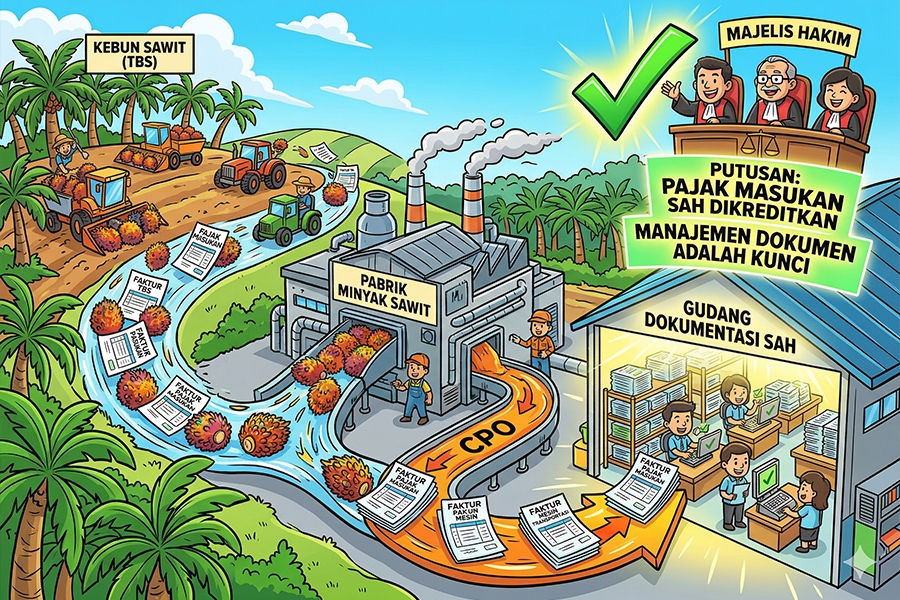
Disputes over Input Tax (VAT) credits in the integrated palm oil industry have found a clearer path following a recent ruling that reaffirms the taxpayer's constitutional right to credit acquisition taxes. PT GM (the Petitioner) faced significant corrections from the Respondent, who insisted that Input Tax on plantation unit costs could not be credited. The Respondent argued these costs were directly linked to the delivery of Fresh Fruit Bunches (FFB) and Crude Palm Oil (CPO), which are specific strategic goods exempted from VAT under the Article 16B regime of the VAT Law.
The core conflict arose when the Respondent rigidly applied the "direct connection" principle, attributing all acquisitions of taxable goods/services in the plantation unit solely to VAT-exempt deliveries. Conversely, PT GM argued that as an integrated palm oil industry, the plantation unit is an inseparable part of the production process that produces not only CPO (exempt) but also Palm Kernels (PK), which are taxable deliveries. Thus, PT GM emphasized their right to credit the Input Tax, at least through the apportionment mechanism stipulated in the Guidelines for Input Tax Crediting under PMK-135/2014.
The Board of Judges provided a resolution favoring substantial justice in their legal considerations. The Judges opined that trial facts proved all expenses in the plantation unit were an integral part of business activities aimed at producing taxable goods. The artificial separation of costs by the Respondent was deemed inconsistent with the operational reality of an integrated industry. Consequently, the Board of Judges decided to annul the Respondent's correction and granted PT GM's appeal in its entirety, as formal and material evidence for crediting Input Tax had been fulfilled according to Article 9, Paragraph (2) of the VAT Law.
The implications of this decision provide legal certainty for integrated palm oil industry players, confirming that Input Tax credits for plantation units are valid as long as there is a taxable output. This ruling strengthens the taxpayer's position against the forced cost dichotomy imposed by tax authorities on overlapping production units. In conclusion, robust documentation of goods and cost flows remains the primary key for taxpayers to defend their tax credit rights in court.
A Comprehensive Analysis and the Tax Court Decision on This Dispute Are Available Here












 tpc.consulting
  tpc.consulting
  info@taxindo.co.id