



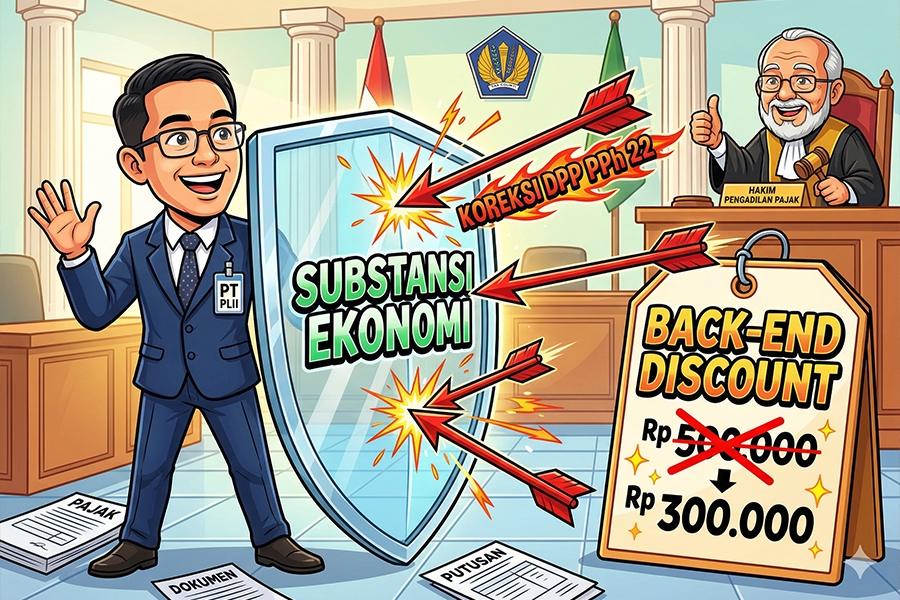
The application of tax provisions in Indonesia often leads to conflicting interpretations, particularly regarding the determination of the Tax Base (DPP in Indonesian) for Income Tax Article 22 (PPh Pasal 22) in connection with sales incentive schemes. The back-end discount case involving PT PLII and the Income Tax Article 22 correction for the December 2019 tax period has become a major highlight of tax litigation. The core dispute revolves around characterizing the nature of volume discounts: whether they qualify as price reductions that lower the Tax Base (DPP) or as awards/rewards that constitute a separate object of PPh. The Tax Court Judges definitively granted PT PLII’s appeal in its entirety, simultaneously confirming the principle of hierarchy in legal regulations.
The central conflict in this case was the juridical classification of the volume incentive, known as the Discount-Third Party-Back-End Discount, amounting to IDR 5,935,547,941.00. The Directorate General of Taxes (DJP) relied on internal guidance in the form of a Circular Letter (SE-24/PJ/2018), arguing that incentives tied to achieving specific sales/purchase volume targets constituted an award or reward. As an award, this amount was deemed a separate PPh Article 22 object to be withheld by the provider (PT PLII) and should not reduce the gross selling price.
Conversely, PT PLII strongly argued that the mechanism was purely a price discount intended to adjust the net selling price and enhance competitiveness. It was recognized in accounting as a reduction of sales under the Indonesian Statement of Financial Accounting Standards (PSAK) and must therefore lower the DPP based on Article 2 paragraph (1) letter c of Minister of Finance Regulation Number 34/PMK.010/2017.
In resolving this dispute, the Tax Court Judges’ Legal Opinion was critical, focusing on both the formal legal basis and the substance of the transaction. The Panel explicitly refused to consider Circular Letter SE-24/PJ/2018 used by the DJP because a Circular Letter does not possess the legal power to serve as a binding basis for tax corrections against a Taxpayer. Furthermore, the Panel assessed the transaction's substance as a reasonable and customary business practice intended for volume sales incentives. The discount was inherently linked to the buy-sell activity, not an event organized by PT PLII to give an award. Consequently, the Panel determined that the DPP for Income Tax Article 22 must be calculated based on the net selling price (after deducting the discount).
The analysis and impact of this decision provide significant legal certainty. The ruling affirms that the economic substance of a back-end discount as a price adjustment prevails over a formal classification as an award, provided the discount is directly related to the volume of purchases. This decision sets an important precedent for Taxpayers in the industrial or distribution sectors utilizing volume incentive schemes, highlighting the necessity of clear and consistent documentation and reaffirming that regulations below the level of a Minister of Finance Regulation cannot override the provisions of the Indonesian Income Tax Law (UU PPh).
The conclusion drawn from this case study is a victory for the certainty of the principle that the net selling price constitutes the Income Tax Article 22 Tax Base. For Taxpayers, this decision serves as a strategic reference point to counter DJP corrections based solely on internal guidelines that conflict with superior regulations.













 tpc.consulting
  tpc.consulting
  info@taxindo.co.id