



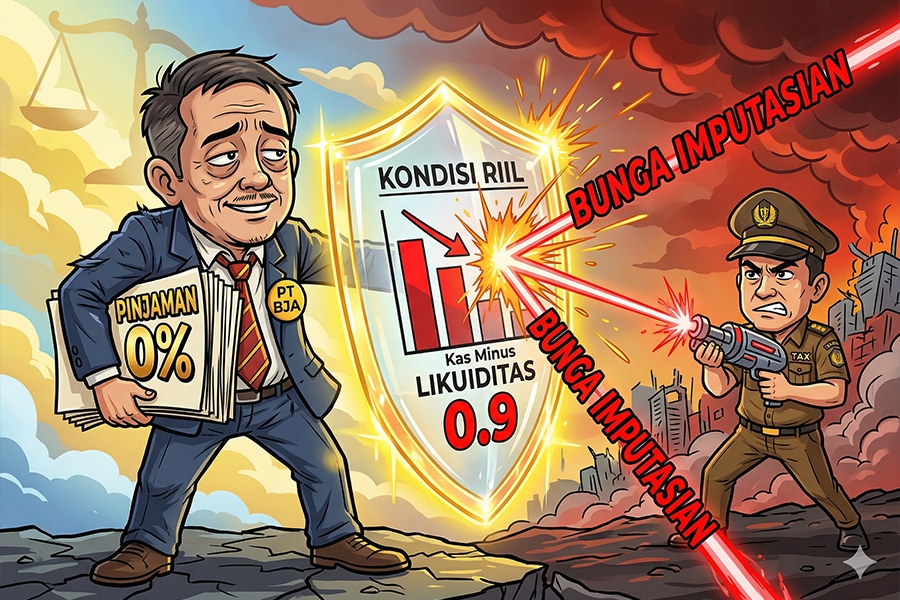
The application of Article 12 of Government Regulation Number 94 of 2010 (PP 94/2010) is a central issue in tax disputes concerning interest-free loans received by Taxpayers from related parties or shareholders. The case of PT BJA highlights the complexity of proving the condition of financial distress, which is one of the cumulative requirements for the loan not to be subject to arm's length interest (imputed interest) leading to an Income Tax Article 23 (PPh 23 in Indonesian) withholding obligation. The Directorate General of Taxes (DJP) corrected the Base of Income Tax Article 23 (DPP) because it deemed PT BJA, as the loan recipient, had not met the financial distress requirement, leading the DJP to calculate an arm's length interest rate and impose a withholding obligation on this deemed accrued interest.
The core conflict in this dispute lies in the differing interpretations and proofs of PT BJA's financial condition. The DJP relied on its transfer pricing correction authority under Article 18 paragraph (3) of the Indonesian Income Tax Law (UU PPh), utilizing three out of four financial distress models (Altman, Zmijewski, Grover) which concluded that PT BJA was not in distress. Therefore, the interest-free loan was considered not at arm's length and should be subject to a fair interest rate (using the BI-7 Day Reverse Repo Rate) according to Article 12 paragraph (2) of PP 94/2010, thereby automatically creating a Income Tax Article 23 object.
However, PT BJA rejected the correction with an argument based on Article 23 of the Income Tax Law, stating that no interest was paid or had become due contractually, thus the formal element for PPh 23 accrual was not met. More compellingly, PT BJA presented evidence showing an operating cash flow deficit, a current ratio below 1 (0.96), and a quick ratio of 0.9011. Real operational data such as mass layoffs (PHK) and cessation of sales were also submitted as concrete proof of liquidity difficulties, which explicitly met the exclusion requirement in Article 12 paragraph (1) letter d of PP 94/2010.
In its resolution, the Tax Court Panel focused intently on the quality of the evidence. The Panel considered the DJP's analysis to be weak and inconclusive because the results of the financial distress models used contradicted each other. Conversely, the Panel accepted the evidence presented by PT BJA which demonstrated poor liquidity ratios and genuine operational difficulties, including cash flow deficits and layoffs. Therefore, the Panel concluded that PT BJA had met the financial distress requirement allowing for the interest-free loan from its shareholder. Consequently, the correction to the Base of Income Tax Article 23 was fully reversed.
This decision has significant implications as a precedent for Taxpayers receiving interest-free facilities from affiliates. The ruling confirms that determining the arm's length nature of an interest-free loan does not solely depend on the formal results of statistical models used by the DJP, but primarily on the quality of the real-world evidence presented by the Taxpayer regarding operational and liquidity conditions demonstrating financial distress. Taxpayers must be proactive and comprehensive in documenting the reason for the loan (including the distressed condition) to mitigate the risk of imputed interest corrections and PPh 23 obligations.













 tpc.consulting
  tpc.consulting
  info@taxindo.co.id