



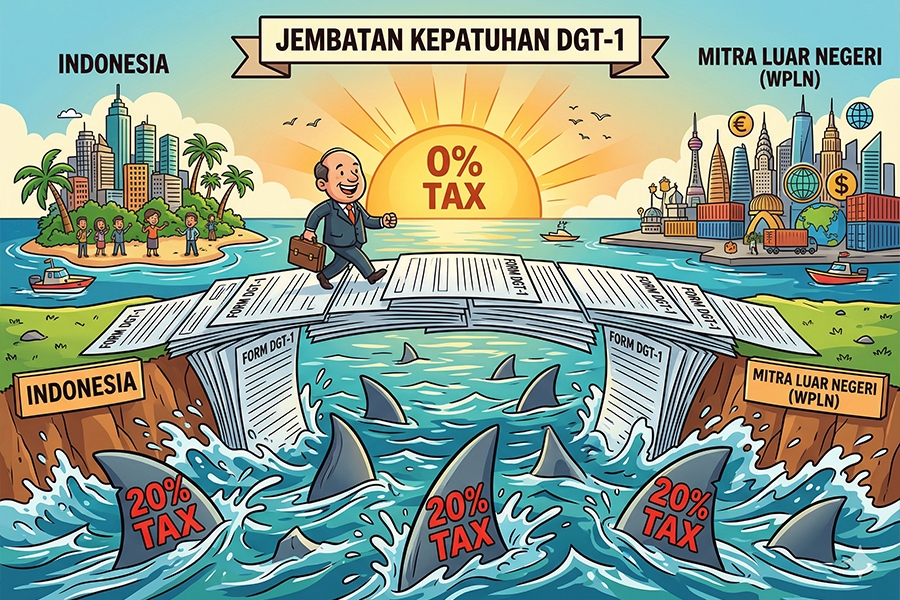
The implementation of Income Tax (PPh) Article 26 withholding on income received by Non-Resident Taxpayers (WPLN) consistently represents a complex area of dispute, particularly when involving claims for reduced rates under a Double Taxation Agreement (DTA). This Tax Court Decision involving PT AA, serves as a crucial case study emphasizing the urgency of fulfilling the formal requirements for the Certificate of Domicile (SKD) or Form DGT-1, in line with the provisions in PER-10/PJ/2017. This case originated from a correction by the Directorate General of Taxes (DJP) based on the equalization of expenses in PT AA's financial statements with the Income Article 26 actually withheld, resulting in a substantial difference and the issuance of an Underpaid Tax Assessment Letter (SKPKB).
The core conflict in this dispute is divided into two main areas. On one hand, PT AA argued that part of the corrected expenses (IDR 377,580,567.00) was not subject to Income Tax Article 26 because it represented amortization of prepaid expenses or accrual journals, thus negating Indonesia's taxing right. On the other hand, for the service transactions acknowledged as taxable (including the IDR 1,035,314,610.00 item), PT AA claimed entitlement to a 0% DTA rate because it had submitted Form DGT-1, pursuant to Article 7 of the relevant DTA concerning Business Profits. The DJP rejected these arguments, asserting that PT AA failed to provide complete and consistent source documents required to trace the substance of the transactions. Furthermore, the DJP rejected the DTA benefit even though the Form DGT had been submitted, based on formalistic reasons such as the absence of the management during the court hearing, thereby disregarding the flexibility in evidence stipulated in SE-35/PJ/2021.
In its consideration, the Panel of Judges adopted a position that balances the principles of substance and formality. The Panel annulled the Income Tax Article 26 correction for the IDR 1,035,314,610.00 item. This decision was grounded in the fact that the DJP itself had acknowledged the submission of Form DGT-1 by PT AA, meaning that a DTA rejection based solely on non-documentary formalistic reasons such as absence from the hearing was deemed legally untenable. Consequently, the taxing right reverted to the WPLN's country of residence (0% rate). However, the Panel upheld the Income Tax Article 26 correction for the other disputed item (IDR 377,580,567.00). This decision was based on the finding that for this transaction, PT AA failed to provide the relevant Form DGT-1 to the Panel. Without valid proof of residency, the WPLN could not enjoy the DTA benefit, and the Income Tax was therefore imposed based on Article 26 of the Indonesian Income Tax Law (20% rate).
This decision significantly clarifies the conflict between formal compliance and substance in Income Tax Article 26 disputes. The implication for tax practice confirms that ownership and submission of the relevant Form DGT-1 are absolute prerequisites to claiming DTA benefits. The Tax Court is willing to override excessive formalistic rejections by the DJP but will not tolerate the complete absence of residency documentation. For Taxpayers, the PT AA case serves as a critical reminder that every DTA claim must be supported by a DGT document that is specifically linked to the disputed transaction. Failure to establish this proper document linkage can result in the Income Tax Article 26 correction being fully sustained.
The PT AA case illustrates that the effectiveness of Income Tax Article 26 litigation heavily relies on the quality and completeness of DTA documentation. The Tax Court reaffirms its commitment to honoring DTA provisions when the basic SKD/DGT requirements are met, while simultaneously rejecting DTA claims that lack valid residency evidence. Taxpayers must be proactive in document management, ensuring that Form DGT-1 is always available and closely tied to every foreign service payment.
A Comprehensive Analysis and the Tax Court Decision on This Dispute Are Available Here













 tpc.consulting
  tpc.consulting
  info@taxindo.co.id