



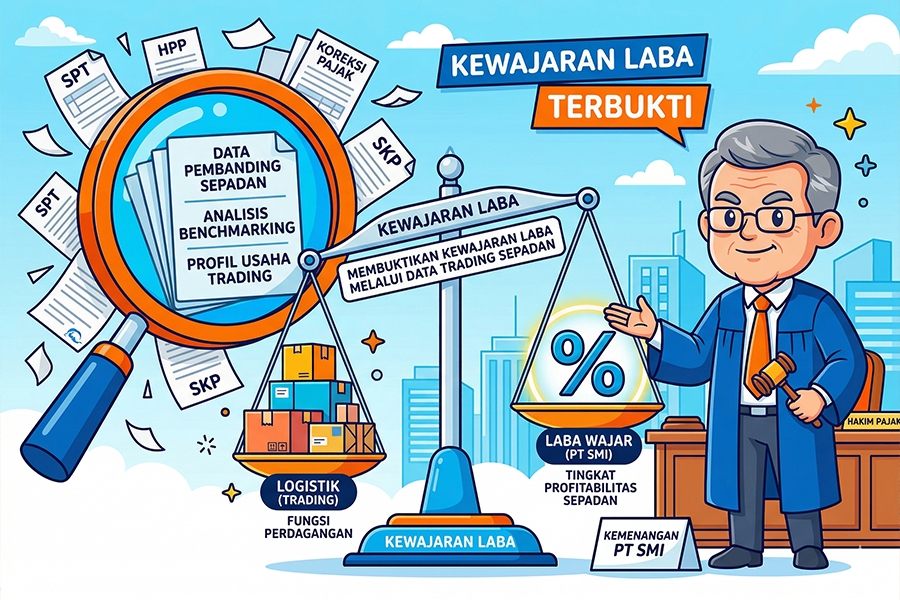
This Tax Court Decision explicitly annuls the Underpaid Tax Assessment Letter (SKPKB in Indonesian) for Income Tax Article 26 for the 2021 Tax Period imposed on PT SMI. The central dispute faced by this taxpayer, operating in the trading sector, revolved around a Transfer Pricing correction (primary adjustment) that led to the imposition of Income Tax Article 26 as a secondary adjustment or constructive dividend. The Panel of Judges in its ruling strongly emphasizes the essence of implementing the Arm's Length Principle (ALP), particularly in the context of functional analysis and the selection of reliable comparable data as mandated by Article 18 paragraph (3) of the Indonesian Income Tax Law (UU PPh).
The Core Conflict originated when the Director General of Taxes (DJP) corrected the Cost of Goods Sold (COGS) of PT SMI, implying that the purchase price of raw materials from its foreign affiliate (Japan) was excessively high, consequently eroding PT SMI's profit. To determine the fairness of the profit, the DJP utilized the Transactional Net Margin Method (TNMM in Indonesian) with 14 comparable companies, including manufacturing entities, which resulted in a narrow arm's length range and placed PT SMI's Operating Margin outside this boundary. The profit difference arising from the correction was then designated as a constructive dividend subject to Income Tax Article 26 withholding, in accordance with Article 22 paragraph (8) of PMK Number 22/PMK.03/2020.
PT SMI, on the other hand, vehemently refuted the correction by demonstrating that its transactions were already at arm's length. PT SMI rejected the majority of the comparable data used by the DJP, arguing they were functionally incomparable. PT SMI, a taxpayer acting as a trading company, should not be compared with manufacturing companies. By limiting the analysis to 3 comparable trader/distributor companies, PT SMI proved that its Operating Margin of 2.46% fell within the arm's length range (1.53% to 2.52%). Furthermore, PT SMI legally contended that the COGS correction did not automatically constitute a dividend, as the definition of a dividend must adhere to the stipulations of the Limited Liability Company Law (UU 40/2007), which requires a General Meeting of Shareholders (GMS) resolution.
The Panel of Judges of the Tax Court, after examining the evidence and arguments of both parties, granted the appeal in full. This decision is fundamentally based on the invalidity of the comparable data utilized by the DJP. The Judges agreed that comparable companies with differing functions (manufacturing, non-distributor) must be excluded from the comparability analysis. By only using 3 functionally comparable companies (as traders), the Panel affirmed that PT SMI's profit margin of 2.46% was already within the arm's length range.
The most significant implication of this ruling is the annulment of the secondary adjustment. When the primary adjustment—the profit/COGS correction—is declared invalid because the Taxpayer's profit already meets the ALP, the legal basis for establishing a constructive dividend also vanishes. This means there is no differential transaction value deemed as an outward profit transfer, thus resulting in no Income Tax Article 26 object being due. This ruling serves as an important precedent for multinational corporations, especially those in the distribution and trading sectors, confirming that the quality of Functional Analysis (FAR Analysis) and the accuracy of selecting comparable data are the absolute keys to winning Transfer Pricing disputes and avoiding the imposition of Income Tax Article 26 on constructive dividends.
A Comprehensive Analysis and the Tax Court Decision on This Dispute Are Available Here













 tpc.consulting
  tpc.consulting
  info@taxindo.co.id