



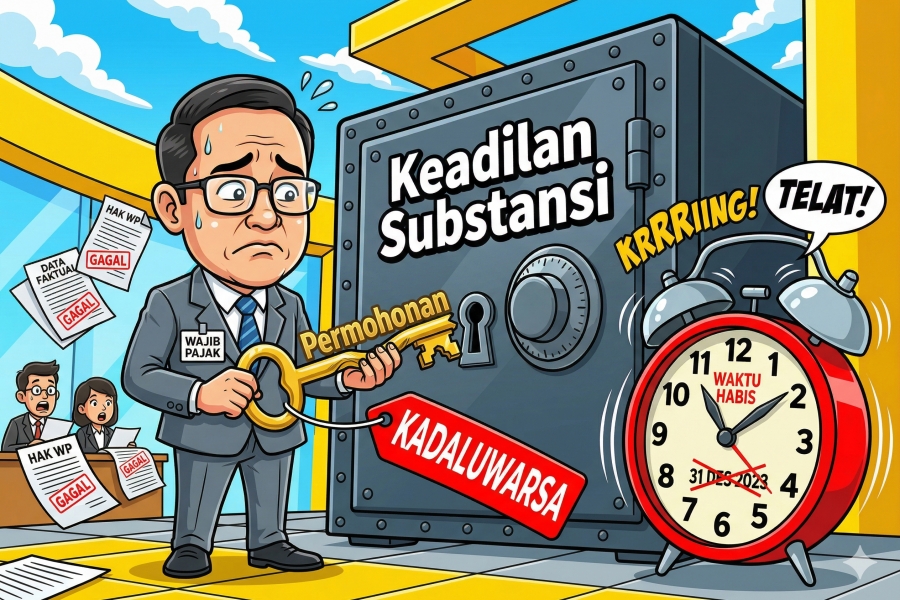
The Tax Court explicitly rejected PT GWJ's lawsuit concerning the Return of a Request for Reduction or Cancellation of an Incorrect Tax Assessment Letter (SKP), asserting that procedural formalities must be strictly adhered to, especially concerning the deadline for submitting a second request. This decision, based on Article 14 section (6) of the Minister of Finance Regulation Number 8/PMK.03/2013 (PMK 8/2013), reinforces the principle that administrative legal remedies submitted beyond the stipulated timeframe are formally flawed and cannot trigger the application of the fictitious positive principle as regulated in the General Provisions and Tax Procedures Law (UU KUP).
The core conflict in this case arose from the Director General of Taxes (DJP) Letter Number S-430/PJ/WPJ.24/2023, which was an administrative act returning PT GWJ's request. PT GWJ argued that Letter S-430 must be annulled because it was issued beyond the 6-month deadline, meaning the SKP cancellation request should have been deemed granted (fictitious positive). This argument was supported by the claim that the SKP and Letter S-430 were issued by the Head of the Tax Office/Regional Tax Office, whose authority was based on an internal DJP Decree (KEP) that should not bind external parties. Conversely, the DJP maintained that PT GWJ's request was the second request, submitted 14 months after the first decision, which significantly exceeded the 3-month deadline mandated by PMK 8/2013. According to the DJP, S-430 was merely a letter returning the request due to a formal defect, not a substantive decision, thereby rendering the fictitious positive principle inapplicable.
In its resolution, the Panel of Judges firmly sided with the DJP's arguments. The Panel's legal consideration stated that the 3-month deadline for submitting a second request, according to Article 14 section (6) of PMK 8/2013, is a formal requirement that must be met by PT GWJ. Violation of this deadline renders the request legally flawed from the outset. Consequently, the DJP's action of issuing Letter S-430 as a Request Return Letter was valid and consistent with the procedure. The Panel implicitly rejected PT GWJ's fictitious positive claim, emphasizing that the principle is only relevant if the request has met the formal requirements to be processed on its merits. Furthermore, the Panel also dismissed the argument regarding the illegitimacy of the issuing official, asserting that the delegation of authority from the DJP to subordinate officials via internal KEPs is a legitimate Mandate mechanism and that the resulting legal products are externally binding.
An analysis of this decision highlights the significant impact of procedural negligence in tax litigation. For Taxpayers, this precedent serves as a stern warning that the gateway to discussing the substance of a dispute (the SKP content) will be firmly closed if there is an unavoidable formal defect. The Panel of Judges has provided a strong confirmation regarding the distinction between a substantive "Decision" that is subject to the fictitious positive principle and an administrative procedural "Return Letter." The implication of this ruling affirms that a Taxpayer's compliance with administrative deadlines, particularly in filing a second request, is a decisive factor in the continuation of the dispute resolution process outside of the court realm.
The conclusion to be drawn is that Taxpayers must prioritize timeliness and the fulfillment of formal requirements in every administrative legal effort. The key lesson from this case is that a dispute strategy focusing solely on the breach of the 6-month deadline and the fictitious positive principle will fail if the request itself is formally defective due to the late submission of the second request.













 tpc.consulting
  tpc.consulting
  info@taxindo.co.id