



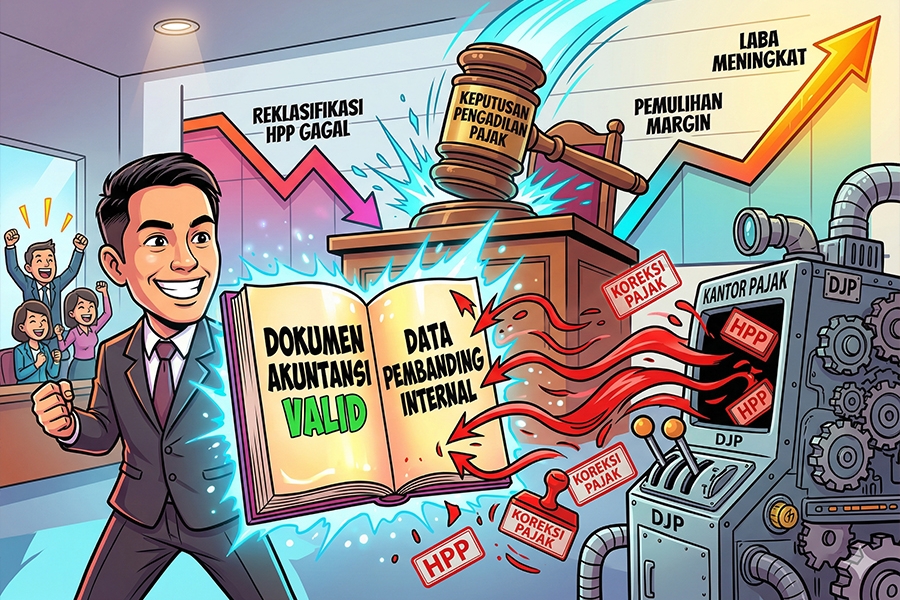
Tax authorities often exercise administrative discretion to reclassify expense accounts to adjust a taxpayer's profit profile in transfer pricing disputes. In the case of PT PLII, the Directorate General of Taxes (DJP) applied a positive adjustment to the Cost of Goods Sold (COGS/HPP in Indonesian) by shifting management fees and promotional expenses into the cost of procurement structure. This action systematically lowered the company's Gross Profit Margin (GPM), which was subsequently used by the DJP as a basis to argue that the affiliated transactions failed the Arm’s Length Principle.
The primary conflict centered on the discrepancy in expense classification between financial accounting standards and the tax authority's interpretation. The DJP argued that an independent entity would not bear such high marketing costs without compensation in the purchase price of the goods. Conversely, PT PLII maintained that these expenditures are period costs intended for general business support in the local market, covering both affiliated and non-affiliated products. PT PLII demonstrated that without the forced reclassification of accounts, the resulting gross profit margin was already comparable to other independent transactions.
The Panel of Judges provided a resolution affirming the supremacy of accounting standards in fiscal bookkeeping, provided they are not specifically regulated otherwise by tax laws. The Judges opined that the DJP failed to prove a direct correlation between those operating expenses and the acquisition cost of goods from affiliates. Juridically, reclassification without a solid evidentiary basis is considered an act exceeding administrative authority.
This decision strengthens PT PLII's position: as long as the transfer pricing method is supported by valid internal comparable data, the margin must be recognized.
The implications of this ruling provide a crucial lesson for multinational enterprises on the importance of maintaining consistency between commercial accounting policies and transfer pricing documentation. The absolute victory of PT PLII confirms that the arm's length test should not be conducted arbitrarily by altering a taxpayer's cost structure without a clear factual foundation. This verdict serves as an important precedent that operating expenses such as management fees and advertising cannot be automatically pulled into COGS components merely to achieve margin adjustment targets.













 tpc.consulting
  tpc.consulting
  info@taxindo.co.id