



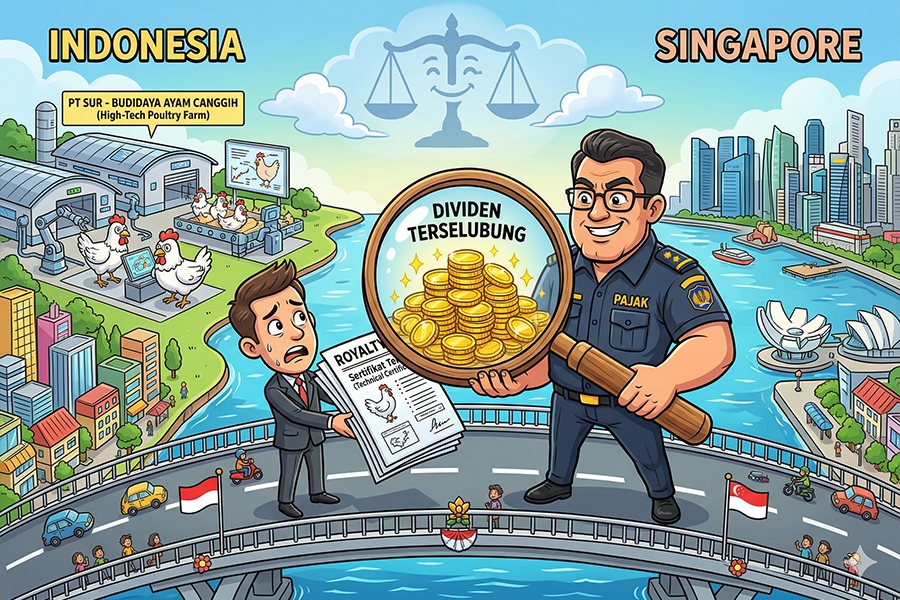
The dispute between PT SUR and the Directorate General of Taxes (DJP) brings to light a crucial issue regarding the recharacterization of royalty payments to a Singaporean entity as constructive dividends. The DJP applied a secondary adjustment instrument on the grounds that the transacted know-how lacked unique economic value and that the recipient's substance in Singapore was deemed inadequate. This argument triggered an adjustment of the tax rate from 15% to 20%, as it was considered a violation of the beneficial owner provisions under the Tax Treaty between Indonesia and Singapore.
The core of the conflict centers on proving the existence of intangible assets and the recipient's rights to the resulting income. PT SUR aggressively maintained that the poultry breeding know-how was exclusive and supported by valid operational documentation. Conversely, the DJP emphasized the minimal number of employees at CPNBI (an affiliated party in Singapore) as an indicator of a lack of economic substance required to manage those intangible assets.
In its resolution, the Panel of Judges adopted a legally compelling middle ground. The Judges upheld the recharacterization of the transaction into dividends in accordance with Article 10, paragraph (4) of the Tax Treaty. However, they rejected the tax rate adjustment proposed by the DJP. The Judges asserted that quantitative indicators, such as the number of employees, cannot serve as the sole parameter to disqualify beneficial owner status without evidence that the recipient is merely an agent or nominee lacking control over the funds.
This decision carries significant implications for multinational companies in Indonesia, highlighting that they must not only focus on formal documents like the DGT form but also on proving the economic control of the recipient entity. Taxpayers must be prepared to face recharacterization challenges by providing tangible evidence of intangible property utilization that aligns with the group's functional profile.
A Comprehensive Analysis and the Tax Court Decision on This Dispute Are Available Here













 tpc.consulting
  tpc.consulting
  info@taxindo.co.id