



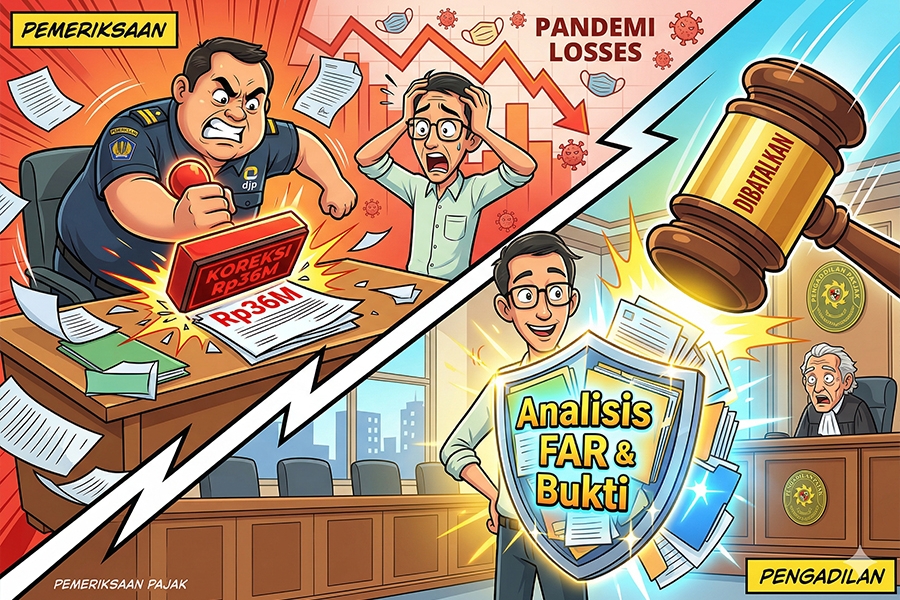
The significant decline in the financial performance of PT JSSI during 2020 triggered a complex transfer pricing dispute with the Directorate General of Taxes (DJP). The DJP imposed massive corrections on sales revenue, Cost of Goods Sold (COGS), and service/royalty fees totaling IDR 36,297,225,955.00. The core of this conflict lies in the interpretation of the arm's length principle regarding operational losses amidst the Covid-19 pandemic and the verification of economic substance for intra-group payments.
The DJP argued that the entity-wide TNMM method (Transactional Net Margin Method) used by PT JSSI was inadequate and masked the unfairness of individual transactions. Conversely, PT JSSI argued that the losses were genuine, caused by a 50.26% drop in both export and domestic sales, consistent with automotive industry data from GAIKINDO (Association of Indonesian Automotive Industries). Furthermore, PT JSSI provided strong evidence that intra-group service fees provided tangible benefits, such as access to global safety systems essential for their production lines.
The Tax Court Panel provided a resolution in favor of administrative justice by overturning all of the DJP's adjustments. The Judges ruled that the DJP’s application of the Cost Plus and Resale Price methods lacked valid comparable data and consistency. The Court emphasized that supporting documents for services, including Global Service Agreements and detailed cost allocations, fulfilled the legal requirements for proving the existence and economic benefits of such transactions.
The implications of this ruling reinforce the necessity for multinational enterprises in Indonesia to rely not only on formal documents but also on operational documentation that explains the economic context behind financial figures. This decision serves as an important precedent that pandemic-induced losses are fiscally acceptable as long as they are supported by a comprehensive Functional, Asset, and Risk (FAR) analysis.













 tpc.consulting
  tpc.consulting
  info@taxindo.co.id