



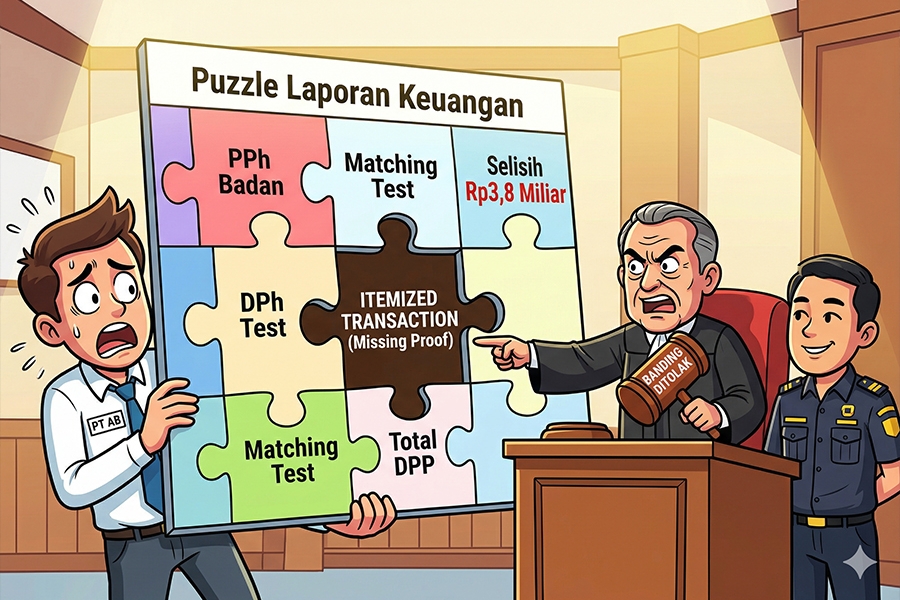
The implementation of Income Tax Article 23 (PPh Pasal 23) as a withholding mechanism on service and capital remuneration often triggers major disputes, especially when the Directorate General of Taxes (DJP) utilizes the cost equalization method in its audits. The case of PT AB, with this Tax Court Decision, highlights the taxpayer's failure to effectively challenge a correction stemming from such an equalization. With the rejection of the appeal, this Decision re-establishes a fundamental principle in tax litigation: the reverse burden of proof must be met comprehensively with detailed data.
This dispute originated from a positive correction to the Article 23 Tax Base (DPP in Indonesian) amounting to IDR 3,877,337,330.00 by the DJP. This correction resulted from a matching test between the total costs claimed by PT AB in its Corporate Income Tax Statement and the total Article 23 Tax Base reported. The DJP argued that this substantial discrepancy represented unwithheld remuneration for Other Services which is subject to Income Tax Article 23. PT AB countered this, asserting that all Income Tax Article 23 obligations had been fulfilled and that the equalization discrepancy could be due to non-Article 23 transactions or errors in the allocation of the tax period.
During the trial, the Panel of Judges focused on Articles 69 and 78 of the Indonesian Tax Court Law. The Panel agreed that the DJP’s correction, derived through equalization, was reasonably grounded. Conversely, PT AB was deemed to have failed to present convincing evidence to explain the discrepancy. The absence of transactional details per invoice or general ledger proving that the IDR 3.8 billion difference was not an object of Income Tax Article 23 weakened PT AB's rebuttal in the eyes of the law. The Panel ultimately rejected the appeal, confirming its conviction that the DJP's correction was valid because the Taxpayer could not remove the Judge's doubt.
This decision serves as a stern warning to all Corporate Taxpayers. In Article 23 disputes, an equalization result yielding a positive discrepancy immediately shifts the burden of proof to PT AB. The implication of this ruling is the affirmation that tax documentation must not only exist but must be detailed down to the itemized transaction level, capable of explaining every discrepancy found by the DJP. PT AB's failure to present strong, organized evidence was the key to the appeal's rejection, emphasizing that formal compliance must be backed by the substantive validity of the data.
This case concludes that the cost equalization method is a powerful tool for the DJP to test Article 23 compliance. To win similar disputes, Taxpayers must proactively conduct internal equalization, identify and rationalize every discrepancy, and be prepared to present complete transactional evidence, including detailed general ledgers, contracts, and supporting invoices.
A Comprehensive Analysis and the Tax Court Decision on This Dispute Are Available Here













 tpc.consulting
  tpc.consulting
  info@taxindo.co.id