



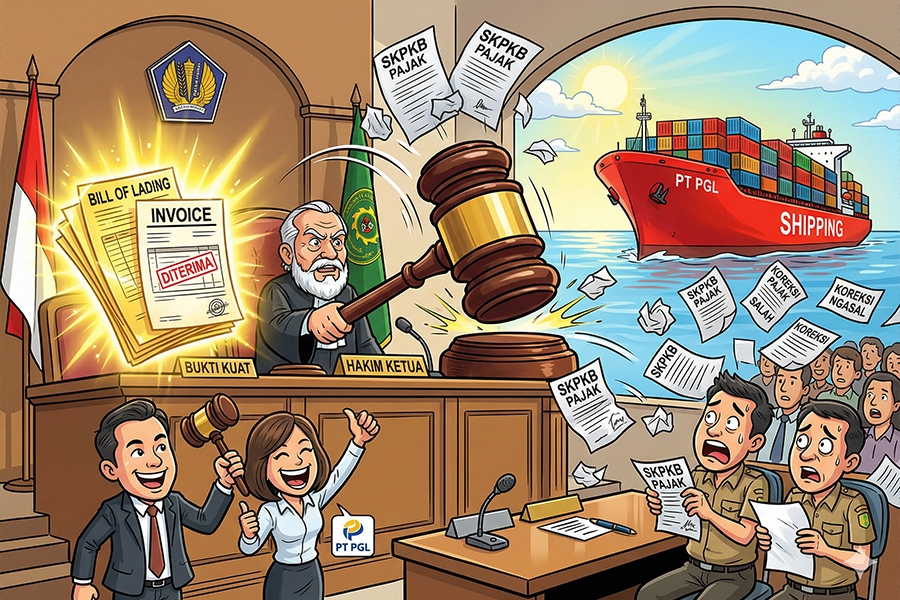
Income Tax Article 15 disputes often become a "grey area" in the logistics industry, especially when Director General of Taxes (DJP) generalize all payments to shipping companies as objects of withholding tax. The case of PT PGL against the DJP serves as a crucial precedent that affirms the strict boundary between the withholding tax obligation for ship charters and the self-payment mechanism for freight forwarding transactions. This decision saved PT PGL from billions of rupiah in tax exposure due to transaction misclassification.
This dispute began when the DJP issued a Notice of Tax Underpayment Assessment (SKPKB) for Article 15 Final Income Tax for the January 2021 Tax Period with a fantastic Tax Base (DPP) correction value reaching IDR 11,698,343,657.00. The basis for the DJP’s correction was simple but had massive impact: The DJP discovered a "Shipping Cost" account in PT PGL's general ledger and immediately assumed all such costs were ship charter payments to domestic shipping companies. Citing Article 15 of the Income Indonesian Tax Law (UU PPh) and Decree of the Minister of Finance No. 416/KMK.04/1996, the DJP argued that PGL, as the service user, was obliged to withhold Final Income Tax of 1.2% of the transaction value. This argument was reinforced by the claim that PT PGL did not provide sufficient supporting evidence during the objection process, leading the DJP to assess the tax ex-officio.
On the other hand, PT PGL strongly rejected this interpretation. As a Freight Forwarding company, PT PGL argued that their business model was not chartering ships, but rather acting as an intermediary shipping customer goods using generally available ship space (public space). PT PGL emphasized that their transactions were "outright sales," where they paid freight charges per shipment, not renting a ship based on time or a specific voyage. Referring to the Director General of Taxes Circular Letter Number SE-29/PJ.4/1996, PT PGL asserted that for shipping income not based on a charter agreement, the tax obligation is self-paid by the shipping company, not withheld by the service user.
The Panel of Judges of the Tax Court examining this case dissected the trial facts in depth. Through the evidence examination process, the Judges scrutinized crucial documents such as Business Licenses (SIUPAL/JPT), Invoices, Bills of Lading, and Bank Statements. The legal facts revealed aligned with PT PGL's arguments: the transactions that occurred were the use of general shipping services, not ship charter agreements. No charter contracts were found giving PT PGL rights of possession over the ships. The Judges emphasized that transaction classification is decisive in determining the applicable tax mechanism.
In their legal considerations, the Panel of Judges dealt a decisive blow to the DJP's arguments. The Judges cited Point 6 of Circular Letter SE-29/PJ.4/1996 which explicitly distinguishes the Income Tax Article 15 payment mechanism. The Judges stated that since PT PGL's transactions were proven not to be charters, the withholding tax mechanism did not apply. The Article 15 Final Income Tax payment obligation rests entirely with the shipping company vendors through the self-payment mechanism. The DJP's correction worth IDR 11,698,343,657.00 was declared to have no strong legal basis and was annulled in its entirety.
The implication of this decision is significant for players in the logistics and freight forwarding industry in Indonesia. This case serves as a reminder for Taxpayers to always document transactions neatly and ensure that the nomenclature in contracts and invoices reflects the actual substance of the transaction (substance over form). For DJP, this decision is a signal to be more careful in characterizing transactions and not to automatically generalize cost accounts without examining the underlying contracts. PT PGL's victory confirms that in tax law, factual detail and legal classification accuracy are the keys to justice.
A Comprehensive Analysis and the Tax Court Decision on This Dispute Are Available Here













 tpc.consulting
  tpc.consulting
  info@taxindo.co.id