



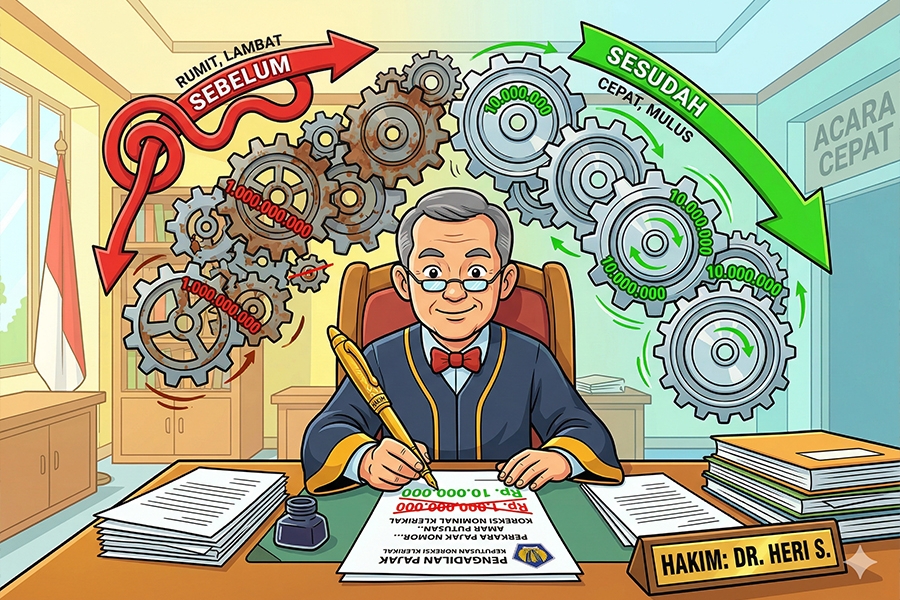
Administrative correction through a fast-track examination mechanism has become the legal remedy for numerical discrepancies in the tax decision of PT RSI. The Tax Court emphasized that clerical and mathematical errors regarding gross income deductions and tax credits in the previous decision must be rectified to uphold legal certainty. This step was taken following the discovery of differences in the detailed nominal tax credits, amounting to millions of rupiah, between the factual data and the text of the pronounced decision.
The conflict originated when the Large Taxpayer Office (KPP) for Foreign Investment (PMA) Five identified inconsistencies in the calculations within this Tax Court Decision. The Directorate General of Taxation (DJP) filed a request for correction because the tax amount due became inaccurate due to input errors in the business expense elements. Conversely, this mechanism is crucial for PT RSI to ensure that their tax rights and obligations are executed based on mathematically correct figures.
The Panel of Judges, provided the legal consideration that the request met the criteria of Article 66, paragraph (1), letter c of the Tax Court Law. The Judges opined that the integrity of a decision lies not only in its legal considerations but also in the accuracy of the figures that serve as the basis for execution by the DJP. Consequently, the examination was conducted swiftly without requiring the lengthy standard appeal procedures.
This correction decision carries significant implications for tax law practitioners regarding the limits of a judge's authority to amend an inkrah (final and binding) decision. Amendments are only permitted for clerical and mathematical aspects, not for the substance of the dispute. This reaffirms that precision in drafting decisions is absolute to avoid additional litigation processes that could have been prevented since the evidentiary stage.
In conclusion, the decision correction mechanism is a vital instrument for aligning substantial justice with administrative accuracy. For business entities, this case serves as a reminder to always perform a reconciliation of figures after a decision is received to ensure no calculation errors adversely affect the company's financial position.
A Comprehensive Analysis and the Tax Court Decision on This Dispute Are Available Here













 tpc.consulting
  tpc.consulting
  info@taxindo.co.id