



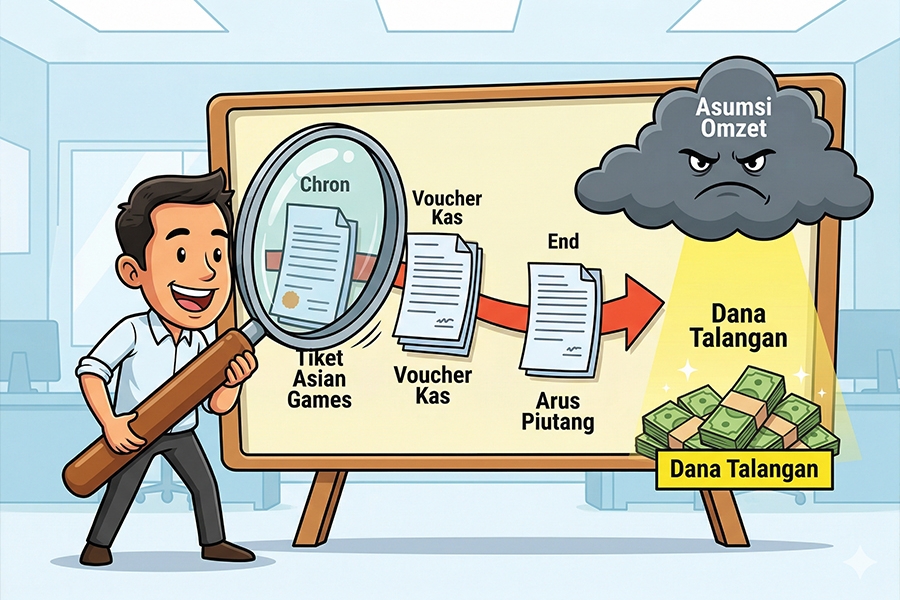
Tax disputes frequently arise from a taxpayer's inability to prove the source of funds entering the company's accounts, which Directorate General of Taxes (DJP) then unilaterally categorize as taxable revenue. In the case of PT SSA, the DJP corrected the VAT Base (DPP PPN in Indonesian) based on cash flow analysis in the "Other Payables" account, assuming it represented undisclosed consulting fees. The dispute peaked when the DJP failed to prove the actual delivery of Taxable Services, relying instead on accounting figures without substantial supporting evidence.
The core of the conflict lay in the DJP's use of account receivable flow techniques to trigger Output VAT. The DJP argued that the absence of a formal loan agreement between the director and the company rendered the cash inflow a taxable object. Conversely, PT SSA demonstrated that the one million rupiah in question was the remaining balance of a director's personal advance used for purchasing Asian Games tickets, returned to the office cash. Internal petty cash vouchers became PT SSA's key instrument in debunking DJP's assumption of hidden income.
The Panel of Judges took a firm stance on material truth. The judges ruled that the DJP assumptions cannot stand alone without evidence of a service delivery transaction. Furthermore, the Panel highlighted procedural flaws in the issuance of the tax assessment, noting discrepancies between the final discussion results and the actual assessment. The legal resolution favored PT SSA, as the Panel was convinced that the cash flow was purely an internal loan to support operational liquidity rather than a business transaction with a third party.
This decision provides legal certainty that cash flow analysis by tax auditors must not ignore field facts. For businesses, this ruling serves as a stark reminder to document every personal fund injection into the company. The main conclusion is that proof in tax disputes is not just about numbers, but about the Taxpayer's ability to construct a chronological narrative supported by credible internal documentation to rebut the DJP's assumptions.













 tpc.consulting
  tpc.consulting
  info@taxindo.co.id