



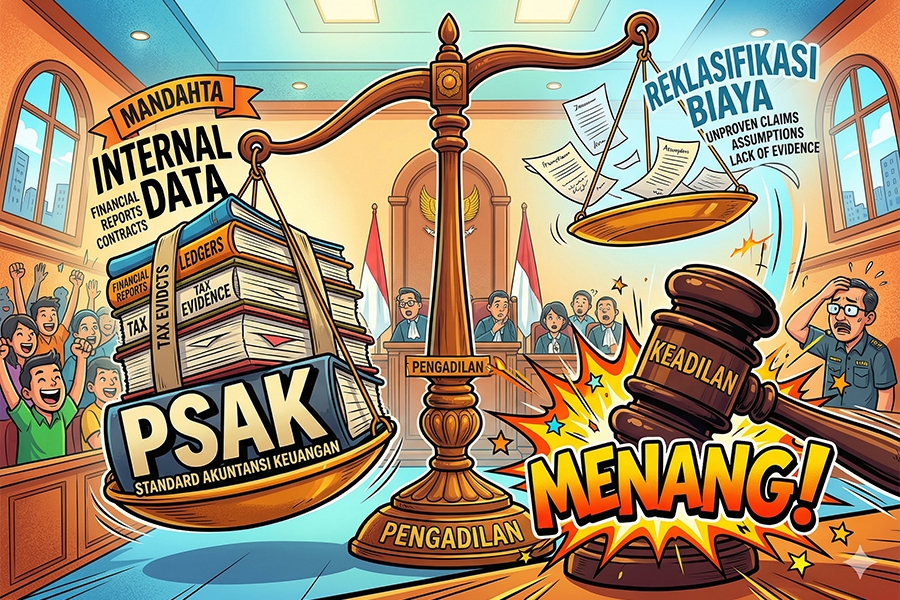
Based on this Tax Court Decision, a crucial issue in the transfer pricing dispute concerning the positive correction to the Cost of Goods Sold (COGS) amounting to IDR 11,312,575,055.00 has been resolved with a complete victory for PT PLII (the Taxpayer). This case highlights the boundary of the DJP's power in making comparability adjustments through the reclassification of cost accounts that are already compliant with the Financial Accounting Standards Statement (PSAK), as regulated under Article 28 paragraph (7) of the General Provisions and Tax Procedures Law (UU KUP). The core of the dispute centers on the Directorate General of Taxes' (DJP) attempt to incorporate PT PLII's operating expenses, such as advertising costs, sales discounts, and director salary expenses, into the COGS, despite PT PLII proving that its Gross Profit Margin (GPM) from affiliate transactions (20.39%) significantly exceeded the GPM from an internal comparable (14.18%).
The conflict originated from the DJP's audit findings, which assessed PLII as having more intensive functions and risks (above a routine distributor profile) than warranted, thus demanding a higher GPM compensation. To demonstrate the lack of arm’s length, the DJP utilized the authority of Article 18 paragraph (3) of the Indonesian Income Tax Law (UU PPh) to reclassify the Advertising and Promotion Costs, Sales Discounts, and Director Salary Expenses into COGS. As a result of this unilateral reclassification, PLII's GPM, which was initially deemed reasonable (20.39%), drastically dropped to -1.08%, leading the DJP to then make a positive COGS correction.
PT PLII argued that the reclassification was invalid because it violated Article 28 paragraph (7) of the UU KUP, which requires the Taxpayer's bookkeeping to conform to generally accepted Financial Accounting Standards in Indonesia. According to PLII, Article 18 paragraph (3) of the UU PPh only grants the DJP the authority to redetermine the amount of income or deductions, not to change the classification of legitimate bookkeeping entries.
| Margin Indicator (GPM) | Percentage (%) |
|---|---|
| Related-Party Transaction (Before Reclassification) | 20.39% |
| Internal Comparable (Independent Party) | 14.18% |
| DJP's Post-Reclassification Result | -1.08% |
The Tax Court Judges agreed with PT PLII's arguments. In their considerations, the Panel affirmed that PT PLII's audited bookkeeping must be respected. Promotion costs and management service fees were operating expenses correctly classified as Selling and Administrative Expenses and could not be arbitrarily forced into the COGS calculation. Furthermore, the Panel found that based on the evidence presented by PT PLII, the GPM from the affiliated transaction (20.39%) being higher than the internal comparable (14.18%) proved that the purchase price transfer was already at arm’s length.
This decision carries significant implications for transfer pricing practices in Indonesia. First, it strengthens the protection provided by Article 28 paragraph (7) of the UU KUP: the integrity of PT PLII's bookkeeping prepared in accordance with PSAK is a crucial line of defense. The DJP cannot arbitrarily reclassify accounts solely to manufacture non-arm's length results in a transfer pricing test. Second, the decision emphasizes the superiority and ease of proof offered by an internal comparable.
The case of PT PLII serves as an important case study confirming that the basis for transfer pricing corrections must adhere to sound accounting principles and strong evidence of arm’s length, particularly through the utilization of internal comparable data. PT PLII's victory proves that comparability adjustments must have a specific legal basis and cannot contradict generally accepted accounting standards.













 tpc.consulting
  tpc.consulting
  info@taxindo.co.id