Executive Summary
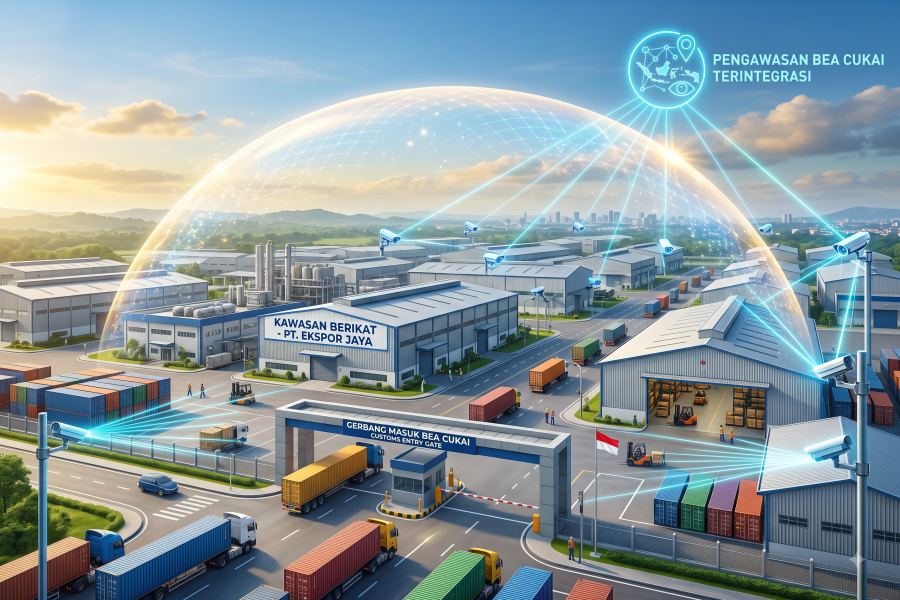
The Indonesian Government provides Bonded Zone facilities to stimulate economic growth and enhance the competitiveness of the export industry. Entrepreneurs in these zones receive various fiscal incentives, such as the suspension of import duties and exemptions from import taxes. The Directorate General of Customs and Excise fully oversees all manufacturing activities within these Bonded Storage Places. Every entrepreneur is required to integrate their goods' entry and exit recording system (IT Inventory) with the system owned by the tax authorities. Furthermore, companies must provide 24-hour online surveillance cameras and conduct regular physical stocktaking of goods..
A Bonded Zone is one of the strategic policy instruments of the Government of Indonesia aimed at fostering economic growth, driving investment, and enhancing the competitiveness of export-oriented industries. Broadly speaking, entrepreneurs within this zone receive various fiscal incentives to reduce production costs, ensuring local products remain competitive in the global market. The provisions regarding the rights and obligations of entrepreneurs, as well as the various fiscal facilities offered under the applicable laws and regulations, are as follows:
1. Definition and Basic Concept
Pursuant to Minister of Finance Regulation (PMK) No. 131/PMK.04/2018, a Bonded Zone falls under the category of a Bonded Storage Zone (TPB)—namely a building, venue, or area with specific requirements used to store imported goods and/or goods originating from other places within the customs territory, to be processed or combined before being exported or imported for home use. Put simply, this zone functions as a "specialized factory" where the manufacturing process (from raw materials to finished goods) receives preferential customs and tax treatment. Due to its special nature, this area operates entirely under the supervision of the Directorate General of Customs and Excise (DGCE).
2. Fiscal Facilities and Tax Incentives
One of the primary attractions of a Bonded Zone is its fiscal incentives. As stipulated in the latest regulation, PMK No. 65/PMK.04/2021, the operational facilities provided within a Bonded Zone include:
Goods from Outside the Customs Territory (Imports):
- Postponement of Import Duty: Import duties do not need to be paid upfront when raw materials enter the factory.
- Exemption from Excise: Applies to excisable goods used as production components.
- Non-Collection of Taxes in the Framework of Import (PDRI): Exempt from Value Added Tax (VAT), Sales Tax on Luxury Goods (STLG), and Income Tax Article 22 on Import.
Goods from Other Places Within the Customs Territory (Local):
- The entry of raw materials, auxiliary materials, capital goods, or office equipment from local areas into a Bonded Zone is granted the facility of non-collection of VAT or VAT & STLG.
- The latest rule (PMK 65/2021) also affirms that this facility includes raw materials owned by foreign tax subjects that are intentionally sent to be processed in a Bonded Zone before being re-exported.
3. Establishment Requirements and Spatial Planning
The Government does not grant Bonded Zone permits arbitrarily. Based on applicable statutory provisions, storage locations must meet strict geographical and technical criteria, including:
- Located in an Industrial Estate or an industrial allocation zone according to the Regional Spatial Plan (RTRW).
- If located in a non-industrial zone, the continuous expanse of the site must measure at least 10,000 square meters.
- Road access must allow direct entry from public roads and be passable by container transport vehicles.
- Have clear boundaries, consisting of either natural barriers or sturdy artificial boundary fences separating the site from external areas.
4. Strict Obligations of Bonded Zone Entrepreneurs
Given the substantial tax facilities granted, the Government balances these privileges with compliance- and technology-based supervision. As regulated in PMK No. 65/PMK.04/2021, every Bonded Zone Entrepreneur or Entrepreneur in a Bonded Zone concurrent as a Bonded Zone Operator (PDKB) must comply with the following provisions:
- Display Company Signboard: The company must display a signboard identifying itself as a Bonded Zone Entrepreneur or PDKB in a location clearly visible to the public.
- Provide Electronic Means and Infrastructure: Provide facilities for electronic data interchange to support supervisory functions over the Bonded Zone Entrepreneur or PDKB by Customs Offices utilizing electronic data interchange systems.
- Integrated Accounting System (IT Inventory): The company must utilize a inventory control information system for incoming and outgoing goods that is a subsystem of their financial accounting system. This system must be directly accessible by the DGCE and the Directorate General of Taxes (DGT).
- 24-Hour Online CCTV: Provide surveillance cameras (CCTV) at entry and exit points for goods that are connected online and in real time to Customs and the DGT, with a minimum recording storage period of the last 7 (seven) days.
- Routine Stocktake (Stock Opname): Conduct physical inventory counts (stock opname) at least once a year under the supervision of the Customs Office, and report the results to the Tax Office (KPP).
- Administrative Compliance: Retain corporate documents for 10 years and submit annual reports as well as economic impact reports (such as investment value data, labor absorption, and export sales value).
- Maintain Bookkeeping: Maintain books of accounts regarding the entry and exit of goods to and from the Bonded Zone, as well as the transfer of goods within the Bonded Zone, in accordance with Generally Accepted Accounting Principles (GAAP) in Indonesia.
- Submit Activity Documents: Submit operational documents related to Bonded Zone activities upon audit by the Directorate General of Customs and Excise and/or the Directorate General of Taxes in accordance with statutory regulations.
- Submit Financial Statements: Submit company financial statements and/or the company's annual report to the Head of the Customs Office.
- Submit Economic Impact Reports: Submit a report on the economic impact of the Bonded Zone facility—containing at least information regarding the value of fiscal facilities granted, investment value, workforce headcount, and sales value of production output—to the Head of the Customs Office at least 1 (one) time a year.
Through the integration of Law No. 17 of 2006, PMK No. 131/PMK.04/2018, and PMK No. 65/PMK.04/2021, the Bonded Zone is designed to be a mutually beneficial ecosystem. On one hand, business actors achieve significant cash flow efficiency by eliminating upfront payments for taxes and import duties for production needs. On the other hand, the state gains legal certainty, increased investment value, job creation, and accurate, risk-based supervision of customs commodities.




















 tpc.consulting
  tpc.consulting
  info@taxindo.co.id