



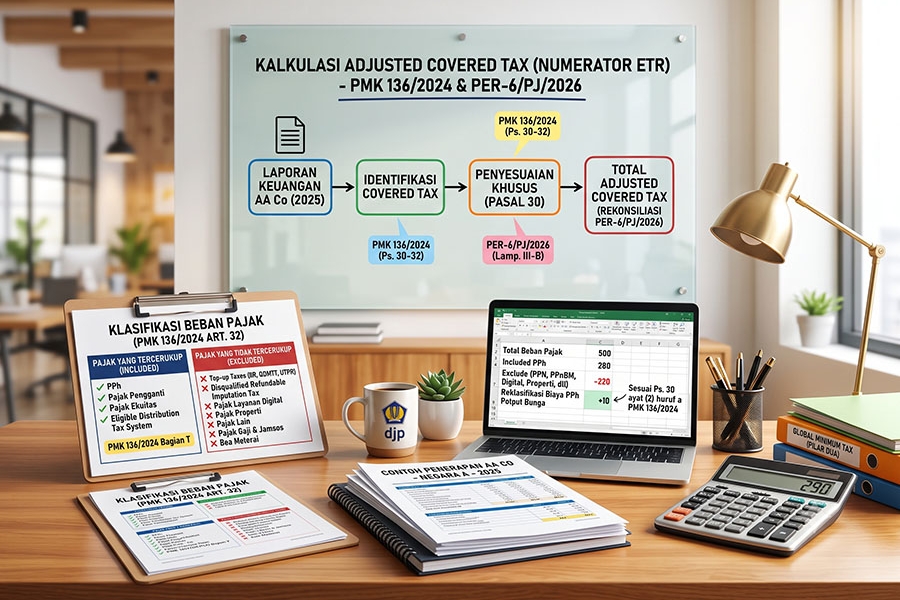
Comprehensive understanding of the Adjusted Covered Tax is highly crucial because this value serves as the numerator in calculating the Effective Tax Rate (ETR). This fundamental calculation is strictly subject to the highest domestic legal hierarchy, namely Minister of Finance Regulation (PMK) Number 136 of 2024, with its reporting procedures precisely articulated in Director General of Taxes Regulation Number PER-6/PJ/2026.
The initial step and main prerequisite before carrying out tax adjustments is to carefully identify which tax expense components from the Constituent Entity's commercial financial statements meet the juridical definition of a Covered Tax. Below is a side-by-side comparison table regarding the classification of included and excluded tax expenses based on Article 32 of PMK Number 136 of 2024 and its Appendix guidelines:
| Pajak yang Tercakup (Included) | Pajak yang Tidak Tercakup (Excluded) |
|---|---|
| Taxes on Income/Profits: Taxes recorded in the financial accounts of a Constituent Entity with respect to its income or profits. | GloBE Top-up Taxes: Top-up taxes recognized under a Qualified IIR, QDMTT/DMTT, and Qualified UTPR. |
| Taxes under an Eligible Distribution Tax System: Taxes on distributed profits, deemed profit distributions, and non-business expenses imposed under this distribution system. | Disqualified Refundable Imputation Tax: Taxes that can be refunded to the beneficial owner, or credited against tax liabilities other than the liability with respect to that dividend. |
| Taxes in Lieu: Taxes specifically imposed in lieu of a generally applicable Corporate Income Tax. | Policyholder Insurance Taxes: Taxes paid by an insurance company in respect of returns to policyholders. |
| Taxes on Equity: Taxes levied by direct reference to retained earnings and corporate equity. | Consumption, Property & Other Levies: Value Added Tax (VAT), Luxury Goods Sales Tax (PPnBM), property taxes, stamp duties, digital services taxes, and payroll taxes as well as social security contributions. |
Based on the formulation in Article 30 paragraph (1) of PMK 136 of 2024, the Adjusted Covered Tax of a Constituent Entity for a Fiscal Year is the current tax expense actually recognized in the financial accounting net income or loss for the current Fiscal Year, after various specific adjustments have been made. These adjustments take into account the net amount of Covered Tax additions and reductions, deferred tax expense calculation adjustments, as well as any increases or decreases in Covered Taxes recorded in equity or other comprehensive income that are included in the GloBE Income or Loss calculation. At the administrative level in Indonesia, via the PER-6/PJ/2026 form, this accumulated value will be reported in Appendix III Subsection B.
In accordance with Article 30 paragraph (2) of PMK 136 of 2024, the additions that will increase the Covered Tax value of a Constituent Entity for a Fiscal Year are the cumulative sum of:
Referring to Article 30 paragraph (3) of PMK 136 of 2024, the reductions that will eliminate the Covered Tax value of a Constituent Entity for a Fiscal Year are the sum of:
To provide a precise illustration regarding the classification and addition of Covered Taxes, we refer to the principles outlined in the Appendix of PMK 136 of 2024 Section T regarding the sorting of tax types combined with Article 30 paragraph (2) letter a of PMK 136 of 2024.
Assume AA Co is a Constituent Entity (GloBE Taxpayer) located in the jurisdiction of Country A. In the 2025 GloBE Fiscal Year, AA Co's commercial financial statements record a total corporate tax expense of 500. This tax expense figure of 500 does not purely consist of Corporate Income Tax, but is an accumulated mix of various types of tax levies with the following details:
Based on the bookkeeping details above, AA Co must carve-out taxes that do not meet the criteria for Covered Taxes under the GloBE architecture. Consumption-based taxes such as PPN and PPnBM, asset-based levies like Property Tax, as well as transactional levies like Digital Services Tax, Payroll Tax, and Stamp duty have no connection to net income or equity. Therefore, these components absolutely cannot be categorized as Covered Taxes. After separating these excluded items, it can be concluded that the only component that purely passes the Covered Tax definition test is Income Tax (PPh), valued at 280.
However, the determination of the Adjusted Covered Tax does not stop at the figure of 280. Upon analysis of the commercial income statement, it is discovered that AA Co recorded a pre-tax operating expense which actually embedded a Withholding Tax Expense (PPh Potput) on interest income amounting to 10. According to Article 30 paragraph (2) letter a of PMK 136 of 2024, any "Covered Taxes recognized in the financial accounts as an expense in the computation of pre-tax profit" acts as an instrument to increase the value of the Adjusted Covered Taxes.
Thus, the Withholding Tax (PPh Potput) value of 10 must be extracted from the operating expenses and reclassified as an addition to Covered Taxes. Through this legal adjustment, the Adjusted Covered Tax value that will be used by AA Co as the numerator in calculating the GloBE Effective Tax Rate (ETR) is 290 (derived from the initial PPh value of 280 + the PPh Potput reclassification of 10). This value of 290 is what must ultimately be reconciled into Appendix III Subsection B of the Annual Income Tax Return for the implementation of GloBE in Indonesia.
















 tpc.consulting
  tpc.consulting
  info@taxindo.co.id