



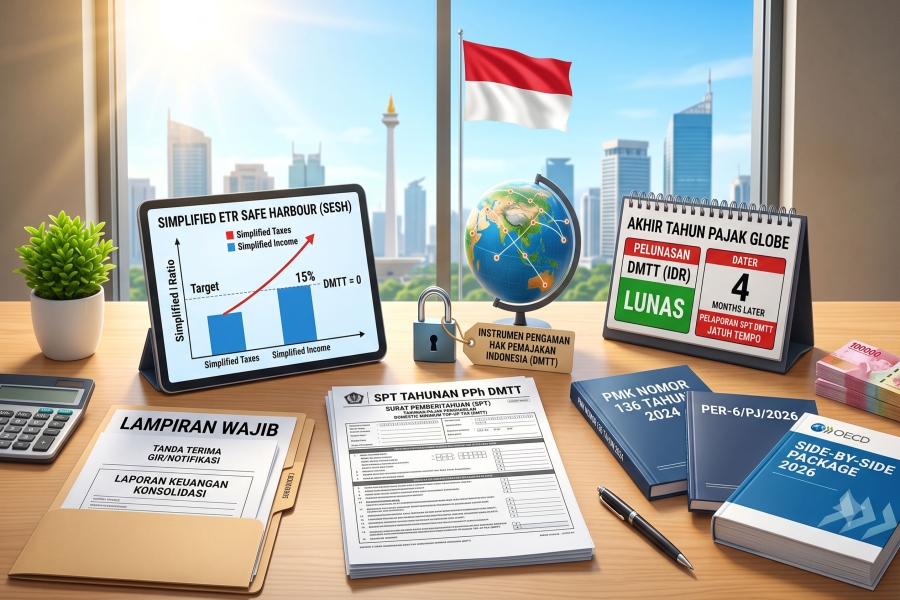
Within the Global Minimum Tax (GloBE) architecture, the Government of Indonesia prioritizes the collection of domestic top-up taxes through the Domestic Minimum Top-up Tax (DMTT) mechanism as mandated by Minister of Finance Regulation (PMK) Number 136 of 2024. To administer this obligation, Director General of Taxes Regulation Number PER-6/PJ/2026 establishes the requirement to submit a specific reporting instrument called the DMTT Annual Income Tax Return (SPT Tahunan PPh DMTT). Unlike the GloBE Annual Income Tax Return which is only required for the Ultimate Parent Entity (UPE), the DMTT Annual Income Tax Return is strictly mandatory to be completed and submitted by every GloBE Taxpayer (Constituent Entity) domiciled in Indonesia.
The DMTT Annual Income Tax Return contains comprehensive data including the de minimis exclusion provisions, the aggregate Effective Tax Rate (ETR) in Indonesia, the specific ETR for the GloBE Taxpayer, the total amount of DMTT in Indonesia, and the allocation of DMTT charged to the respective GloBE Taxpayer. A crucial aspect of compliance for this tax return is the timeline paradox; Taxpayers must settle the DMTT top-up tax payment to the state treasury in Rupiah no later than the end of the GloBE Tax Year, while the actual tax return filing is due 4 (four) months after the end of the GloBE Tax Year. Specifically for the first-year transition period, Taxpayers are granted a 2-month extension for reporting. Furthermore, it is an absolute requirement for Taxpayers to attach the receipt of the GloBE Information Return (GIR) submission or Notification into the system for the DMTT return to be processed.
To reduce the massive compliance burden caused by data reconciliation obligations, Foreign Direct Investment (PMA) companies in Indonesia are highly encouraged to utilize the Simplified ETR Safe Harbour (SESH) simplification scheme based on the OECD Side-by-Side Package 2026 framework. If the utilization of the Simplified Taxes and Simplified Income ratio from the consolidated financial statements data demonstrates the fulfillment of the 15% rate, then the DMTT obligation reported on the tax return automatically becomes zero.
Tax Regulation References:
















 tpc.consulting
  tpc.consulting
  info@taxindo.co.id