



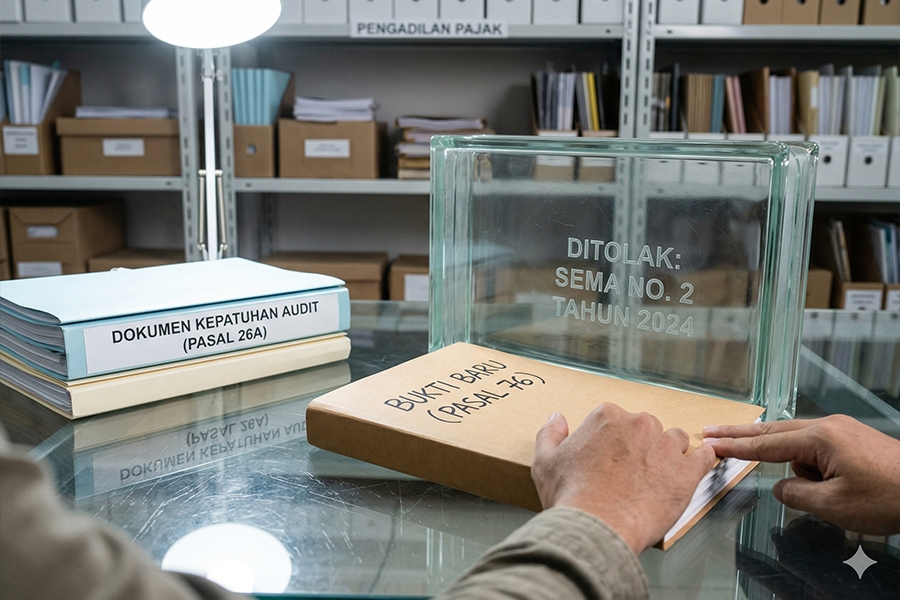
In tax litigation, the strategy of proof relies not only on physical documents but also on the consistency of the parties' statements and the completeness of data. Two legal issues frequently debated between the Taxpayer (Appellant) and the Tax Authority (Appellee) are the validity of withdrawing a confession (Article 74) and the admissibility of new evidence not submitted during the audit (Article 76 vs. Article 26A of the KUP Law). Understanding the interaction between these articles, along with the recent strict exception from the Supreme Court, is key to winning on material truth.
In the eyes of Tax Court procedural law, a confession is a powerful piece of evidence. Article 74 of Law Number 14 of 2002 establishes the fundamental principle that a confession made by parties in court cannot be withdrawn. This principle aims to maintain legal certainty and prevent proceedings from dragging on due to opportunistic changes in stance.
However, the law provides a window for justice. A confession may be withdrawn if it meets strict conditions: it must be based on strong reasons and those reasons must be accepted by the Panel of Judges. This means if a Taxpayer or the Tax Authority made a statement due to a genuine mistake or legal misunderstanding that is later corrected with valid evidence, the Judge may allow the withdrawal for the sake of actual truth.
The second, more frequent issue is the introduction of new evidence in court. The Tax Authority often rejects the Taxpayer's evidence by citing Article 26A paragraph (4) of the KUP Law, which states that documents not provided during an audit cannot be considered during an objection. The Authority argues that accepting new evidence in court violates the principle of equal treatment because the data was not tested during the audit.
However, the Tax Court adheres to the principle of material truth as regulated in Article 76 of the Tax Court Law. The elucidation of this article explicitly allows parties to disclose new matters (facts or evidence) that have not been revealed in previous processes (Audit/Objection). Judges have the authority to determine what must be proven, unrestricted by mere administrative facts.
Therefore, Judges will typically order an Evidentiary Test (Uji Bukti). In this process, the new evidence is examined for validity and relevance. If the evidence proves the actual transaction, the Judge tends to override the formal limitations of Article 26A KUP to achieve substantial justice.
Although Article 76 opens the door for new evidence, Taxpayers must be wary of the limitations reinforced by Supreme Court Circular Letter (SEMA) Number 2 of 2024. This SEMA formulates a critical exception: if the evidence was in the possession of the Taxpayer and was properly requested by the Examiner but was not submitted during the audit or objection, then such evidence cannot be considered by the Panel of Judges in resolving the dispute.
A concrete and strict application of this rule is visible in Tax Court Decision Number PUT-010296.15/2021/PP/M.IIB Tahun 2025. In a dispute regarding a depreciation correction of IDR 10.7 Billion, the Panel of Judges refused to consider evidence and explanations submitted by the Taxpayer in court.
The facts of the hearing showed that during the objection process, the Tax Authority had properly requested data via letters (S-310 and S-514), but the Taxpayer failed to provide it. Although the Taxpayer attended the tax dispute discussion (SPUH), the supporting data was never submitted.
Based on these facts, the Panel of Judges opined that pursuant to SEMA Number 2 of 2024, the evidence deliberately withheld cannot be considered in the dispute resolution at the Tax Court. Consequently, the Judge decided to maintain the Tax Authority's correction on depreciation because the Taxpayer was deemed uncooperative during the administrative process.
Let us observe the application in other general scenarios, such as a Turnover Correction dispute:
The Tax Court is the final bastion for substantive justice. While confessions are binding (Article 74), they are not absolute if strong reasons exist. However, the door for "new evidence" (Article 76) is now strictly guarded by SEMA Number 2 of 2024. As seen in Decision Number PUT-010296.15/2021, non-compliance in providing data during an audit can be fatal, where even valid evidence will be rejected by the Judge due to past procedural defects.

















 tpc.consulting
  tpc.consulting
  info@taxindo.co.id