
SP2DK and Tax Audit
Testing

The Pillar of Tax Justice: An In-Depth Exploration of Competent Evidence and Fiscal Corrections in Tax Audit

Taxindo Prime Consulting | Arya Hibatullah - Lilik F Pracaya, Ak., CA., ME., BKP (C) • 08 Januari 2026
00:00
Optimized with Google Chrome
The Pillar of Tax Justice: An In-Depth Exploration of Competent Evidence and Fiscal Corrections in Tax Audit

In the Indonesian tax system, which adheres to the self-assessment principle, full trust is granted to Taxpayers to calculate, pay, and report their taxes. However, to ensure fairness and compliance, the state possesses a law enforcement instrument known as Tax Audit. An audit is not merely an activity to find faults but a series of activities to collect and process data, information, and evidence carried out objectively and professionally based on audit standards.

The heart of this audit process lies in one fundamental concept: Competent Evidence. Without competent evidence, a tax correction is merely a fragile assumption lacking a strong legal foundation. This article will dissect the anatomy of competent evidence, its relationship with management assertions, and how such evidence leads to valid fiscal corrections under the latest regulatory umbrella, including MoF Regulation (PMK) Number 15 of 2025 and PER-23/PJ/2013.

1. Anatomy of Competent Evidence: Validity and Relevance

Based on PER-23/PJ/2013 concerning Audit Standards, it is emphasized that audit findings must be based on sufficient competent evidence. The term "competent" here has two main dimensions:

  1. Validity: Evidence must meet formal and material requirements. Formally, the evidence is legally valid (e.g., an invoice signed by an authorized official). Materially, the evidence reflects the truth of the actual transaction substance (substance over form).
  2. Relevance: Evidence must be directly related to the items being audited as listed in the Audit Program. A piece of evidence might be valid, but if it is irrelevant to the item being tested, it is useless in proving a correction.

Beyond competence, the aspect of sufficiency is also key. Sufficiency relates to the quantity of evidence adequate to support findings. The measure of "sufficient" is subjective and relies heavily on the professional judgment of the Tax Examiner [PER-23/PJ/2013; Teaching Materials on Audit Methods, Techniques, and Procedures, 2016].

2. Linking Evidence with Management Assertions

In-depth audit practice requires examiners not only to look at physical documents but to test what are known as Management Assertions. Tax auditors seek evidence to test the following assertions in Taxpayer financial statements:

  • Existence or Occurrence: Did the recorded transaction actually happen? Examiners will use inspection or vouching techniques (tracing from records to source documents) to ensure no fictitious transactions exist.
  • Completeness: Have all transactions that should have been recorded been reported? Here, the tracing technique (from source documents to the general ledger) is crucial for detecting income under-reporting.
  • Accuracy: Is the recorded amount mathematically correct? This is tested through recalculation techniques.
  • Cut-off: Are transactions recorded in the correct period? Proof of delivery (delivery orders) and invoices around the balance sheet date are prime competent evidence here.

3. Evidence Acquisition Techniques: From Manual to Digital Forensics

To obtain competent evidence, tax authorities use various techniques as regulated in SE-65/PJ/2013.

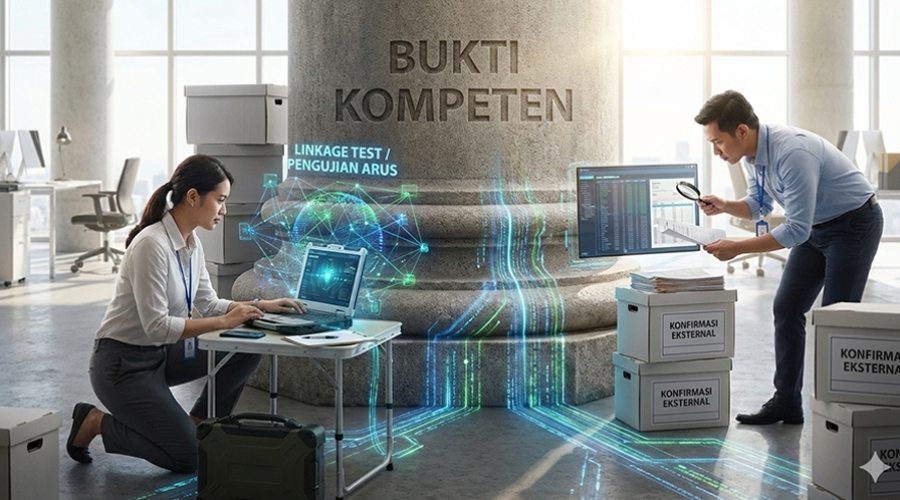
  • External Confirmation: One of the strongest forms of evidence is confirmation from independent third parties. For example, confirming accounts payable/receivable balances or sales transactions with counterparties. In PMK 108 of 2025, access to banking data also becomes a very strong form of authoritative confirmation.
  • Linkage Test: Examiners often use Flow of Goods, Cash Flow, and Accounts Receivable Tests to find evidence of non-compliance. If money inflows in bank statements exceed reported sales, the discrepancy becomes an initial indication requiring further supporting evidence.
  • Digital Forensics: In the modern era, evidence is no longer just paper. SE-36/PJ/2017 regulates Digital Forensic Guidelines. Examiners can perform imaging of electronic data from Taxpayer servers or computers. Electronic data that has been hashed (digitally fingerprinted) becomes authentic evidence that is very difficult to refute in tax disputes.

4. Concrete Data: Evidence with Absolute Probative Value

The latest regulations, PMK Number 15 of 2025 and PER-18/PJ/2025, introduce a classification of evidence called Concrete Data. This is a type of evidence with a very high degree of certainty, allowing it to be directly used to calculate tax due without the need for convoluted testing.

Examples of Concrete Data include:

  1. Output Tax Invoices that have been approved by the DGT system but not reported in the Tax Return.
  2. Withholding Tax Slips issued but not reported.
  3. Transaction data from third parties that has been clarified and admitted by the Taxpayer in an SP2DK (Request for Explanation) but not followed up with a Tax Return correction.

The distinct feature of concrete data is that it triggers a Specific Audit with a super-fast testing period (maximum 10 working days), reaffirming that this type of evidence is considered to have met the requirements of validity and relevance primarily.

5. From Evidence to Tax Correction

A tax correction (audit finding) is the final result of a legal syllogism:

Fact (Evidence) + Legal Basis = Correction

If examiners find a turnover discrepancy, they cannot immediately assess tax. They must show evidence (e.g., double sales invoices or bank statements), pair it with regulations (e.g., Article 4 paragraph 1 of the Income Tax Law regarding the definition of income), and only then calculate the correction.

In SE-28/PJ/2017 concerning Guidelines for Drafting Audit Reports (LHP), it is emphasized that every correction item must contain "Source of Testing," "Testing Performed," and "Conclusion." If the Taxpayer rejects the correction, the process continues to the Closing Conference. This is where the "battle" of evidence occurs. The Taxpayer has the right to refute with counter-evidence. If there is still no agreement, the Taxpayer may request a discussion with the Quality Assurance (QA) Team to review the legal basis and the strength of the correction evidence [PMK 15 of 2025].

Conclusion

Competent evidence is the currency that holds value in the tax audit ecosystem. For tax authorities, the ability to collect valid and relevant evidence is a reflection of the professionalism mandated by law. For Taxpayers, organized documentation and an understanding of management assertions are the best shields against corrections. In the era of information transparency and the Coretax System, the room for arguing without a data basis is narrowing. Therefore, the principle of audit readiness—the availability of competent evidence at all times—is no longer a choice, but a business necessity.



Reference:

  1. Law Number 6 of 1983 as amended by Law Number 6 of 2023 (UU KUP).
  2. Government Regulation Number 50 of 2022 concerning Tax Procedures.
  3. Minister of Finance Regulation Number 15 of 2025 concerning Tax Audit.
  4. Minister of Finance Regulation Number 108 of 2025 concerning Access to Financial Information.
  5. Director General of Taxes Regulations: PER-18/PJ/2025, PER-23/PJ/2013.
  6. DGT Circular Letters: SE-36/PJ/2017, SE-65/PJ/2013, SE-28/PJ/2017.
Lilik F Pracaya, Ak., CA., ME., BKP (C) - Transfer Pricing Specialist UK-ADIT
Telah dikurasi oleh
Lilik F Pracaya, Ak., CA., ME., BKP (C) - Transfer Pricing Specialist UK-ADIT
Managing Director/ Managing Partner
Taxindo Prime Consulting (TPC) is a firm specializing in tax, accounting, business, and business law consulting.
Taxindo Prime Consulting (TPC) is established as a trusted strategic partner, providing comprehensive solutions in tax consulting, accounting, business development, and business law. Driven by a commitment to integrity and professionalism, TPC is dedicated to delivering more than just standard consultation; we provide education, tactical advice, and concrete solutions. Our services are meticulously designed to analyze and resolve clients' tax and business challenges with objectivity, in-depth insight, and full independence, ensuring both regulatory compliance and long-term business sustainability.
OFFICE
Mega Plaza Building 12th Floor
Jl. H.R. Rasuna Said Kav C-3 Jakarta 12940

Phone :
+62 21 521 2686
+62 817 001 3303

Email :
info@taxindo.co.id
Copyright © 2025 Taxindo Prime Consulting

All content on this website is provided solely for general informational and educational purposes. This information is not intended as a substitute for professional tax advice or consultation specific to your situation. We strongly encourage you to contact our team of consultants directly to receive appropriate guidance and advice.

Taxindo Prime Consulting
Tax and Transfer Pricing Calculator
Tax Calendar
×
Newsletter


