
SP2DK and Tax Audit
Testing

Refusing a Tax Audit: Risky Moves with Fatal Consequences in the Modern Tax Enforcement Era

Taxindo Prime Consulting | Arya Hibatullah - Lilik F Pracaya, Ak., CA., ME., BKP (C) • 06 Januari 2026
00:00
Optimized with Google Chrome
Refusing a Tax Audit: Risky Moves with Fatal Consequences in the Modern Tax Enforcement Era

In the Indonesian tax system, which adheres to the self-assessment principle, voluntary compliance is the main pillar. However, the state possesses the sovereign right to test this compliance through the Tax Audit mechanism. Often, Taxpayers feel anxious, disturbed, or even choose to avoid when tax officers arrive. The questions that frequently arise in the minds of Taxpayers are: "Can I refuse to be audited?" and "If I refuse, what will happen?"

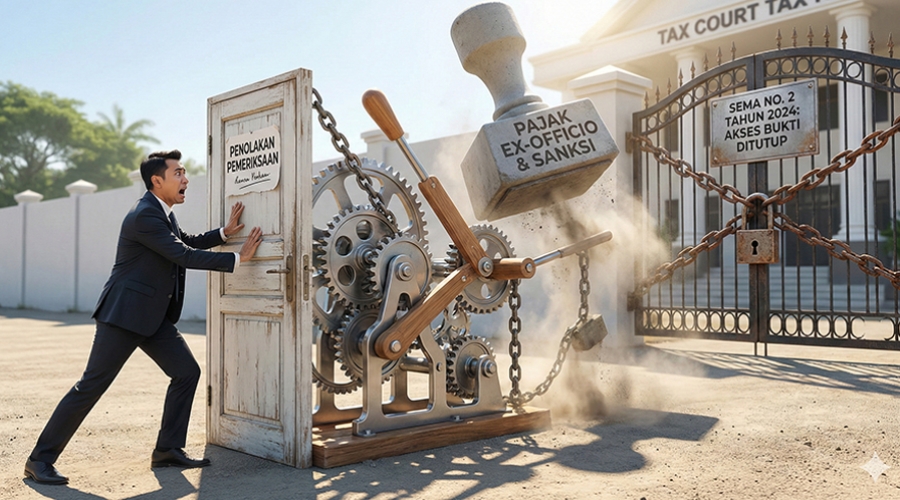
The answer is firm: An audit is a statutory mandate. Refusing an audit is not a smart avoidance strategy; on the contrary, it triggers a series of burdensome legal consequences, ranging from unilateral tax assessment to criminal risks.

Entering 2025, with the enactment of Minister of Finance Regulation Number 15 of 2025 (PMK 15/2025) aligned with the Coretax System, and the affirmation of jurisprudence through Circular Letter of the Supreme Court (SEMA) Number 2 of 2024, the room for maneuver for uncooperative Taxpayers is narrowing. This article will thoroughly dissect the anatomy of audit refusal and the fatal impacts that accompany it.

1. Definition of Refusal through the Regulatory Lens

Before discussing consequences, we need to understand what is categorized as "refusing to be audited." Under PMK 15 of 2025 and standard operating procedures (SOP) for audits, refusal is not just a verbal statement of "I don't want to." Refusal can manifest in several actions:

  1. Refusal to Accept Notification Letter: The Taxpayer or representative/proxy refuses to accept the Notification of Tax Examination delivered directly [Slide PMK 15/2025, Page 24].
  2. Refusal to Provide Assistance: The Taxpayer does not provide the examiner with the opportunity to access electronic data, open rooms, or does not lend books/records [PMK 15 Year 2025, Article 14 paragraph 1; Slide PMK 15/2025, Page 24].
  3. Absence: The Taxpayer does not fulfill the audit summons or is not present at the location during the field audit [Slide PMK 15/2025, Page 24].
  4. Refusal to Sign Minutes: Refusing to sign the Minutes of Final Discussion or Minutes of Information Gathering [PMK 15 Year 2025, Article 17 paragraph 6].

If these conditions occur, the Tax Examiner will not go home empty-handed. They will compile legal documents in the form of Minutes of Refusal of Examination (Berita Acara Penolakan Pemeriksaan) or Minutes of Refusal to Assist in the Smoothness of Examination. These documents serve as the legal basis for the DGT to impose sanctions.

2. Administrative Consequences: Ex-Officio Assessment

The most direct and financially painful consequence of audit refusal is the ex-officio tax determination. Based on Article 12 paragraph (14) of PMK 15 of 2025 and Article 14 of Government Regulation (PP) Number 50 of 2022, if the Taxpayer refuses to be audited or does not provide books/records/documents so that taxable income cannot be calculated:

  • The Tax Examiner has the authority to calculate taxable income by office (ex-officio).
  • This calculation is based on other data held by the DGT, industry benchmarking data, or calculation norms.

Implication: Ex-officio determination tends to result in a much higher tax payable than the actual condition. Why? Because the Examiner cannot recognize expenses (tax credits or deductible expenses) that are not supported by evidence. Without submitted documents, the argument for "expenses" is considered non-existent. Taxpayers lose the opportunity to prove the correctness of their own reporting.

Furthermore, this assessment will be increased by administrative sanctions in the form of interest or surcharges according to the KUP Law provisions, further burdening the company's cash flow.

3. Procedural Law Consequences: "Closed Doors" in Court

One of the most significant legal developments in 2024-2025 is the issuance of SEMA Number 2 of 2024. This regulation serves as a "guillotine" for Taxpayers trying to play the "hide data" tactic during audits.

"Evidence in the possession of the taxpayer and has been requested in detail... but remains unsubmitted during the tax audit and/or objection, cannot be considered in dispute resolution in the Tax Court and/or Supreme Court." [SEMA 2 Year 2024, Administrative Chamber Formulation Number 3].

Implication: If a Taxpayer refuses to be audited or refuses to provide documents during the audit (hoping to open those documents later during an appeal in Court to win the dispute), that strategy is now no longer valid. Judges are prohibited from considering such evidence. This means refusal at the audit stage is equivalent to "suicide" in the tax litigation process.

4. Security Measure Consequences: Sealing

If the refusal takes the form of obstructing access (e.g., refusing to open a warehouse, safe, or server), the Tax Examiner has "hard" authority in the form of Sealing (Penyegelan). According to Article 14 of PMK 15 of 2025, Examiners can seal places, rooms, or movable/immovable goods.

  • Operational Disruption: Sealing will paralyze Taxpayer access to the sealed documents or goods, which can disrupt daily business operations.
  • Criminal Offense of Breaking Seals: Opening or damaging DGT seals without permission is a pure criminal offense that can drag the Taxpayer into the general criminal law realm.

5. Criminal Consequences: Escalation to Preliminary Evidence

Refusal of an audit is often interpreted by tax authorities as an indication of concealment of fraud or tax crimes. Based on Article 23 of PMK 15 of 2025, if a Taxpayer refuses to be audited, the Tax Examiner may propose a Preliminary Evidence Investigation (Bukper).

  • The routine audit will be suspended.
  • The status of the examination changes to a tax criminal investigation.
  • The goal is no longer to issue a tax assessment letter (SKP), but to find evidence to prosecute the Taxpayer with imprisonment sanctions and criminal fines.

6. Conclusion and Recommendations

Refusing a tax audit is a counter-productive action. Instead of being free from tax, Taxpayers face the risk of skyrocketing ex-officio tax assessments, sealing of business premises, loss of defense rights in court, and criminal threats.

TPC advice is very clear:

  1. Be Cooperative: Accept the Notification of Tax Examination and attend the meeting (Entry Meeting).
  2. Audit Readiness: Prepare data and documents in a neat format (including electronic data). Remember, the document borrowing deadline is now very strict (maximum 1 month) [PMK 15 Year 2025, Article 12].
  3. Utilize Rights: Use the right to attend the Preliminary Findings Discussion and Final Discussion to provide clarification, instead of refusing.

In the era of transparency and the Coretax System, compliance is the only safe path.


Reference:

  1. SDSN UU KUP 2023 (Law on General Provisions and Tax Procedures).
  2. PP Number 50 of 2022 concerning Procedures for the Exercise of Rights and Fulfillment of Tax Obligations.
  3. PMK Number 15 of 2025 concerning Tax Examination.
  4. SEMA Number 2 of 2024 concerning Enactment of the Formulation of the Results of the Supreme Court Chamber Plenary Meeting of 2024.
  5. Slides of PMK-15 of 2025 Tax Examination (Complete).
  6. Transcript of Video "RTD - Thorough Discussion of Tax Audit in the Coretax Era Based on PMK No. 15 of 2025".
Lilik F Pracaya, Ak., CA., ME., BKP (C) - Transfer Pricing Specialist UK-ADIT
Telah dikurasi oleh
Lilik F Pracaya, Ak., CA., ME., BKP (C) - Transfer Pricing Specialist UK-ADIT
Managing Director/ Managing Partner
Taxindo Prime Consulting (TPC) is a firm specializing in tax, accounting, business, and business law consulting.
Taxindo Prime Consulting (TPC) is established as a trusted strategic partner, providing comprehensive solutions in tax consulting, accounting, business development, and business law. Driven by a commitment to integrity and professionalism, TPC is dedicated to delivering more than just standard consultation; we provide education, tactical advice, and concrete solutions. Our services are meticulously designed to analyze and resolve clients' tax and business challenges with objectivity, in-depth insight, and full independence, ensuring both regulatory compliance and long-term business sustainability.
OFFICE
Mega Plaza Building 12th Floor
Jl. H.R. Rasuna Said Kav C-3 Jakarta 12940

Phone :
+62 21 521 2686
+62 817 001 3303

Email :
info@taxindo.co.id
Copyright © 2025 Taxindo Prime Consulting

All content on this website is provided solely for general informational and educational purposes. This information is not intended as a substitute for professional tax advice or consultation specific to your situation. We strongly encourage you to contact our team of consultants directly to receive appropriate guidance and advice.

Taxindo Prime Consulting
Tax and Transfer Pricing Calculator
Tax Calendar
×
Newsletter