

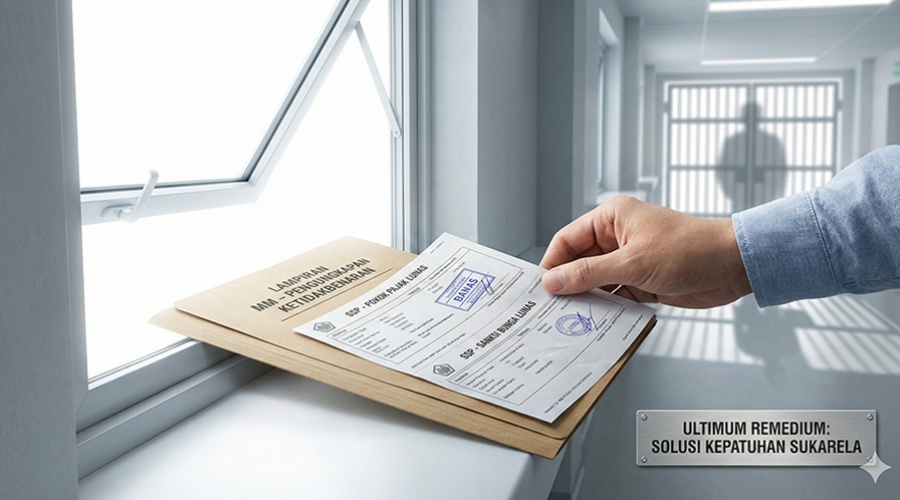
In the Indonesian tax system, which adheres to self-assessment, Taxpayers are granted full trust to calculate, pay, and report their own taxes. However, when tax authorities identify indications of non-compliance and initiate law enforcement actions in the form of a Tax Audit (Pemeriksaan), the window for Taxpayers to perform a normal "Tax Return Rectification" (Pembetulan SPT) (based on Article 8 paragraph 1 of the KUP Law) becomes closed.
Although the door to rectification is shut, the law still provides an "emergency window" for Taxpayers who realize their mistakes while an audit is ongoing but wish to avoid criminal sanctions or heavier administrative penalties. This mechanism is known as the Disclosure of Untruths in Filling the Tax Return (Pengungkapan Ketidakbenaran Pengisian SPT).
Entering 2025, with the enactment of Minister of Finance Regulation Number 15 of 2025 (PMK 15/2025), the technical procedures regarding this privilege are regulated in greater detail to provide legal certainty in line with the implementation of the Coretax System. This article will thoroughly dissect these provisions, from the legal basis and technical requirements to their strategic implications.
The primary legal basis for this mechanism is Article 8 paragraph (4) of the Law on General Provisions and Tax Procedures (UU KUP). The philosophy is to provide a final opportunity for Taxpayers to demonstrate good faith (cooperative behavior) by voluntarily admitting errors even though the audit process is underway [SDSN UU KUP 2023, Elucidation of Article 8 paragraph 4].
Hierarchically, this rule is reinforced by:
Confusion often arises between "Tax Return Rectification" and "Disclosure of Untruths." The difference lies in the timing and legal status:
Based on Article 22 of PMK 15 of 2025, there is a strict corridor that Taxpayers must adhere to in order to utilize this facility:
Taxpayers may disclose untruths in the filling of the Tax Return as long as the Tax Examiner has not yet delivered the Notification of Audit Results (SPHP) to the Taxpayer [PMK 15 Year 2025, Article 22 paragraph 1; PP 50 Year 2022, Article 8 paragraph 1]. Practitioner Note: Once the SPHP is issued, this right is forfeited. Therefore, timing is everything. Taxpayers must proactively assess the risk of findings before the examiner finalizes their working papers.
Disclosure is not made using the standard Tax Return Rectification form, but rather using a Separate Report (Laporan Tersendiri) in writing. This report must be signed by the Taxpayer, Representative, or Proxy of the Taxpayer being audited [PMK 15 Year 2025, Article 22 paragraph 3]. The format of this report has been standardized in Attachment MM of PMK 15 of 2025.
For the disclosure to be considered valid, the separate report must be accompanied by:
If a Taxpayer chooses this path, the sanction imposed is interest according to the reference interest rate plus an uplift factor (according to the Job Creation Law/HPP Law mechanism) calculated from the amount of tax underpaid. This sanction must be self-paid by the Taxpayer along with the settlement of the principal tax before the disclosure report is submitted [PP 50 Year 2022, Article 8 paragraph 2 letter c].
Despite incurring interest sanctions, this path is often more beneficial than waiting for the issuance of a Tax Assessment Letter (SKP) by the examiner, which may contain larger fines or the risk of prolonged disputes.
It is important to note that PMK 15 of 2025 provides a clear exception. The mechanism for disclosing untruths in the filling of the Tax Return cannot be carried out for the Tax Object Notification (SPOP) in the context of Land and Building Tax (PBB) [PMK 15 Year 2025, Article 22 paragraph 2].
What happens after the Taxpayer submits a disclosure of untruths? Does the audit stop? No. The audit continues. However, the material of the disclosure will be a primary consideration for the Tax Examiner:
In the modern tax landscape, transparency is key. Disclosure of untruths becomes highly strategic when linked to Supreme Court Circular Letter (SEMA) Number 2 of 2024.
The SEMA asserts that evidence requested by the examiner but not provided during the audit cannot be considered in disputes at the Tax Court [SEMA 2 Year 2024, Administrative Chamber Formulation Number 3].
This means if a Taxpayer realizes there is "missing" data or unreported errors, it is better to immediately perform a Disclosure of Untruths (Article 8 paragraph 4) and submit the evidence to the examiner before the SPHP is issued. If the Taxpayer remains silent and hopes to "fight" in Court with this new data, SEMA 2/2024 will close that opportunity. Disclosure of untruths is the legal way to introduce correct data into the audit process and avoid ex-officio determination.
The Provision for Disclosure of Untruths in Tax Returns in PMK 15 of 2025 is an ultimum remedium (last resort) facility for Taxpayers under audit to correct their compliance.
For Taxpayers, understanding this right is crucial. Do not wait until the SPHP is issued if you know there are errors. Disclose, pay, and resolve immediately.


 tpc.consulting
  tpc.consulting
  info@taxindo.co.id