SP2DK and Tax Audit
Testing

Evidence Management and Compliance: Procedures for Borrowing Documents and Sealing in Tax Audit (PMK 15/2025 Era)

Taxindo Prime Consulting | Arya Hibatullah - Lilik F Pracaya, Ak., CA., ME., BKP (C) • 06 Januari 2026
00:00
Optimized with Google Chrome
Evidence Management and Compliance: Procedures for Borrowing Documents and Sealing in Tax Audit (PMK 15/2025 Era)

In the Indonesian tax ecosystem, which adheres to the self-assessment system, evidence is the fundamental element. When a Taxpayer is audited, the burden of proof shifts to the administrative realm where the Taxpayer is "obliged" to show and lend documents to the Tax Examiner. Failure in this process not only risks administrative sanctions but can lead to ex-officio tax determination and the loss of evidentiary rights in court.

Entering 2025, with the enactment of Minister of Finance Regulation Number 15 of 2025 (PMK 15/2025), the procedures for borrowing documents and security measures in the form of sealing have undergone significant affirmation, especially regarding integration with electronic data and the legal consequences of failing to fulfill data requests. This article will thoroughly explore these procedures, from requests, warnings, sealing, to legal implications.

1. Authority and Obligation to Borrow Documents

The primary legal basis for borrowing documents stems from Article 29 of the KUP Law, which obliges Taxpayers to show and/or lend books, records, and documents that form the basis of bookkeeping.

In Article 12 of PMK 15 of 2025, this procedure is detailed as follows: Tax Examiners have the authority to borrow or request books, records, and documents (including Electronic Data) related to income, business activities, independent work, or tax-payable objects. This process begins with the delivery of a Request Letter for Borrowing Books, Records, and Documents (Surat Permintaan Peminjaman).

A. Time Limit for Fulfillment (The "One Month" Rule)

The most crucial point in this procedure is the time limit. Taxpayers are obliged to fulfill the borrowing request no later than 1 (one) month from the date the request letter is delivered [PMK 15 Year 2025, Article 12 paragraph 2].

B. Warning Letter Mechanism

If the documents are not submitted within that period, the Tax Examiner will not immediately close the audit but will follow a tiered warning procedure according to Article 12 paragraph 5 of PMK 15/2025 and the technical guide Brief Module on Audit Stages:

  1. Warning Letter I: Delivered after 2 (two) weeks from the date of delivery of the first request letter if the documents have not been fulfilled.
  2. Warning Letter II: Delivered after 3 (three) weeks from the date of delivery of the first request letter if the documents are still not fulfilled.

Every submission of documents must be accompanied by a Proof of Borrowing (Bukti Peminjaman) signed by both parties. This document is vital as evidence in the future that the Taxpayer has been cooperative [PMK 15 Year 2025, Article 12 paragraph 7; Tax Audit Blue Book].

2. Electronic Data Handling and Digital Forensics

In the Coretax System era, the audit focus shifts to digital data. PMK 15/2025 Article 12 explicitly mentions the authority to borrow "Electronic Data".

In practice, borrowing electronic data is not just a copy-paste of files. Based on SE-36/PJ/2017, Tax Examiners can perform Digital Forensic techniques which include:

  • Imaging: Creating an identical copy (bit-by-bit) of the Taxpayer's storage media without altering the original data.
  • Hashing: Performing a digital fingerprint (e.g., MD5 or SHA1) to guarantee data integrity, ensuring the taken data is exactly the same as the original and has not been manipulated [SE-36/PJ/2017, Attachment VIII].

Taxpayers are also obliged to provide access (password/username) if the data is encrypted or protected by a security system [PMK 15 Year 2025, Article 12 paragraph 9].

3. Sealing Procedure: Extreme Security Measures

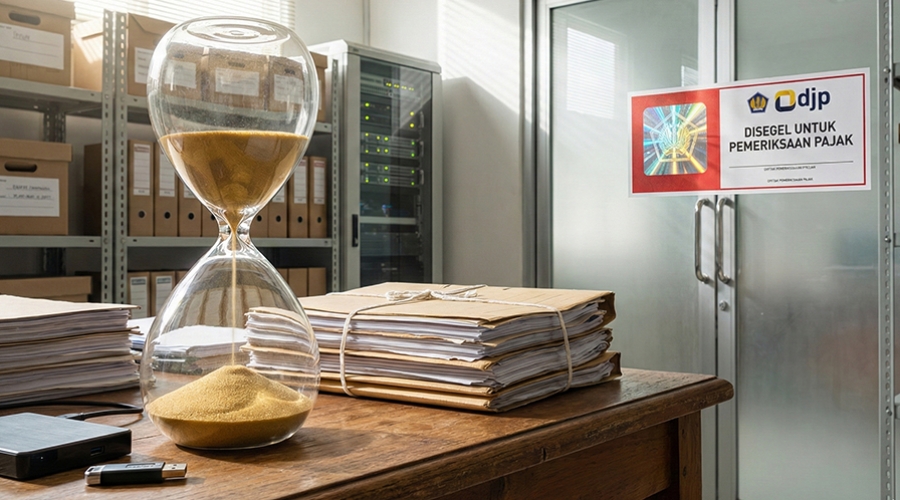
If the Taxpayer is uncooperative, the Tax Examiner has the authority to perform Sealing (Penyegelan). Sealing is not a confiscation action, but an action to "secure" evidence so it is not lost or altered.

A. Grounds for Sealing (Article 14 PMK 15/2025)

Sealing is performed if:

  1. The Taxpayer (or representative/proxy) does not provide the Examiner the opportunity to enter places/rooms suspected of storing documents.
  2. The Taxpayer refuses to provide assistance for the smoothness of the audit (e.g., refusing to open a safe or server).
  3. The Taxpayer is not present at the location during the audit.

B. Sealing Procedures

  1. Witnesses: Sealing must be witnessed by at least 2 (two) adults other than the audit team members (can be Taxpayer's employees or local community members).
  2. Minutes: The Examiner must create Minutes of Sealing (Berita Acara Penyegelan) (Attachment Q of PMK 15/2025) which contains the reasons and list of places/goods sealed.
  3. Seal Label: Affixing the official DGT Seal Paper on the place/goods [PMK 15 Year 2025, Article 14 paragraph 4; SE-10/PJ/2017].

Taxpayers are strictly prohibited from damaging the seal. Damaging a seal is a criminal offense. The seal will be opened again by the examiner witnessed by witnesses and recorded in the Minutes of Seal Opening [PMK 15 Year 2025, Article 14 paragraph 7].

4. Access to Financial Information (Bank Secrecy)

If the Taxpayer refuses to provide financial data, the DGT has a "back door" through the mechanism of opening bank secrecy. Based on PMK 108 of 2025 and the AKASIA system, Examiners can submit a request to open bank secrecy to the Financial Services Authority (OJK) or Financial Services Institutions directly.

This procedure is carried out if the Taxpayer does not provide a power of attorney to the examiner to request data from the bank [SE-10/PJ/2017]. Data obtained from the bank constitutes very strong Competent Evidence from an independent third party.

5. Legal Consequences: The "Guillotine" for Taxpayers

This is the most crucial part. What happens if the 1-month deadline expires and the Taxpayer has not submitted the documents?

  1. Minutes of Non-Fulfillment: The Examiner will create Minutes stating that the documents were not fulfilled [PMK 15 Year 2025, Article 12 paragraph 3].
  2. Deemed Not Provided: Documents submitted after the 1-month time limit are deemed not provided [PMK 15 Year 2025, Article 12 paragraph 4].
  3. Ex-Officio Determination: Since there are no documents to test, the Examiner is authorized to calculate the tax due ex-officio using norms or other comparative data, which usually results in a much higher tax [PMK 15 Year 2025, Article 13].
  4. Loss of Rights in Court (SEMA 2/2024): The Supreme Court through Circular Letter of the Supreme Court (SEMA) Number 2 of 2024 asserts that evidence in the possession of the Taxpayer that has been properly requested by the DGT but not submitted during the audit, cannot be considered in dispute resolution in the Tax Court and/or Supreme Court [SEMA 2 Year 2024, Administrative Chamber Formulation Number 3].

Conclusion

The document borrowing procedure in PMK 15 of 2025 demands high discipline from Taxpayers. The 1-month deadline is a fixed price; if violated, the consequences are fatal—ranging from ex-officio tax determination to the closing of the door for evidence in court.

Advice for Taxpayers: Conduct audit readiness regularly. Ensure physical archives and electronic data are neatly stored and ready to be presented at any time. Being cooperative from the start is key to avoiding sealing and mitigating prolonged tax disputes.


Reference:

  1. SDSN UU KUP 2023 (Law on General Provisions and Tax Procedures).
  2. PP Number 50 of 2022 concerning Procedures for the Exercise of Rights and Fulfillment of Tax Obligations.
  3. PMK Number 15 of 2025 concerning Tax Examination.
  4. PMK Number 108 of 2025 concerning Technical Guidelines on Access to Financial Information for Tax Purposes.
  5. PER-18/PJ/2025 concerning Follow-up on Concrete Data.
  6. SEMA Number 2 of 2024 concerning Enactment of the Formulation of the Results of the Supreme Court Chamber Plenary Meeting of 2024.
  7. SE-15/PJ/2018 concerning Audit Policy.
  8. SE-10/PJ/2017 concerning Technical Guidelines for Field Audit.
  9. SE-36/PJ/2017 concerning Digital Forensic Guidelines for Tax Purposes.
  10. Tax Audit Blue Book (Techniques, Methods, and Audit Programs).
  11. Brief Module on Tax Audit Stages (KPP PMA Tiga).
  12. Video Transcript "RTD - Thorough Discussion of Tax Audit in the Coretax Era Based on PMK No. 15 of 2025".
Lilik F Pracaya, Ak., CA., ME., BKP (C) - Transfer Pricing Specialist UK-ADIT
Telah dikurasi oleh
Lilik F Pracaya, Ak., CA., ME., BKP (C) - Transfer Pricing Specialist UK-ADIT
Managing Director/ Managing Partner
Taxindo Prime Consulting (TPC) is a firm specializing in tax, accounting, business, and business law consulting.
Taxindo Prime Consulting (TPC) is established as a trusted strategic partner, providing comprehensive solutions in tax consulting, accounting, business development, and business law. Driven by a commitment to integrity and professionalism, TPC is dedicated to delivering more than just standard consultation; we provide education, tactical advice, and concrete solutions. Our services are meticulously designed to analyze and resolve clients' tax and business challenges with objectivity, in-depth insight, and full independence, ensuring both regulatory compliance and long-term business sustainability.
OFFICE
Mega Plaza Building 12th Floor
Jl. H.R. Rasuna Said Kav C-3 Jakarta 12940

Phone :
+62 21 521 2686
+62 817 001 3303

Email :
info@taxindo.co.id
Copyright © 2025 Taxindo Prime Consulting

All content on this website is provided solely for general informational and educational purposes. This information is not intended as a substitute for professional tax advice or consultation specific to your situation. We strongly encourage you to contact our team of consultants directly to receive appropriate guidance and advice.

Taxindo Prime Consulting
Tax and Transfer Pricing Calculator
Tax Calendar
×
Newsletter