


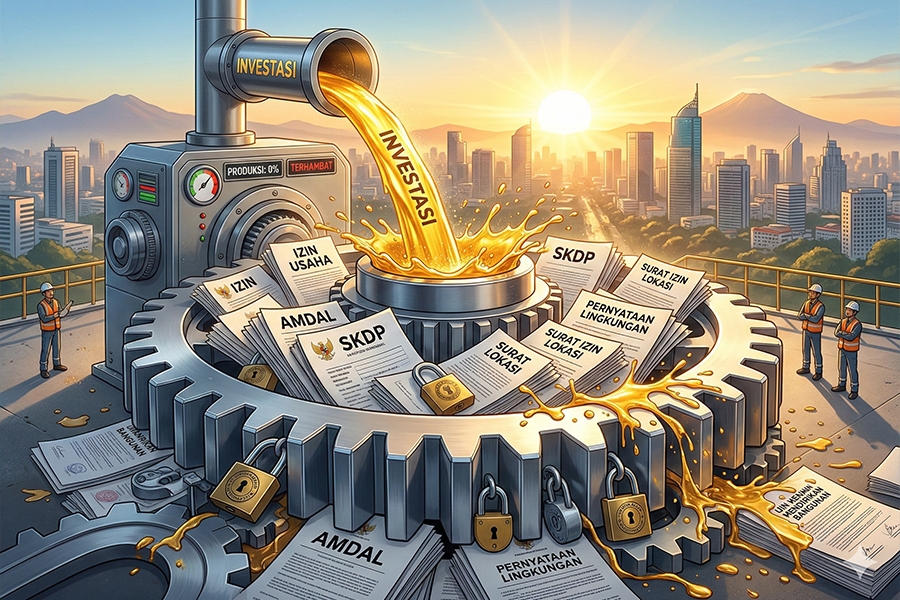
Indonesia's economy is currently facing interrelated structural challenges, which ultimately hold back economic growth at around 5%. Based on recent dynamics, there are three main pillars of issues that form the chain of national economic problems: the slow realization of investments due to licensing hurdles, the declining performance of the manufacturing sector, and the unequal burden on the tax revenue structure.
The initial step to encourage economic expansion relies heavily on capital flows. Although the investment growth rate, represented by the Gross Fixed Capital Formation (PMTB), successfully climbed gradually from 3.80% in 2021 to 5.09% in 2025, PMTB's role in the Gross Domestic Product (GDP) actually shrank to 28.77%, down from 30.79% in 2021. This contribution shrinkage is rooted in the classic issue of convoluted licensing. There is an accumulation of unrealized investments worth nearly Rp1,500 trillion. Many companies have actually obtained a Business Identification Number (NIB) and are registered in the Indonesian Standard Industrial Classification (KBLI), but their execution in the field is stalled due to out-of-sync regulations between ministries and agencies.
Regarding this matter, the Deputy Minister of Investment and Downstreaming/Deputy Head of the Investment Coordinating Board (BKPM), Todotua Pasaribu, highlighted that one of the main differentiators between Indonesia and competitors like Vietnam lies in the investment cycle. Todotua revealed that the investment cycle in Indonesia still takes a very long time, around 4 to 5 years, which is partly contributed by slow licensing services. This lengthy timeframe from commitment to execution causes Indonesia's competitiveness to lag behind Vietnam, whose economic growth rate was able to break through 8.05% because its investment cycle is practically limited only to the physical construction period.
The sluggish realization of investments directly spreads to the hampered expansion of the processing industry (manufacturing) sector, which historically has been the backbone of the economy. The tax revenue performance from the manufacturing sector in 2025 recorded a 0.9% year-on-year decline to Rp471.17 trillion. This decline indicates industrial stagnation due to structural problems that erode industrial profits and value-added, rather than just an issue of tax compliance. The manufacturing sector faces pressure from high logistics costs, expensive imported raw materials, weakening demand, and an onslaught of cheap imported goods that erode domestic value-added. On the other hand, industrial policy directions and the provision of fiscal subsidies through tax expenditures, projected to skyrocket to Rp530.3 trillion in 2025, are considered more dominant in attracting capital to capital-intensive downstream sectors with narrow tax bases, instead of strengthening labor-intensive manufacturing. This series of problems leaves the manufacturing sector's contribution to GDP trapped in stagnation at the 18% to 19% level.
The stagnation experienced by the manufacturing sector culminates in the creation of inequality in the state's tax structure. The manufacturing sector bears a very heavy tax burden, with its contribution share reaching 24.6% of total tax revenue in 2025, a figure that far exceeds its contribution share to the GDP. This disparity is very striking when compared to the agricultural sector. In 2025, the agricultural sector recorded its highest growth in the last ten years, reaching 5.33%, with an average GDP contribution of 12.78% over the past five years. However, its tax payment is minimal, contributing only around 1.38% to tax revenue, or equivalent to a projected Rp26.57 trillion. Besides agriculture, the construction and property sectors also provide lower tax contributions compared to their contributions to the GDP due to the implementation of final income tax. This unequal tax burden further pressures labor-intensive sectors, such as the textile industry, which has to struggle against the onslaught of cheap imported products as well as fundamental challenges in human resource development.
Overall, the weakening of investment contributions, the stagnation of the manufacturing industry, and the inequality of tax revenues constitute a single structural problem that cannot be resolved partially. The government is currently striving to conduct open hearings to penetrate sectoral egos between agencies to unlock the thousands of trillions in stranded investments. If these investments can be executed quickly and directed to strengthen the manufacturing industry structure, this step has the potential to create adequate economic value-added while rebalancing the national tax revenue structure in the future.













 tpc.consulting
  tpc.consulting
  info@taxindo.co.id