


Transfer pricing rules apply primarily to the cross-border business operations of multinational enterprises (“MNEs”). MNEs are firms that conduct integrated business operations in more than one country. This chap-ter describes the factors that gave rise to MNEs in an attempt to provide the reader with the basic business context for the detailed transfer pricing discussion that will follow in the rest of this Manual. This chapter shows how an MNE may be able to exploit integration opportunities in the cross-border production of goods and provision of services through a “value-chain” (or “value-added chain”). As used in this Manual, the term “value chain” refers to the process or activities by which a company adds value to a good or service, including production, marketing, and the provision of after-sales service.
MNEs generally operate across international borders through locally incorporated subsidiaries or permanent establishments. They may also use other legal structures such as joint ventures and partnerships. An MNE’s business operations may be organized and managed in several different ways such as through a functional structure, a divisional structure or a matrix structure. This chapter outlines the legal and operational structures that may be used by MNEs, and considers the differences between them.
This chapter also describes how a “value chain analysis” can be used to measure or test the performance of an MNE. An MNE manages its busi-ness to maximize its profits and minimize its costs. It manages its transfer pricing function to minimize the risk of transfer pricing adjustments and to avoid double taxation. While MNEs often monitor the overall performance of their business operations on a line of business basis without regard to national borders, for tax and company law purposes they are often required to separately report the performance of associated entities in each of the countries in which they operate. An MNE’s transfer pricing policy helps the group to report on a separate country basis and should provide guidance on how the group will comply with transfer pricing documentation requirements, how it will report the results of operations in its tax returns, how it will deal with transfer pric-ing audits conducted by local tax authorities, and the appropriate measures the group will utilize to resolve any disputes with tax authorities that may arise
Firms are organizations that arrange the production of goods and the provision of services. The aim of a firm is to produce goods and provide services to maximize profits. In the absence of MNEs, production and distri-bution would be carried out through a series of arm’s length transactions between independent parties6. These transactions require contracts between the independent parties to transactions, but a significant part of each individ-ual firm’s resources are used in the process of making contracts. Individual firms become MNEs as these firms grow, expand and diversify their oper-ations internationally. Rapid advances in technology, transportation and communications have given MNEs the flexibility to place their enterprises and activities almost anywhere in the world.
UNCTAD (1993). World Investment Report: Transnational Corporations and Integrated Production. New York: UN Publishing. Available from https://unctad. org/system/files/official-document/wir1993_en.pdf; Coase, R. (1988). The Firm, the Market and the Law. Chicago: University of Chicago Press. See p. 7.
The expenses of making contracts is referred to as “transaction costs” since expenses are incurred by entities in finding other entities with whom to contract, as well as in negotiating and finalizing the contracts. As contracts cannot cover every possible issue that may arise between contracting parties, there is a risk of disputes arising from unforeseen contingencies. When disputes occur between contracting parties, those parties may incur consid-erable costs in resolving these including negotiation costs, legal expenses, and litigation and mediation expenses. It is economically rational for MNEs to be created to produce goods and services to achieve efficiencies in scale in transaction and associated costs, provided that the MNE’s costs of produc-tion are less than the costs of outsourcing the production.
Within an MNE, contracts between the various parties involved in production of goods and services may be eliminated and replaced with admin-istrative arrangements; in other cases, the group members within the MNE may enter into formal contracts The administrative costs of organizing produc-tion within an MNE are usually lower than the cost of the alternative, which is outsourcing market transactions. The theoretical limit to the expansion of an MNE is the point at which its costs of organizing transactions are equal to the costs of carrying out the transactions through the market. An MNE will internalize the costs of production to the extent that it can achieve economies of scale in production and distribution and establish coordination economies.
MNEs create organizational structures and develop strategies to arrange the cross-border production of goods and services in locations around the world, and to determine the level of intra-entity or intragroup integration. The structure of transactions within an MNE is determined by a combination of market and group forces which can differ from open market conditions between independent parties. A large number of international transactions within MNEs are therefore not governed directly by market forces but driven by the common interest of the MNE.
Successful MNEs use their location and internalization advantages to maximize their share of global markets and growth opportunities. Thus, MNEs may be able to minimize costs through their integration economies; such economies are not available to domestic firms.
A key feature of MNEs is that they have integrated global supply chains. A supply chain is a collection of suppliers required to create one specific product or service for a company. Each supplier is a link in the end-to-end supply chain. If those links/enterprises are under common control, the enterprises may be considered as “associated enterprises”. The term “supply chain” is defined as “the sequence of processes involved in the production and distribution of a commodity.”7 The process of running and improving the efficiency of the supply chain for the benefit of most, if not all, of the links in the supply chain, can be a feature of the value chain of the MNE.
The Oxford English Dictionary. Oxford: Clarendon Press. Available from https://www.lexico.com/definition/supply_chain
Globalization has made it possible for an MNE to achieve high levels of integration and the ability to have control centralized in one or a few locations. Modern information and communications systems also facilitate communi-cations across geographic and functional business lines. This has resulted in many MNEs providing services such as advisory, research and development (R&D), legal, accounting, financial management, and data processing from one or several regional centres to group companies. Also, management teams of an MNE can be based in different locations, so that the group may have manage-ment resources dispersed in several locations. From the economic perspective of the MNE, these resources need to be allocated with maximum efficiency and in an optimal manner, in order to contribute to an optimal value chain.
International business has experienced far-reaching structural change with the rise of service and knowledge-intensive industries and, with the expansion of the internet economy, service and technology enterprises are playing an increasingly important role in the international marketplace.
In the past MNEs mostly operated in physical markets and through presence in multiple jurisdictions. However, the current pace of digitaliza-tion of the economy enables some MNEs to conduct significant business in places where they do not have any physical presence. This makes addressing the taxing rights of the respective countries to avoid double or non-taxation particularly challenging.
The rapid evolution in MNEs is also reflected in the rise of many developing economies where foreign investments have grown significantly. In developing countries, MNEs have diversified well beyond primary produc-tion and extractive industries into manufacturing, assembly, domestic market development and services, utilizing transport and other infrastruc-ture, skilled labour and low production costs.
The activities of MNEs, through international trade and investment, have strengthened and deepened the ties that join countries in an increas-ingly interdependent world. These activities can bring substantial benefits to both home and host countries. These benefits accrue when MNEs supply the products and services that customers want to buy at competitive prices and when they provide fair returns to the suppliers of capital. Their trade and investment activities can contribute to the efficient use of capital, technology and human and natural resources.
MNEs have common control, common goals and common resources, and the members of the group — parent/HQ company, subsidiaries, affili-ates and branches — are located in more than one country. Thus, many MNEs are fully integrated businesses that plan and implement global strate-gies. UNCTAD has noted, however, that integration of production by MNEs creates challenges for policymakers in adapting the methods for allocating the income and costs of MNEs between jurisdictions for tax purposes.8
UNCTAD (2019). Trade and Development Report 2019. New York: UN Publishing. Available from https://unctad.org/system/files/official-document/ tdr2019ch1_en.pdf
In Multinational Enterprises and the Global Economy (2008)9 the authors argue that the history of MNEs was shaped by political, social and cultural events that influenced the ownership, organization and location of international produc-tion of their goods and services. The authors claim that MNE groups tended to integrate their operations until the late 1980s and then more recently moved to outsource some activities in which they do not have competitive advantages.
Dunning, J. H., & Lundan, S. M. (2008). Multinational Enterprises and the Global Economy. Cheltenham: Edward Elgar Publishing. See p. 197.
For most of the twentieth century, the same authors note, MNE groups and international enterprises operating through branches or subsid-iaries tended to expand the range of their value-adding activities, and by the late 1980s MNEs had integrated their production and marketing functions. Up to the 1960s and 1970s, MNEs engaged in limited or no outsourcing of operations and many became large integrated conglomerates. However, the authors argue that from the late 1980s MNEs began outsourcing activities that were previously performed by the companies themselves.10 From the early 1990s, MNEs began restructuring to specialize in the areas where they had competitive advantages, such as unique, firm-specific assets, in particu-lar high value intangible assets, and the capabilities that provided the firms with their market position and competitive edge.
Ibid, p. 196.
MNEs examined their value chains to identify the functions in which they had no advantage over other firms.11 They then began deciding which functions they would perform themselves and which functions could be outsourced to independent firms or centralized shared service centres, a process called “value chain optimization”. For in-house services, an MNE may decide to provide some services through centralized service centres. While the initial functions that were outsourced were non-core activities such as payroll, billing and maintenance services, in some cases outsourc-ing has expanded to cover core activities. The core activities may involve producing goods or providing services. For example, many firms outsource call centre activities or certain administrative functions to (in)dependent firms in countries which have educated workforces and relatively low-cost labour. Consequently, modern MNEs organize their cross-border operations through a network of contractual arrangements with (in)dependent enter-prises and cooperative in-house relationships.
Ibid.
Consequently, domestic transfer pricing rules which apply to SMEs should reflect the capacity of SMEs to comply and the capacity of the tax authorities to administer such rules. Some countries may have special simplified rules for SMEs, such as simplified documentation requirements, and may use flexible approaches in handling transfer pricing issues involving SMEs. This creates the need to define an SME. Although there is no universal definition, an SME may be defined on the basis of criteria including: turno-ver; balance sheet value; number of employees; and transaction values.
The legal systems used by countries include the common law and civil law systems. The common law system originates in the UK and is used in Commonwealth countries such as Australia, Canada, India, Malaysia, New Zealand, and is also used in the majority of states in the United States. Common law originated in the practices of the courts of the English kings after the Norman Conquest, and is derived from custom and judicial prece-dent rather than statutes. This system spread through the British Empire to its then colonies, many of which retain the common law system today. These are legal systems that give great weight to judicial precedent, and to the style of reasoning inherited from the English legal system. A judgment of a supe-rior court is binding on lower courts in future cases.
The civil law system has its origins in Roman law and operates in most European countries, Latin America and Japan. Under a civil law system, law is enacted and codified by parliament. Companies are recognized under both systems as artificial legal persons with perpetual life and generally limited liability.
One of the key decisions any MNE needs to take when expanding its operations is the type of legal structure it will use to operate. There are many alternatives for an MNE to operate either through locally incorporated subsidiary companies (associated enterprises) or else through permanent estab-lishments (branches). Subsidiaries may be either fully owned by the parent company or partly owned. An MNE may also operate by using an agent, which may be an independent agent, a dependent agent or a commissionaire. Other alternatives may be expanding via a partnership or a limited liability partner-ship. Depending on domestic law in the investee jurisdiction, partnerships may be treated for tax purposes as fiscally transparent entities with flow-through treatment; alternatively, they may be treated as taxable entities.
MNEs can also carry on their business through a joint venture. Joint ventures involve independent businesses (which could themselves be incor-porated entities, branches or partnerships) working together on a specific project. Joint venture partners can include a government agency or an entity that is normally a competitor (subject to competition policy/ antitrust rules).
The choice of an MNE’s legal structure may be affected by a number of factors. The tax implications of a particular legal structure may be important. Other equally relevant considerations include issues related to legal liability, risk and control, financing concerns, and administrative and regulatory obligations and costs. In addition, exchange controls, “partnerability” (i.e. how well an entity is set up and managed to operate as a partner with others), “bankability” (i.e. having sufficient profit, assets, and liquidity to get a loan at a bank), requirements for minimum shareholding by local persons or entities, issues related to extraction of profits and capital requirements may all affect the selection of a legal structure.
Legal structures used by MNEs vary and evolve over time. The business structures used by an MNE group may similarly change over time such as, for example, commencing operations in a jurisdiction using a joint venture structure and then buying out the joint venture partner and operat-ing in that jurisdiction through an associated enterprise.
In an MNE, the parent company and subsidiary companies are sepa-rate legal entities and they may enter into intragroup transactions. On the other hand, an international enterprise with a head office in one country and a permanent establishment in another country is considered one legal entity. As such a permanent establishment itself cannot enter into transactions with other parts of the enterprise in a formal, legal sense since transactions typi-cally require at least two legal entities.
Company law determines how corporate entities are governed in many respects. “Corporate authorities”, the powers exercised by various officers of an entity, originate from the respective legal authorities accorded to entities within the MNE. The Board of Directors has the authority to exer-cise all of the corporation’s powers; and it delegates authority to act to certain company officers in certain circumstances. This includes delegating powers locally in accordance with local legal entities’ requirements. The execution of a corporate authority binds the legal entity and consequently delegates must be aware of local legal and tax cross-border requirements as company and/or personal liability may arise as a result of the execution of such an authority.
Corporate and tax laws view corporations as separate entities. That is, parent companies, subsidiaries and affiliates are all legally distinct from each other. The separate existence of the subsidiary may be manifested, for example, in having its own properly constituted management, its own busi-ness purpose and its own assets appropriate to that purpose.
The boards and management of subsidiaries continue to hold fidu-ciary duties to control and manage the assets of, and to govern and manage the operations of, their respective subsidiaries and are not required to imple-ment a shareholder request if implementation conflicts with those fiduciary duties (e.g. if the request contravenes local law).
“Organizational authorities” are the risk-based approval hierarchies that ensure operations are executed in accordance with internal business process and control requirements of the MNE. They are delegated from the Board of Directors down the chain of command. Organizational authorities can be executed across country borders as they do not create or constitute a legal commitment.
Corporate separateness is the concept of maintaining separate legal entities within the MNE, each subsidiary having its own separate legal identity and Board of Directors. While this does not mean that group compa-nies must be treated as if they were wholly detached from the head office or its requests, it does mean that the boards and management of subsidi-aries continue to hold fiduciary duties to control and manage the assets of, and to govern and manage the operations of, their respective subsidiaries. Organizational authorities can be considered as an advice to the separate legal entities and their boards. The corporate authorities in the end are the decision-making powers that legally bind the legal entities.
In order to be able to perform a transfer pricing analysis it is crucial to understand how the management of the MNE is organized and what framework exists for decision-making. Ultimately an analysis of MNE deci-sion making may provide useful context in determining risk assumption and control of important functions. It is important to understand that the management structure of the MNE may or may not be fully aligned with the legal structure. A particular legal entity in the MNE may house employees that function in various operational divisions or various management teams. Similarly, a management team or division may draw on people or use assets housed in several different legal entities.
The management or organization structure is used to outline and direct how people and resources are used to achieve the MNE’s objectives. Finding the optimal arrangement requires adjustments at many levels. Some organizational structures may be more rigid than others. Some may define tasks, competencies and responsibilities, and establish the patterns or rela-tionships between positions more rigidly, while others may be more fluid. There are a number of different types of organizational structures (discussed below) including the traditional ones, functional, divisional and matrix models. However, with the rapid development of the digitalized economy, a new organizational model is on the rise: a decentralized model based on a “network of teams”, the lateral structure.
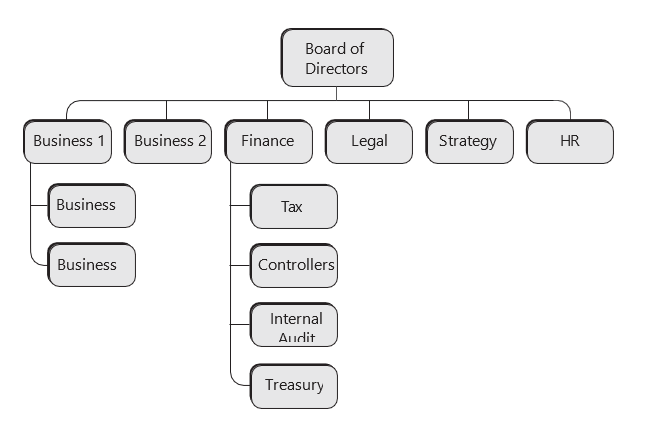
In a functional structure an MNE’s functions are performed by the employees within functional divisions. These functions are usually special-ized tasks, for instance all the accountants, controllers and tax advisors are grouped together in a finance function based on their speciality. In general, a functional organization is best suited to a producer of standardized goods and services at large volume and low cost to exploit economies of scale. Coordination and specialization of tasks are centralized in a functional struc-ture, which makes decision making quicker, because the group members of a function can easily communicate as they have the same background.
Figure 1.D.1
Functional Organization Structure
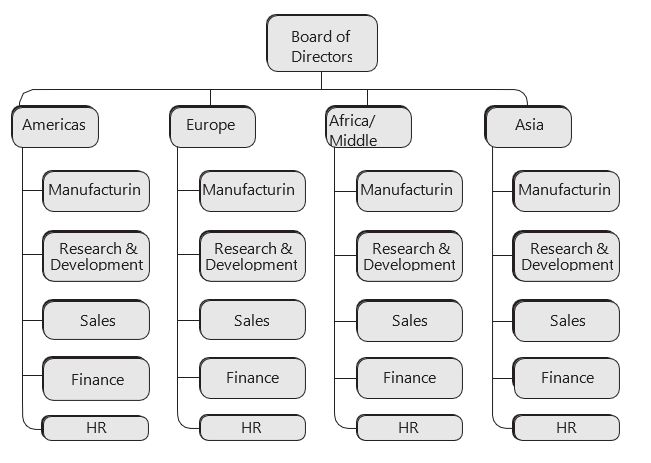
Under a divisional structure, each organizational function is grouped into a division with each division containing all the necessary resources and functions within it, such as human resources and accounts. Divisions can be categorized from different points of view. The distinction could for example be made on a geographical basis (e.g. a China division or a West Africa division) or on a product/service basis (e.g. different products for different customers: households or companies). For example, an automobile company may have a divisional structure with a division for hybrid cars and another division for other cars with each of these divisions having its own sales, engineering and marketing departments.
Figure 1.D.2
Divisional Organization Structure
The matrix structure combines elements of the functional and divisional model, and is therefore more complex. It groups people into functional departments of specialization and then further separates them into divisions. A matrix organization frequently uses teams of employees to accomplish tasks. An example of a function-geographic matrix structure would be a company that produces two types of products (A and B) in several geographic locations. Using the matrix structure, this company would organize functions within the company as follows:
In the lateral structure, which as noted above is becoming more common, MNEs build and empower teams to work on specific business projects and challenges. Groups and departments work together at the same organizational level to achieve common goals. This type of structure depends on having collaborative and informal relations and requires coordination and consultation often through a matrix model. In today’s digital economy there is a growing trend towards technology-enabled team-based lateral organizations where teams can take agile decisions.12
Figure 1.D.3
Matrix Organization Structure
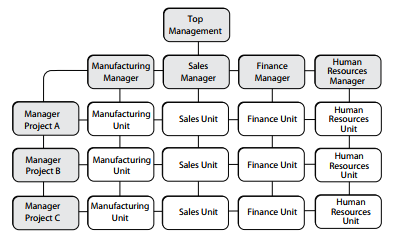
Figure 1.D.4
Lateral Organization Structure
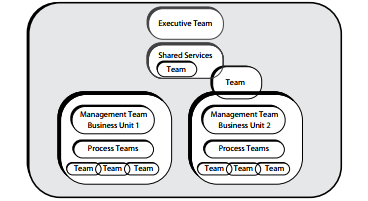
Source: Mohrman, S. A., & Quam, K. (2000). Consulting to Team-based Organizations: An Organizational Design and Learning Approach. Consulting Psychology Journal: Practice and Research, 52(1), 20.
Holbeche, L. (2018). The Agile Organization: How to Build an Engaged, Innovative and Resilient Business. London: Kogan Page Publishers.
The aim of an MNE is to maximize its profits from producing and selling goods and services. A useful starting point to understand how an MNE operates is to perform a business value chain analysis. As noted above, a business value chain is the linked set of activities that the business performs to create value. These activities will be performed by various organizational units and legal entities within the business which together create the value that contributes to the overall profitability. As illustrated, for example, in Porter’s value chain (see Figure 1.D.5 below):
Figure 1.D.5
Value Chain Analysis
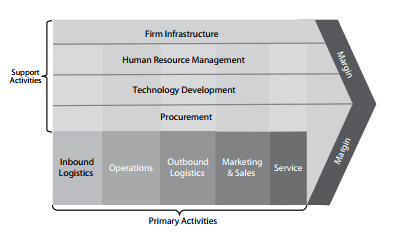
Source: Porter, M. E. (1985). Competitive Advantage: Creating and Sustaining Superior Performance. New York: The Free Press.
Therefore, a value chain analysis should provide qualitative insight into a functional analysis. The value chain analysis is important in assessing intragroup pricing since the value chain identifies the key aspects of an organization that create value, and hence, profits. The value chain analysis involves an investigation into the functions, assets and risks of the MNE as a whole and an evaluation of the contribution each link of the chain makes to the overall value created by the group. Value chain analysis is not an easy task, especially for an MNE with complex function and risk matrices spread across different legal entities.
An MNE’s value chain is fundamentally used to convert its economic resources of lower value into economic resources of higher value, which may involve the following steps:
The following example shows how three different MNEs could adopt different operational structures in relation to the same generic value chain. Some possible reasons or context for these structures being used are discussed further below.
MNE A uses three different companies to perform very specific functions across the value chain as follows:
Company 1 in Country A is an R&D company carrying out research and also undertaking activities relating to the design of products for the entire group. A company of this nature would employ technical personnel such as engineers and scientists.
Company 2 in Country B is a fully-fledged manufacturing company (i.e. not a limited-risk contract manufacturer, for example) and also performs some functions related to the design and practical application of its products.
Company 3 in Country C is responsible for the marketing, distribu-tion and after-sales service functions of the group.
MNE B uses two subsidiaries which perform some of the functions across the value chain and the group also outsources some of the activities to third parties:
Company 1 in Country A is an R&D company and carries out all the research and design activities in relation to the company’s products. This company is similar to Company 1 of MNE A, apart from the fact that the design function is fully located in Company 1 and not partly carried out by Company 2.
Company 2 in Country B is the company responsible for marketing and customer service. This company is therefore the customer inter-face for the group. The MNE has decided to outsource the production and distribution functions to third-party companies.
MNE C uses three companies to perform the same functions in different geographical locations using intangibles developed by a third party, which would typically be used by the group under licence.
In addition to understanding the value chain of an MNE, it is also important to understand the context in which each of the companies within the MNE contributes to the value chain, as this will ultimately be relevant in analyzing the transfer pricing implications of the value chain.
For example, in MNE A’s structure noted above (see Figure 1.D.6 below) the same basic value chain is defined as Company 1 performing R&D, Company 2 manufacturing, and Company 3 distributing the MNE’s products. At first sight, then, the companies appear to be performing the same functions, but a deeper analysis is required to understand whether they are indeed the same. The context in which these activities are performed may be different depending on the legal and contractual arrangements between the companies.
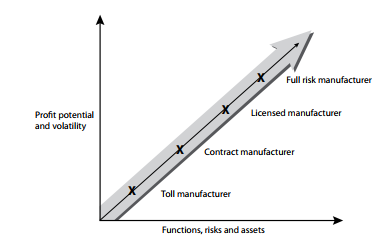
One possible context could be that Company 1 performs R&D at its own risk, and is the legal owner of any intangible property developed through that R&D; Company 2 acts as a limited-risk contract manufacturer through a contractual arrangement with Company 1, and Company 3 acts as a limited-risk distributor through a contractual arrangement with Company 1. In this case, Company 1 is the legal owner of the intangible property of the MNE, and bears substantial risk associated with the manufacturing and sales of the MNE’s products.
A different possible context for exactly the same basic value chain could be that Company 1 performs R&D on a contract basis for Company 2, which is the legal owner of any intangible property developed through that R&D; and Company 3 acts as a limited risk distributor through a contractual arrangement with Company 2. In this case, Company 2 is the legal owner of the intangible property of the MNE, and depending on the details of the functional analysis, may be treated as bearing substantial risk associated with the manufacturing and sales of the MNE’s products.
A different possible structure relating to the same basic value chain could be that Company 1 performs R&D on a contract basis for Company 3, which is the legal owner of any intangible property developed through that R&D; and Company 2 acts as a limited risk contract manufacturer through a contractual arrangement with Company 3. In this case, Company 3 is the legal owner of the intangible property of the MNE, and depending on the details of the functional analysis, may be treated as bearing substantial risk associated with the manufacturing and sales of the MNE’s products.
These three different contexts are illustrated in the following diagram. As will be discussed in subsequent chapters, each of these different contexts would very likely result in different transfer pricing outcomes.13
Contractual arrangements are not simply taken at face value by tax authori-ties. For example, each of these different possible contexts of MNE A’s value chain would be subject to evaluation to ensure that the economic substance of the arrangements is consistent with the legal form of the arrangements, and that the terms of the arrangements are at arm’s length.
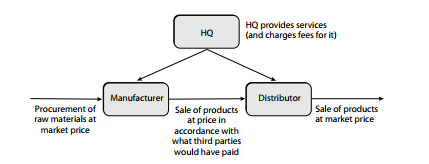
Broadly speaking, MNEs’ business models range from decentralized to centralized. There is no “one size fits all” solution. Under a decentralized model, all separate business units (or legal entities) are self-contained, and they typically only rely on limited services from the head office. In such a model, local sales departments will be responsible for the full range of sales activities, from business planning, marketing, customer acquisition, sales and after sales, warehousing and distribution. Most risks associated with the sales, including market risks and credit risks, will usually be assumed by the local sales company under this type of structure.
The head office, in these models, generally provides high level “steerage” or strategic direction. Similarly, local manufacturing departments will usually be responsible for selecting raw materials, inventory manage-ment, facility maintenance and optimization, running the plant, and selling the manufactured products to the entities performing the sales function. Entities often perform multiple functions, such as manufacturing, sales, marketing, R&D and supporting functions.
Figure 1.D.6
Example: How Different Groups Could "Customize" the Generic Value Chain
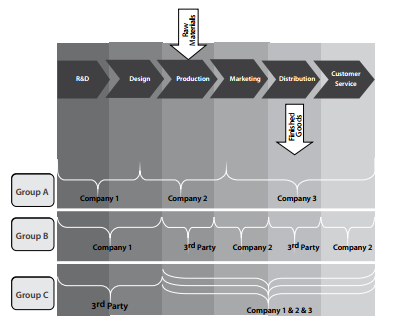
Figure 1.D.7
Example of a Decentralized Business Model
Ultimately, however, most multinationals are, to a greater or lesser degree, integrated, i.e. centralized. Under an integrated model, the headquarters may be responsible for setting out the strategy, for providing detailed instructions to local entities, managing R&D, marketing, centralized back office services and other areas. Benefits of such an integrated structure may include centralizing the allocation of scarce resources, capital, and providing a single “face” to customers and investors. In such a model, local offices have less autonomous decision making authority, and fewer risks to manage.
Another approach for assessing an MNE’s business model is to look at each entity’s functions, assets and risks, performing this evaluation from the simpler entities to the more complex. A complex entity may own, manage and develop intangibles and make key strategic decisions. A simpler entity would normally undertake more routine tasks with lower risk such as contract manufacturing or support service provision.
In practice there are a number of typical examples, or archetypes for sales functions, manufacturing activities and support functions. Depending on the type of activities and the level of risks assumed, the range of individ-ual entity functions and the resulting individual entity profit potential may vary. The diagram below depicts the relationship between functions, risks, assets and profit potential.
Figure 1.D.8
Example of a Centralized Business Model
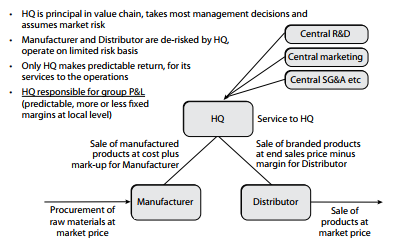
Figure 1.D.9
The relationship Between Functions, Risks, Assets, and Profit Potential
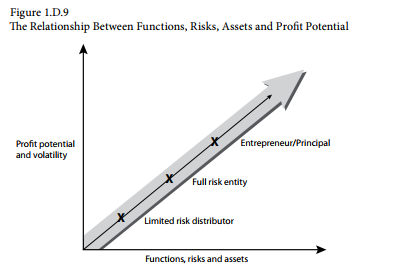
A number of archetypes can be identified within the sales func-tion. At one end of the spectrum is the example of a sales support service and, at the other end, a full risk distributor. In between these examples different models are possible such as: sales agent/commissionaire, limited risk distrib-utor, or licensed distributor (moving along the value chain from low to high). A full risk distributor generally takes price and other market risks, stock risks, credit risks and may in addition develop and license a trade name or other intangible.
Figure 1.D.10
Different Types of Distribution Operations
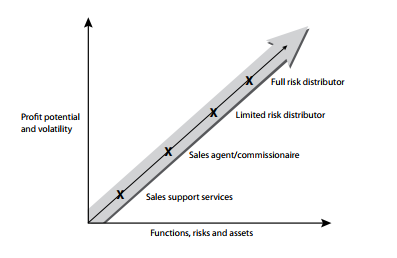
Different types of manufacturing operations can be identified in the manufacturing function. Terms commonly used to identify the spectrum of archetypes, increasing in terms of manufacturing function and the potential for profit, range from toll manufacturer to contract manufacturer, licensed manufacturer and ultimately the full risk manufacturer. The lowest risk entity is likely to be a toll manufacturer, although a toll manufacturer, as with the other types of manufacturers, will likely retain the risk of fixed asset investment and risks associated with sub-optimal utilization of manufacturing capacity. In general, the entrepreneur retains title to both raw materials and goods throughout the whole manufacturing process. The entrepreneur buys the raw materials and bears inventory and sales risk, while the toll manufacturer is primarily responsible for the management and effective utilization of the manufacturing site.
The following two examples draw upon the discussion above to provide illustrations of how MNEs in specific industries might choose to organize their operations.
Figure 1.D.11
Different Types of Manufacturing Operations
Fast-moving consumer goods (FMCG) are products that sell quickly at relatively low cost— items such as confectionery, dairy products, other foodstuffs and home and personal care products. Nearly everyone in the developed and developing world uses some form of FMCGs every day. They are the small-scale consumer purchases which are made at the kiosk, produce stand, grocery store, supermarket or warehouse outlet. FMCGs have short shelf lives, so, while the profit margin on individual FMCG sales may be low, the volume of sales is expected to make up for it.
To become successful in the highly dynamic and innovative FMCG segment, a company has to be acquainted with the consumer, brands, and logistics, but also, it has to have a sound understanding of packaging and product promotion.14 Understanding consumer needs, and responding to them quickly is a key element to success in the FMCG segment. FMCG companies have to gain and maintain a deep understanding of consumers’ needs, lifestyles and spending patterns in the market targeted. The FMCG company must adapt to the evolution of consumers’ shopping habits and tastes in order to effectively place its products in the market.
Shaout, A., & Yousif, M. K. (2014). Employee Performance Appraisal System Using Fuzzy Logic. International Journal of Computer Science & Information Technology, 6(4), 1 - 19.
Branding is a key element of success for FMCG companies. FMCG companies rely on marketing, communications and other techniques to establish and develop brand awareness and loyalty to their products. While superior and innovative physical packaging notably attracts the consumer and helps to convey the message of the brand in the stores, communications through different media and interactions with the consumers are also important to create awareness outside retail outlets and ultimately induce customers to make repeat purchases.
Controlling input and manufacturing costs is vitally important in this business. This requires efficient product sourcing, input logistics strategies and innovative technology.
Another key factor in the FMCG sector is to have efficient, predictable and trustworthy distribution channels. While some retailers opt for vertical integration (this is particularly relevant for developing countries, where distribution channels may not always be as structured as in developed countries) others outsource logistics and warehousing services to trusted third parties. Indeed, in some countries, quality logistics and warehousing services with local knowledge and expertise are increasingly available for businesses at relatively lower cost, enabling even small and medium-sized enterprises to obtain these capabilities early in their business cycle.
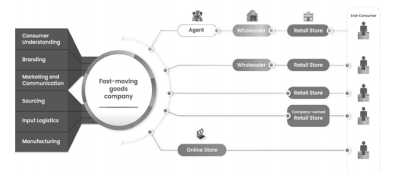
There are several ways an FMCG company can distribute its products to reach end-consumers, depending on the company’s level of vertical integration and the number of intermediaries:
These different types of distribution channels are summarized in the following chart:
Figure 1.D.12
Different Types of Distribution Channels
International Oil Companies (IOCs) are investor-owned, market-oriented, and mainly aim to increase shareholder value. Various degrees of size, specialization and integration exist in IOCs. Often, companies specialize in one or more individual industry segments, such as the exploration and production, refining, transportation/distribution or marketing segments. Many of the largest multinational oil and gas companies integrate all businesses and are referred to as “vertically integrated” oil companies.15
UN (2017). Handbook on Selected Issues for the Taxation of the Extrac-tive Industries by Developing Countries. New York: UN Publishing. Available from https://www.un.org/esa/ffd/wp-content/uploads/2018/05/Extractives-Handbook_2017.pdf.
An example of a vertical integrated oil and gas company can be depicted as per Figure 1.D.13 below:
The oil and gas industry is often considered to have two major parts: “Upstream” activities— those related to the exploration and production of crude oil and natural gas, and “Downstream” activities— those related to the transportation, refining and marketing of oil and natural gas and their products.16
Figure 1.D.13
Example of a Vertically Integrated Oil and Gas Company
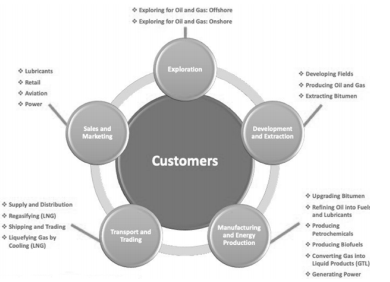
Source: International Tax and Investment Center (ITIC)
Sometimes the term “midstream” is also used — for example: “[a]ctivities connecting the pure upstream and downstream functions are sometimes referred to as “midstream,” and consist of trading and transportation (by pipeline, rail, barge, tanker or truck) storage, and wholesale marketing of crude oil, natural gas or refined petroleum products”—UN (2017). Handbook on Selected Issues for Taxation of the Extractive Industries by Developing Countries. New York: UN Publishing.
Within the two major business parts, there are often several different organizational units representing different business lines. In Upstream, a distinction may be made for example between “exploration” activities and “production” activities, while in Downstream there may be a trading, manufacturing or chemicals businesses. In a vertically integrated IOC, the company may have multiple global businesses with different business models and multiple cost centres.
Each different business line can have a different business model. Certain activities can be centralized, for example service companies which provide advice and services to operating companies, i.e. technical advice or accounting services. The cost of those centralized services may be cost-shared or directly charged to an operating company. The production of oil may be completely decentralized.
The management of each production facility is typically responsible for the performance and long-term viability of its own operations but can draw on the experience of service companies and, through them, of other group companies. Intangibles can be owned centrally, whereas R&D centres around the globe might be doing research. Depending on the products and the manufacturing sites, different models may be used, including contract manufacturing and toll-manufacturing models. And finally, once products are sold to the market, all typical sales functions can be identified: buy-sell distributors, licensed distributors, direct sales, in-market service companies, etc.
MNEs face challenges in managing their transfer pricing function. While transfer pricing may be used in some MNEs for management control, MNEs nevertheless are required to comply with the transfer pricing rules for tax purposes in the countries in which they operate. The determination of the transfer price affects the allocation of taxable income between the associated enterprises of an MNE.
Entities in an MNE conduct a global business that gives rise to opportunities to optimize the value chain of goods or services and they therefore look for synergies. A challenge facing an MNE conducting a global business with associated enterprises is whether the transfer pricing method used for internal transactions is acceptable to the tax authorities in the countries in which the MNE operates. The transfer pricing challenge becomes even greater when the MNE has multiple global businesses with different business models and multiple cost centres. The size of the MNE adds to the complexity.
Financial reporting for MNEs is informed by two decision trees. On the one hand, corporate and tax law require an associated enterprise to determine its taxable income derived from a specific jurisdiction. On the other hand, an MNE will usually need to determine for management purposes the income and costs of its business lines, which, as the previous discussion shows, can operate across several jurisdictions. In other words, while tax authorities focus on an associated enterprise’s taxable income, an MNE’s managers focus on income from their business lines. MNEs should develop and publicize within the enterprise a global transfer pricing policy to help minimize the risk of transfer pricing adjustments which may result in double taxation.
The allocation of profits and costs to the various legal structures is based on the functions performed, assets employed and risks assumed (so-called “FAR analysis”). Since MNE groups consist of numerous associated enterprises it is very difficult to allocate the profits and costs to all the separate legal entities, especially due to the absence of market forces. It is a complex exercise to come up with a consistent and coherent global policy for allocating results to the legal structures.
Transfer pricing rules based on the arm’s length principle allow national tax authorities to make adjustments to the profits of an enterprise where the terms of transactions between associated enterprises differ from terms that would be agreed between unrelated enterprises in similar circum-stances. If the income of an associated enterprise in Country A is increased as a result of a transfer pricing adjustment, it would be reasonable to expect a corresponding transfer pricing adjustment to reduce the income of the other associated enterprise in Country B provided a consistent transfer pricing evaluation is made by both countries.
However, if the tax authority of Country A makes a transfer pricing adjustment, double taxation will occur if the tax authority of Country B does not agree with the adjustment and does not allow a corresponding (down-wards) adjustment. The risk is of “economic” double taxation, i.e. where two different legal entities are taxed on the same profits. It is the task of the transfer pricing function within an MNE to limit the risk of transfer pricing adjustments and double taxation.
In principle, for an MNE, designing, implementing and documenting an appropriate transfer pricing policy should not be viewed solely as a compliance issue. The main goal should be to develop a consistent and principles-based global policy. A well-developed and consistently applied transfer pricing policy should reduce an MNE’s risk of transfer pricing adjustments and the potential for double taxation, thereby increasing profitability by minimizing transfer pricing costs. Moreover, a global transfer pricing policy may be used as evidence in negotiations with tax authorities when transfer pricing disputes occur.
A comprehensive transfer pricing policy should cover four key areas.
Advising on transfer pricing matters requires a thorough knowledge of an MNE’s business operations. There may be a misconception that the tax department makes the key business decisions within an MNE. In practice, the business units of an MNE will identify business opportunities and a deci-sion may be taken to exploit the opportunity if it fits within the MNE’s global business strategy. Advice can be provided to minimize the risk of transfer pricing adjustments and therefore optimize the business opportunity if the tax department is involved in an MNE’s decision-making.
There is an increasing level of detail required to meet each country’s transfer pricing documentation requirements in the current global environment. Most MNEs therefore prepare global and regional documentation (master files) for their various global businesses. Global and regional reports are prepared for local purposes (local files) based on the identified tax risks for each country in which the MNE operates.
Tax authorities around the world are increasingly focused on trans-fer pricing and on expanding their transfer pricing capabilities. MNEs have to deal with the detailed, complex and potentially conflicting domestic trans-fer pricing legislation in the countries in which they operate. Some countries closely follow guidance from international bodies, others only implement part of the guidance while some develop transfer pricing rules independently.
It should not be generally assumed that MNEs are not complying with transfer pricing rules in order to obtain tax benefits. Corporate manage-ment is under pressure to control corporate costs including tax costs; however many MNEs, especially those with shares quoted on a stock exchange (listed MNEs), may have published codes of conduct, a set of business principles, or both. Some of these codes or principles may explicitly require that an MNE must comply with the tax rules of the countries in which they operate. Violations of these codes may result in severe consequences for a listed MNE. Nevertheless, they should not be seen as a guarantee that there may not be a disagreement about the proper application of the transfer pricing rules.
As transfer pricing is often referred to as “an art, not a science”, the resulting uncertainty creates the potential for transfer pricing disputes, even if the MNE is seeking to comply with domestic transfer pricing rules. MNEs may invest in setting appropriate transfer prices and preparing comprehensive documentation, but the risk that tax authorities disagree with the approach taken may remain. This creates uncertainty for MNEs and may result in costs associated with preparing additional documentation, managing tax audits and conducting litigation. Notwithstanding this, there are cases where transfer prices are manipulated to shift profits from one jurisdiction to another to gain tax benefits including low taxation or no taxation.
MNEs generally express a preference for transfer pricing rules if they are able to achieve a globally consistent approach and eliminate the risk of disputes. If an MNE’s transfer prices are adjusted in one country, resulting in higher taxable income, the associated enterprise in the other country should in principle17 receive a “corresponding adjustment”, reducing its taxable income. Where, there is no corresponding adjustment in the absence of a treaty or by express agreement through the treaty provisions, the MNE will suffer double taxation. In this situation, the dispute is between two tax authorities with the MNE seeking to have consistent transfer prices accepted by both countries.
UN and OECD Model Tax Conventions, Article 9 (Associated Enterprises).
Where a transfer pricing adjustment is made by the tax authority, Article 9 of the UN Model Tax Convention or the equivalent article in a bilateral tax treaty (where applicable) provides for a corresponding adjustment to be made in the other jurisdiction. However, in some cases there may be legitimate reasons why a corresponding adjustment is not given, or is less than the original adjustment. In such a case, it is appropriate for the two countries to enter into discussions under the mutual agreement procedure mechanism provided for in Article 25 of the UN Model (or a corresponding provision in an actual treaty) to try to resolve any double taxation which arises.


 tpc.consulting
 tpc.consulting
 info@taxindo.co.id