


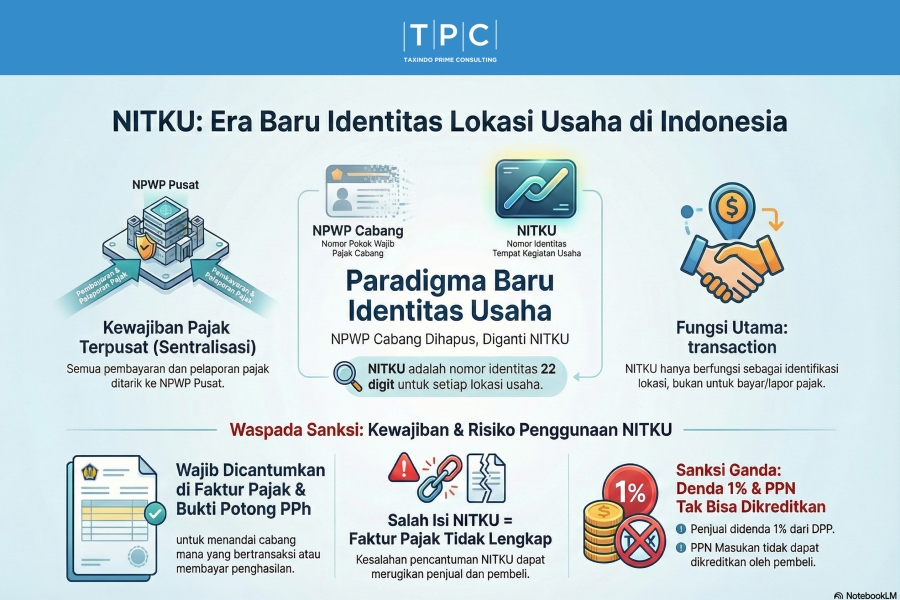
In the transforming landscape of Indonesian taxation under the Core Tax Administration System (Coretax), one of the most fundamental changes for all business actors is the abolition of the Branch Taxpayer Identification Number (Branch NPWP) and the introduction of the Business Activity Location Identity Number (NITKU). This change is not merely a shift in nomenclature; it represents a paradigm shift from decentralized to centralized administration while maintaining the identification of economic locations.
This article provides a comprehensive overview of NITKU, covering its definition, its crucial role in issuing tax documents, and the risks of sanctions if this identity is ignored.
1. Definition and Core Concept of NITKU
Based on the latest regulations, the Business Activity Location Identity Number (NITKU) is defined as an identity number assigned to every place of business activity of a Taxpayer, including their residence or domicile. In the legacy system, each branch office held its own Branch NPWP. Under Coretax, this concept is replaced by NITKU.
Crucial Note: NITKU does not carry independent tax obligations. This means NITKU cannot be used to pay taxes or file Monthly Tax Returns (SPT Masa) in its own name. All payment and reporting obligations are consolidated under the Head Office NPWP (Centralization). NITKU functions strictly as a location identification tool.
2. The Urgency and Function of NITKU in Coretax Administration
Despite the centralization of tax obligations, the existence of NITKU remains vital. Its primary functions are clearly defined in the Coretax technical regulations:
3. Application of NITKU in Issuing Tax Invoices (Faktur Pajak)
Under the VAT (PPN) regime in Coretax, the issuance of Tax Invoices has undergone significant adjustments regarding identity disclosure.
Obligations of Taxable Persons for VAT (Sellers): Tax Invoices must contain details regarding the delivery of Taxable Goods (BKP) or Taxable Services (JKP). While the seller's identity includes the name, address, and NPWP of the VAT-registered entity, the regulations place specific emphasis on the location of delivery:
Special Case for Retailers: For VAT-registered retailers serving foreign tourists (VAT Refund scheme), including the business location address (Store NITKU) on the Tax Invoice is mandatory if the tourist presents a foreign passport.
4. Application of NITKU in Withholding Tax Certificates (PPh)
The use of NITKU is critical in the administration of withholding and collecting Income Tax (e.g., Article 21, 23, 4 paragraph 2).
Withholding Agent Obligations: When creating an Income Tax Withholding Certificate (e.g., Article 21/26), the Withholding Agent uses the Head Office NPWP. However, if the Agent has separate business locations, the certificate must be issued by including the NITKU of the specific location that manages the payroll administration.
Case Study: A company has a head office in Jakarta and a factory in Surabaya. Factory employees in Surabaya receive salaries. When the tax admin creates the Article 21 Withholding Certificate (Form 1721-A1 or monthly), the admin must select the Surabaya Factory NITKU in the withholding agent identity column. This ensures that the tax withheld from Surabaya employees is recorded as a contribution from that location, even though the payment to the state is settled by the Head Office.
The Coretax system will validate this entry. If the NITKU column is left blank or is invalid, the certificate cannot be processed or saved.
5. Sanctions and Risks of Incorrect Data Entry
Failure to include the actual Business Activity Location Identity (NITKU) carries legal and financial consequences, particularly regarding VAT.
Administrative Sanctions for Tax Invoices: A Tax Invoice that does not contain correct, complete, and clear information is categorized as an Incomplete Tax Invoice. This includes the identities of the buyer and seller as well as the actual business location.
If a PKP issues a Tax Invoice without the actual NITKU as required:
Therefore, NITKU data validity is not just an internal administrative matter; it is a formal requirement for a Tax Invoice to be recognized by the state and to prevent financial loss for transaction partners.
Conclusion
NITKU is the backbone of location identification in the centralized Coretax system. For corporate taxpayers with multiple branches, the accurate mapping and use of NITKU in every Tax Invoice and Withholding Certificate is mandatory. Failure to implement NITKU not only disrupts administrative data but also triggers financial penalties and potential tax credit disputes with business partners.
References:












 tpc.consulting
  tpc.consulting
  info@taxindo.co.id