Home Publication & Consultation Article Harmony and Distortion: The Dynamics of Family Unit Data (DUK) and Family Cards in the Coretax Era

Harmony and Distortion: The Dynamics of Family Unit Data (DUK) and Family Cards in the Coretax Era

Taxindo Prime Consulting - Naufal Afif, M.Ak., BKP., CA., APCIT., APCTP., ASEAN CPA.
Tuesday, December 30, 2025 | 09:51 WIB
00:00
Optimized with Google Chrome
Harmony and Distortion: The Dynamics of Family Unit Data (DUK) and Family Cards in the Coretax Era

The digital transformation of Indonesia’s tax administration system has reached a new milestone with the implementation of the Core Tax Administration System (Coretax). One of the fundamental shifts brought by this system is how the state views the smallest economic unit in society: the family. The integration of the National Identity Number (NIK) as the Taxpayer Identification Number (NPWP) demands a deeper understanding of the synchronization between population data and tax data.

Amidst this transition, a crucial question often arises from taxpayers: Is the Family Unit Data (DUK) in the tax system identical to the Family Card (KK) issued by the Population and Civil Registry Office (Dukcapil)? The answer is not a simple "yes" or "no."

This article will explore the relationships, differences, and rules of play between the KK and DUK, as well as the implications for your tax obligations.

The Core Concept: The Family as a Single Economic Unit

Before dissecting the technicalities of DUK and KK, we must understand the underlying philosophy of taxation in Indonesia. In accordance with Article 8 of the Income Tax Law (UU PPh) and its explanation, the Indonesian tax system adheres to the Family Tax Unit principle, where a family is treated as a single economic entity. This means that the income or losses of all family members—husband, wife, and minor children—are essentially combined into one unit, and the fulfillment of tax obligations is carried out by the head of the family.

In the Coretax system, this principle is manifested through the Family Unit Data (DUK) feature. DUK is a data container within a Taxpayer’s profile that lists family members whose tax rights and obligations are linked to the head of that family.

DUK vs. Family Card (KK): Similar but Not Identical

Many taxpayers assume that anyone listed on a Family Card (KK) automatically becomes a tax dependent, and conversely, anyone not on the KK cannot be included in the tax system. This understanding needs clarification.

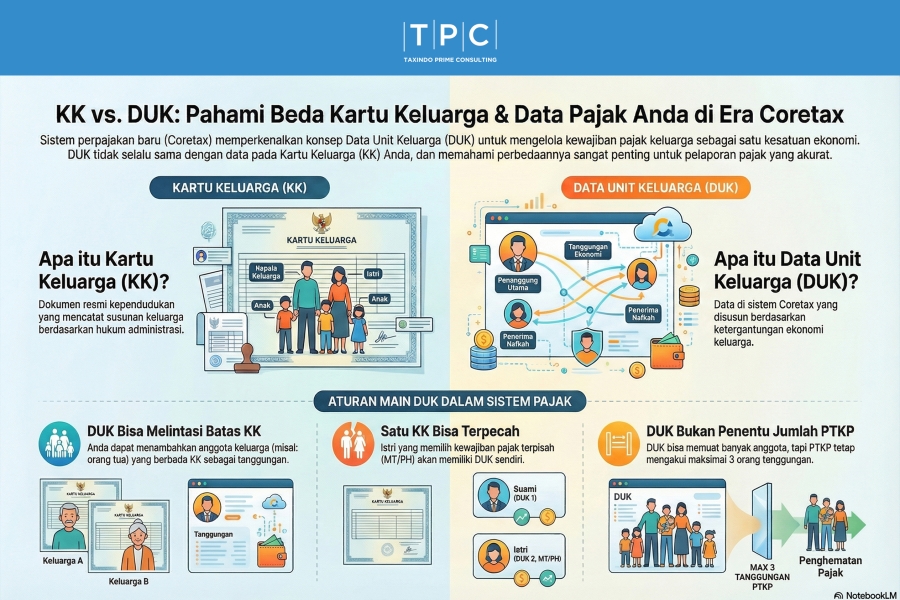
  • Family Card (KK): An administrative population document that records the composition, relationships, and number of family members based on population law.
  • Family Unit Data (DUK): Administrative tax data organized based on economic dependency and tax status.

While population data from Dukcapil serves as the primary basis for NIK validation, DUK offers flexibility that extends beyond the administrative boundaries of the KK to accommodate the economic realities of the Taxpayer.

Does One KK Equal One DUK?

By default, immediate family members (husband, wife, children) within one KK will be included in the DUK of the Head of the Family. However, sharing the same KK does not automatically require unification into a single DUK if specific tax conditions exist. There are "distortions" where members of one KK can be split into different tax entities:

  1. Wives Opting for Separate Taxation (PH/MT): Within the same KK, a husband and wife can have separate DUKs. This occurs if the wife chooses to fulfill her tax rights and obligations separately from her husband, either due to a Separation of Assets Agreement (PH) or by Choosing to be Taxed Separately (MT). In this scenario, the wife will have her own Coretax account.
  2. Adult Children: Children over the age of 18, those who are married, or those who have their own income and NPWP, are no longer included in their parents' DUK as dependents, even if their names remain on the parents' KK.

Crossing Borders: Family Members from Different KKs in One DUK

A unique feature of the DUK system in Coretax is its ability to accommodate dependents who are administratively on a different Family Card. The tax system recognizes the reality that many taxpayers support the living expenses of parents or parents-in-law who live separately.

Based on the Director General of Taxes Regulation No. PER-7/PJ/2025, Taxpayers are permitted to include family members not listed on their Family Card into their DUK, under strict conditions:

  1. Family Relationship: Must be a blood relative or a relative by marriage in a direct line of descent.
  2. Full Dependency: The family member must be fully dependent on the Taxpayer (no income of their own).
  3. NIK Validation: The family member's NIK must be valid and registered with Dukcapil.
Case Example: A Taxpayer (husband) has a KK consisting of himself, his wife, and two children. However, he also supports his retired mother who lives in his hometown (different KK). In Coretax, this Taxpayer can add his mother's NIK to his DUK through the profile data update menu. This is legal and recognized for the purpose of calculating Non-Taxable Income (PTKP).

DUK and Its Implications for PTKP

It is vital to distinguish between members registered in the DUK and members calculated for Non-Taxable Income (PTKP).

  • DUK (Family Unit Data): Can contain all family members who are dependents, without a limit on the number.
  • PTKP (Non-Taxable Income): Even if your DUK records 7 dependents, the Income Tax Law limits the number of recognized dependents for PTKP to a maximum of 3 (three) people.

In short, DUK is your family data "pool," while PTKP is the tax calculation "filter" that draws a maximum of 3 people from that pool.

Managing DUK in the Coretax Application

In the Coretax implementation, DUK management is autonomous and digital. Taxpayers no longer need to visit the Tax Service Office (KPP) with stacks of photocopied KKs just to update family data.

  1. Adding Members: Via the My Profile > Family Unit Data menu on the Taxpayer portal.
  2. Tax Unit Status: Taxpayer must determine their status (e.g., "Dependent").
  3. Removal: Must update data if circumstances change (e.g., divorce or death).

Conclusion

The relationship between DUK and KK in the Coretax ecosystem is complementary but not identical. The KK is the legal population database, while the DUK reflects the economic reality of the family for taxation purposes.

Understanding this difference is vital for Taxpayers to ensure accurate tax calculations, optimize PTKP facilities, and avoid administrative disputes in the future.


References: (Titles of regulations remain in Indonesian for legal precision)

  1. PER 7/PJ/2025 regarding Administrative Guidelines for NPWP, Taxable Persons for VAT, and Property Tax Objects...
  2. PER 11/PJ/2025 regarding Provisions for Reporting Income Tax, VAT, Luxury Goods Sales Tax, and Stamp Duty...
  3. Family Tax Unit Administration - General KUP 2.0.pdf (DGT Educational Leaflet).
  4. Coretax Manual Book 2024 - Reporting Individual Income Tax Returns (SPT).
  5. Coretax Manual Book 2024 - Registration for Corporate Taxpayers.
  6. DGT Presentation Slide on DUK vs PTKP.

Warning: Trying to access array offset on null in /home/taxindod/public_html/taxindo.co.id/en/modules/publicdetails.php on line 273
<br />
<b>Warning</b>:  Trying to access array offset on null in <b>/home/taxindod/public_html/taxindo.co.id/en/modules/publicdetails.php</b> on line <b>275</b><br />

Warning: Trying to access array offset on null in /home/taxindod/public_html/taxindo.co.id/en/modules/publicdetails.php on line 283

Warning: Trying to access array offset on null in /home/taxindod/public_html/taxindo.co.id/en/modules/publicdetails.php on line 286

Decision More Details
January 14, 2026 • Taxindo Prime Consulting | Dita Rahmah Fitri - Lilik F Pracaya, Ak., CA., ME., BKP (C)
PUT-006540.102023PPM.XIIIA Year 2025 - Agustus 21, 2025
January 14, 2026 • Taxindo Prime Consulting | Dita Rahmah Fitri - Lilik F Pracaya, Ak., CA., ME., BKP (C)
PUT-010233.272024PPM.XA Year 2025 - August 28, 2025
Taxindo Prime Consulting (TPC) is a firm specializing in tax, accounting, business, and business law consulting.
Taxindo Prime Consulting (TPC) is established as a trusted strategic partner, providing comprehensive solutions in tax consulting, accounting, business development, and business law. Driven by a commitment to integrity and professionalism, TPC is dedicated to delivering more than just standard consultation; we provide education, tactical advice, and concrete solutions. Our services are meticulously designed to analyze and resolve clients' tax and business challenges with objectivity, in-depth insight, and full independence, ensuring both regulatory compliance and long-term business sustainability.
OFFICE
Mega Plaza Building 12th Floor
Jl. H.R. Rasuna Said Kav C-3 Jakarta 12940

Phone :
+62 21 521 2686
+62 817 001 3303

Email :
info@taxindo.co.id
Copyright © 2025 Taxindo Prime Consulting

All content on this website is provided solely for general informational and educational purposes. This information is not intended as a substitute for professional tax advice or consultation specific to your situation. We strongly encourage you to contact our team of consultants directly to receive appropriate guidance and advice.

Taxindo Prime Consulting
Tax and Transfer Pricing Calculator
Tax Calendar
×
Newsletter