


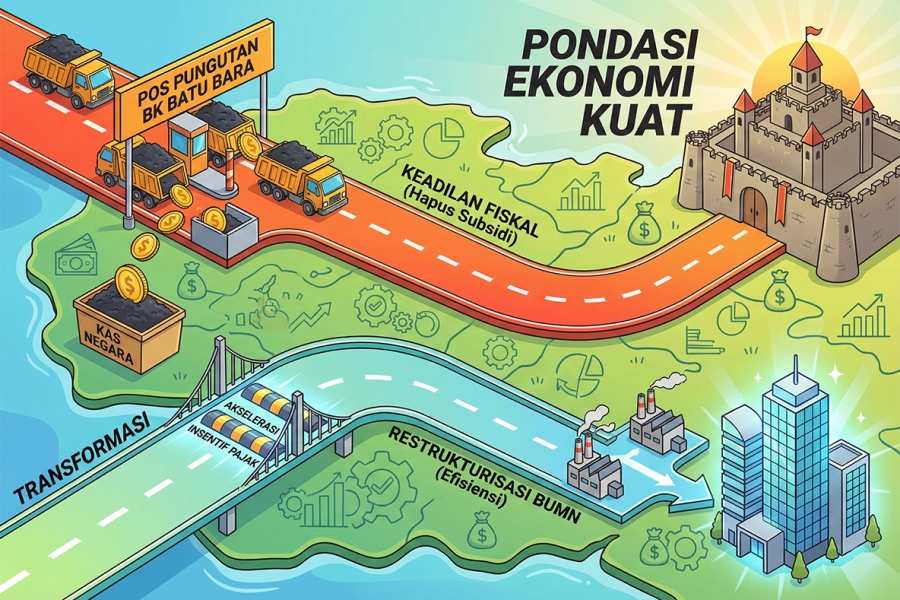
The current focus of economic policy is directed at adaptive fiscal strategies to maintain APBN stability while simultaneously enhancing the efficiency of State-Owned Enterprises (BUMN). Despite tax revenue remaining below target, the Finance Minister assures that the deficit remains under control. To strengthen BUMNs, the government is setting tax incentives for consolidation and restructuring processes, valid for three years. At the same time, the Finance Minister confirms that a coal export duty will be implemented starting 2026 to eliminate subsidies for large business groups. Up to November 2025, Export Duty revenue from monitoring activities was recorded at Rp496.77 billion. This policy reflects a combination of revenue reinforcement from the natural resources sector and a push for BUMN corporate transformation.
The Finance Minister is implementing fiscal policy to secure revenue and strengthen State-Owned Enterprises (BUMN), despite tax revenue missing the target. The Minister also ensured that the budget deficit condition remains safe and controlled, which aims to maintain public and market confidence. In an effort to secure revenue, the Minister affirmed that a Coal Export Duty (BK) will be collected starting in 2026. This measure is based on the principle of fiscal justice, specifically to reduce subsidies currently enjoyed by wealthy entrepreneurs.
Regarding revenue security efforts, revenue from Export Duty (BK) supervision has breached Rp496.77 billion up to November 2025. This achievement indicates the effectiveness of oversight in securing state revenue from export commodities.
On the other hand, to encourage BUMN consolidation and merger, Finance Minister Purbaya officially approved tax incentives that will be valid for three years. This approval of tax incentives aims to create BUMNs that are more efficient and competitive, and is simultaneously part of a major effort to improve BUMN governance.
Today's developments have significant implications for fiscal management, tax fairness, and BUMN governance. The Minister's decision to collect the Coal Export Duty implies potential massive revenue growth starting 2026, while also reflecting the principle of fairness in energy subsidy policy. Meanwhile, the three-year tax incentive for BUMN mergers provides a strong catalyst for BUMN restructuring, which is expected to increase efficiency and value added. Although tax revenue missed the target, the guarantee of a safe deficit is important for maintaining macroeconomic stability.
In conclusion, the Finance Minister is executing a double-edged fiscal policy: tightening revenue through the collection of the Coal Export Duty starting 2026 as a form of justice, and easing tax obligations through BUMN merger incentives for efficiency. Both measures aim to strengthen the economic foundation despite the missed tax revenue targets. The government is now focused on BUMN restructuring and securing revenue from natural resources to keep the deficit stable.














 tpc.consulting
  tpc.consulting
  info@taxindo.co.id